CATHOLIC RELIEF SERVICES ORGANIZATION
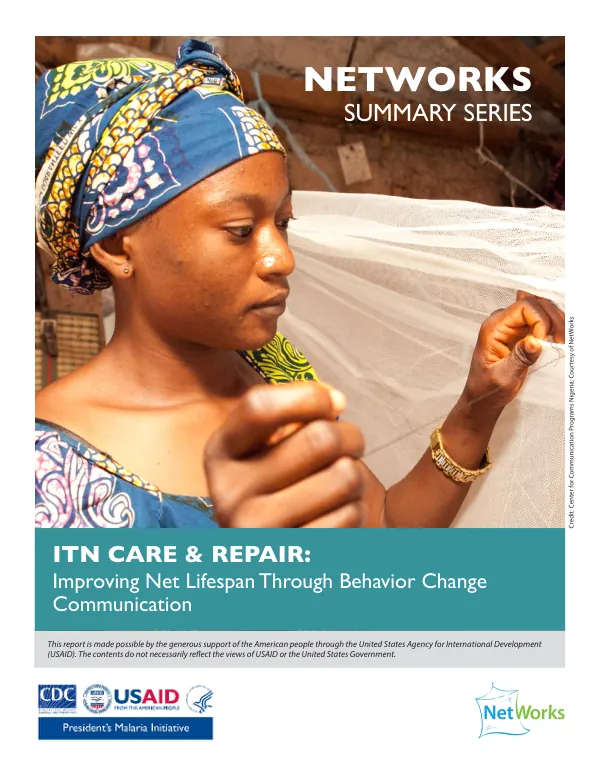
ITN CARE & REPAIR: Improving Net Lifespan Through Behavior Change Communication
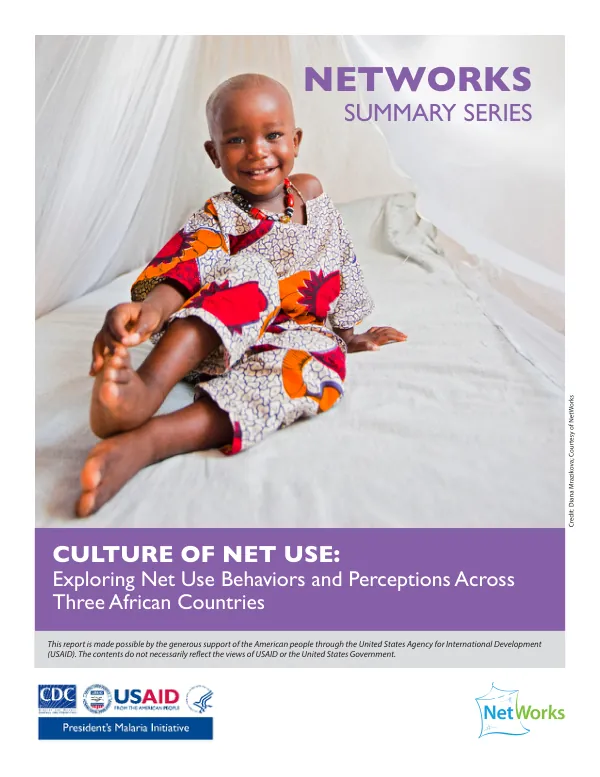
The NetWorks project conducted qualitative research and designed Social Behavior Change Communication (SBCC) campaigns in Nigeria and Uganda to test whether SBCC campaigns could improve net care and repair attitudes and behaviors, and whether changes in these behaviors would prolong the useful life of Insecticide Treated Nets (ITNs) in the field.
2015 · 12 pages
Sign in to readA free account is required to download.
Abstract
As many countries have now achieved high ITNs coverage and are approaching their universal coverage targets, maintaining coverage becomes the focus of discussion. ITNs are expected to remain effective for malaria prevention for at least three years, and potentially longer. However, studies have shown that ITNs durability varies greatly under field conditions. The NetWorks project examined the issue of net care and repair closely, beginning by establishing working definitions of net care and repair concepts. "Net care and repair" refers to actions that will maintain mosquito nets in good condition so that they continue to be used in homes to prevent malaria. "Caring for nets" refers to actions intended to prevent damage to nets, for example, by handling nets carefully, keeping them away from sources of damage, and washing nets gently and not too often. "Repairing nets" means closing holes and tears by stitching, patching, tying knots, or any other method. The NetWorks project conducted qualitative research in Nigeria, Senegal, Uganda, and Mali to better understand care and repair behavior, attitudes and norms, and determine effective ways to promote behavior for net care repair. The research methods were similar across the countries and these qualitative methods elicited rich, in-depth information on net care and repair from the perspective of net users. Common themes across the studies included the ways in which nets are damaged, how damage can be prevented and nets be repaired, and the barriers and motivators of net care and repair behavior. Net damage was common and reported as being caused by behaviors related to daily use, such as children and rodents, improper handling, and rough surfaces. Many people believed that long-lasting ITNs need to be re-treated with insecticide after several washes. Rationales for cleaning and repairing nets were cleanliness and aesthetics of the net after. Motivations for taking care of and repairing nets centered around caring for one's family, avoiding mosquito bites, saving money, and maintaining the positive opinion of others by keeping a clean and intact net. Barriers to net care and repair related to lack of time or not knowing how to repair. Most users would prefer purchasing a new net to repairing an old one, but finances limit their ability to do so. Net users do not consider nets to be worthy of repair when they are overly damaged or when holes are too large or too numerous. Despite the many similarities across the qualitative research studies, there also were some variations, such as the perspective that net degradation was inevitable and that repairs themselves could weaken nets in Senegal. The NetWorks project is a five-year, USAID-funded global project to improve and establish sustainable access to and use of ITNs. NetWorks is led by the Johns Hopkins Bloomberg School of Public Health Center for Communication Programs (CCP) and implemented in partnership with Catholic Relief Services, Malaria Consortium (MC), Mennonite Economic Development Associates (MEDA) and in-country collaboration partners. The project aims to improve net care and repair attitudes and behaviors, and to prolong the useful life of ITNs in the field.
Related documents