MALARIA CONSORTIUM
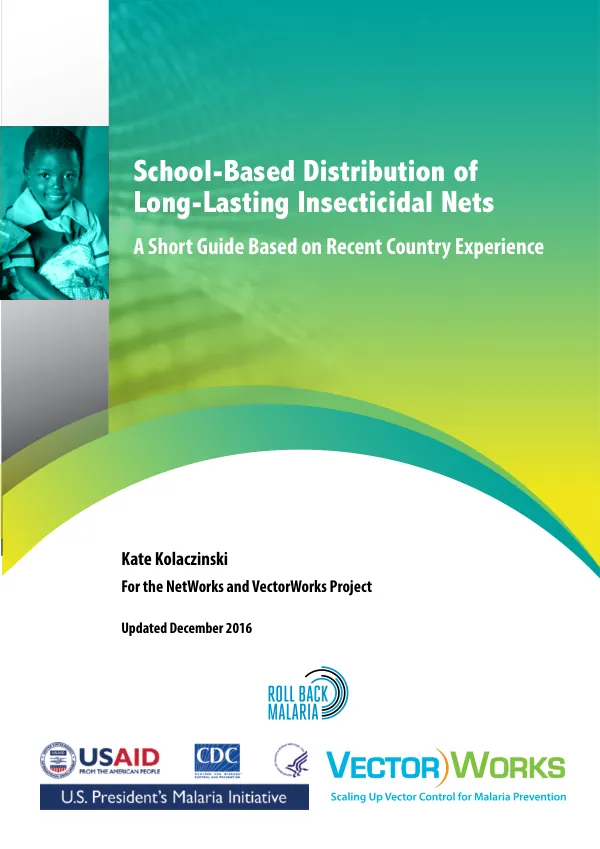
School-Based Distribution of Long-Lasting Insecticidal Nets
School-based distribution of long-lasting insecticidal nets (LLINs) has been explored as a channel for maintaining LLIN ownership levels in various countries.
2016 · 38 pages
Sign in to readA free account is required to download.
Abstract
Continuous distribution through a mix of channels is essential to maintain LLIN ownership levels. Schools can be used as a distribution channel for LLINs, particularly in contexts with a well-functioning and supportive education sector at national and subnational levels. Recent pilots in Ghana, Nigeria, Senegal, and Tanzania have seen LLINs distributed through schools at scale. In Nigeria, 8,444 LLINs were distributed through 88 schools in the initial round, and 21,000 LLINs were distributed through 191 schools in the second round. Senegal delivered 73,445 LLINs through 1,153 schools, split across two consecutive rounds. Tanzania distributed 510,000 LLINs through 2,302 schools, while Ghana conducted an initial pilot distribution of 181,600 LLINs through 2,313 schools followed by distribution of 1.2 million LLINs through approximately 22,500 remaining public and private schools in the country. School-based distribution is more feasible in contexts with a well-functioning and supportive education sector at national and subnational levels. Supportive and effective local authorities are also important. Where countries plan to repeat annual school-based distributions at scale, it may not be feasible to maintain centralized management roles. School-based distribution is generally more appropriate in school systems with higher enrollment levels. Even in areas of high enrollment, school distribution should still be considered one channel in an overall mixed model. The main strengths of school-based LLIN delivery include the ability to deliver large quantities of LLINs annually, reaching a high proportion of targeted students, and the extensive ability to tailor the size of the target group. School registration data are often sufficiently accurate to avoid the need for a separate registration exercise. However, the feasibility of using schools as a continuous source of LLINs may be limited due to logistic and security concerns. In settings with large numbers of small schools, the channel may be less efficient. The benefit of the reach of schools into communities can be complicated by a lack of necessary infrastructure in remote areas. Recommendations for design include using similar models, such as one-day distribution events to selected classes planned annually, which have been shown to work well in different settings. Other options that may be appropriate in specific settings include distribution of vouchers or coupons instead of LLINs, which could be redeemed for nets at distribution sites accessible to the community, and continuous distribution of LLINs through schools with a rolling stock. NetCALC is a valuable tool for planning LLIN distributions, and all continuous distribution mechanisms should be planned, managed, and implemented in synergy. Operational recommendations include careful planning of timing, with conservative buffers for delays, particularly for LLIN arrival in country, given the fixed school calendars for exams and holidays. Disbursement of training and other allowances was challenging in some settings given the large numbers of personnel involved. Countries where this was least problematic put the management responsibility for the funds at lower levels and used processes they were already experienced in. Given the large numbers of schools and personnel involved, operations are more feasible if financial and management responsibility is decentralized. Accountability is essential in school-based LLIN distribution. LLINs should be delivered to schools as close to the distribution day as possible to minimize opportunities for theft. A clear and well-communicated plan should be in place for reverse logistics, including managing any surplus LLINs, which should be properly recorded and included in data reporting. Standard best practice for a robust logistics supply chain should be followed, as outlined in the guide "Preventing, identifying and mitigating the impact of fraud, theft and diversion of LLINs" and in the VectorWorks continuous distribution online toolkit.