ARIZONA STATE UNIVERSITY
Curriculum Enhancements to Promote a More Diverse Energy Sector Workforce
The USAID South Asia Smart Power Program (SPP) aims to advance economic growth and development in Southeast Asia through ensuring that the region's energy sectors are secure and market driven.
2023 · 18 pages
Sign in to readA free account is required to download.
Abstract
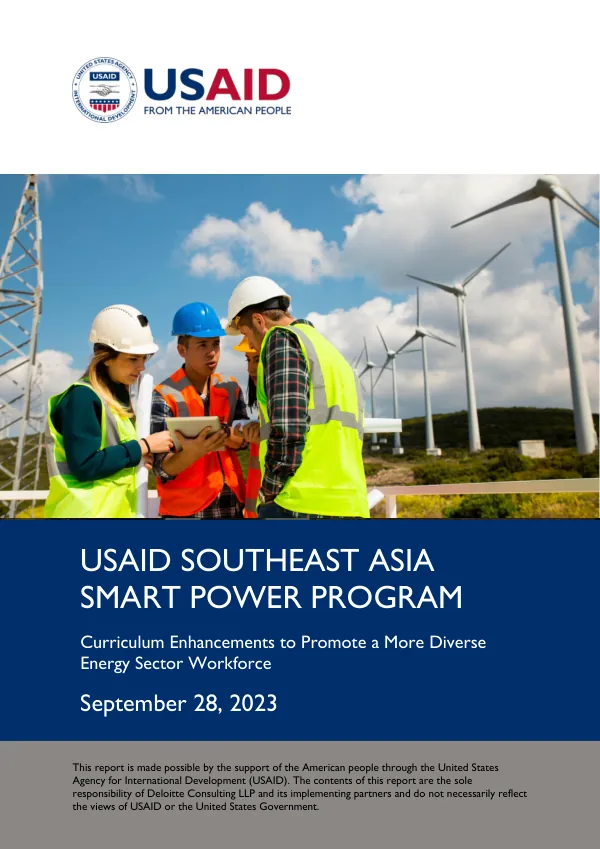
The program's core targets include deploying 2,000 megawatts of advanced energy, mobilizing $2 billion in finance, and increasing regional energy trade by five percent. SPP's primary objective is to improve the performance of energy utilities, increase deployment of Advanced Energy Systems (AES), and enhance trade and energy. The SPP report builds upon the results of prior work, Powering and Empowering Women in Southeast Asia, which identified potential enhancements to curricula at local universities, starting with King Mongkut's University of Technology Thonburi (KMUTT), that would address energy-related topics including renewable energy, cybersecurity, and digitization while helping to boost the participation of women in the Association of Southeast Asian Nations (ASEAN) power sector. The report identifies three areas that support curricula enhancement to promote a more diverse energy workforce: curricula enhancements, outreach programs, and supportive environment. The SPP team's desktop research also identified three universities in the United States as potential partners for KMUTT: Arizona State University (ASU), University of California Berkeley (UC Berkeley), and Massachusetts Institute of the Technology (MIT). To promote a more diverse energy sector workforce, KMUTT has several options, including curricula changes to improve diversity and to include diversity trainings, developing new programs that will be interdisciplinary and include business, management, and data analytics, outreach programs to attract potential young women engineers, and encouraging a supportive, inclusive, welcoming environment to foster diversity in the field of engineering. The SPP team's next step will be to discuss findings from this report with KMUTT in order to gauge their interest in collaborating with CMU and other universities on curriculum enhancement. If KMUTT is interested, SPP can support curriculum and program development by facilitating meetings with and summarizing recommendations from power engineering educators. SPP will also support KMUTT's outreach efforts to promote the enrollment of women in these programs. The evolving smart grid includes a broader range of technologies that need new skill sets, some of which are their own disciplines (for example, communication systems, cybersecurity, and data analytics). These new skills are more gender-neutral, enabling more women in the energy and power workforce. In addition to developing the smart grid, Thailand will need a workforce to operate the electricity market. To increase the presence of women in the power and energy workforce, KMUTT can enhance the existing curriculum for undergraduate and master's degrees, develop an outreach program to establish a pipeline of female students, and create a supportive environment for female engineering students. Curriculum enhancements can include diverse perspectives and an interdisciplinary approach to the curriculum. Diverse perspectives can be achieved by ensuring course materials include diverse voices and perspectives, as well as case studies from underrepresented groups, including women, in the energy sector. Diversity training can be included in the curriculum to teach students about the importance of diversity in the workplace and how to create inclusive environments. An interdisciplinary approach can be encouraged by integrating subjects like environmental justice, sociology, and ethics into energy-related courses. Universities often offer specific outreach programs to attract female students to the field of engineering. These programs can include internships, mentorship, and networking opportunities that provide female students with hands-on experience and exposure to the field. Additionally, universities can market their programs to be more inclusive of and attractive to potential female students by highlighting the societal applications of power and energy engineering and the opportunities available to women in the field.