DELOITTE CONSULTING, LLP
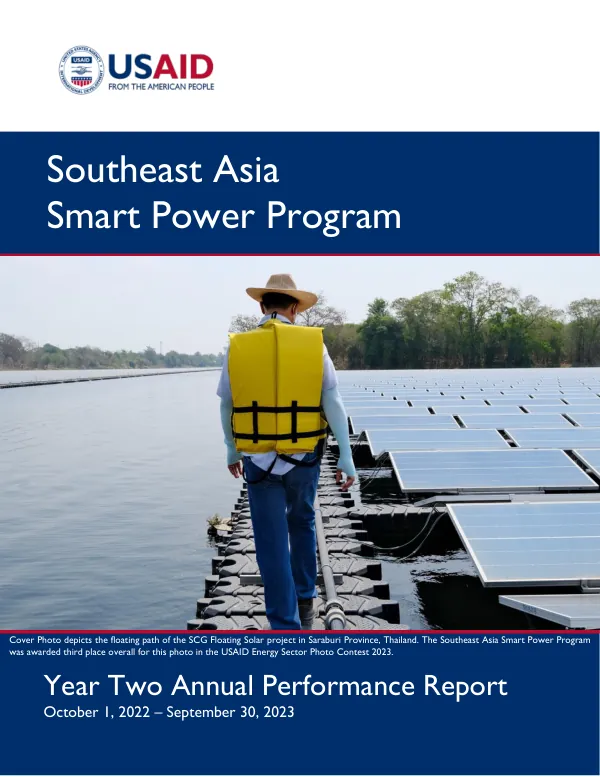
Southeast Asia Smart Power Program Year Two Annual Performance Report
Southeast Asia Smart Power Program (SPP) was established to promote the development and deployment of Advanced Energy Systems (AES) in the region.
2023 · 70 pages
Sign in to readA free account is required to download.
Abstract
The program's performance period spans from December 10, 2021, to September 30, 2026, with a total estimated cost of $100 million. The program aims to mobilize $2 billion in investment to bring 2 gigawatts (GW) of clean energy into the region. The SPP has established partnerships with various regional institutions, including the Association of Southeast Asian Nations (ASEAN) Centre for Energy (ACE). A $3 million, three-year Grant under Contract (GUC) was issued to ACE to support its pursuit of the ASEAN Plan of Action for Energy Cooperation (APAEC). This partnership embodies the "whole of government" approach espoused by USAID's Regional Development Mission for Asia (RDMA). The SPP has also developed a dual strategy to mobilize investment in AES. The first approach involves providing direct one-on-one support to companies in the region that develop innovative projects featuring AES. The second approach involves developing and initiating a "platform-based" approach to help identify and overcome key barriers to AES deployment. This includes helping to develop and popularize new models for corporate power purchase agreements and innovative project structuring approaches for industrial zones throughout the region. To advance regional power trade, the SPP has launched a dual approach. The long-term effort focuses on developing a robust and expansive ASEAN Power Grid (APG), while the short-term effort involves helping to facilitate power trade through the development of a regional power market. The SPP has also established partnerships with various stakeholders, including the Asian Disaster Preparedness Center (ADPC), Consultants of Technology (COT), and Asia Clean Energy Partners (ACE-P). Despite funding constraints, the SPP has made significant progress in its second year of operation. However, due to these constraints, the program did not achieve its annual targets for Year 2. Instead, the SPP will roll these targets into increased targets for Year Three. The program's progress to date includes mobilizing $2 million in investment, deploying 10 megawatts (MW) of AES, and increasing energy traded in Southeast Asia by 243.55 gigawatt-hours (GWh). The SPP's financial support underpins ACE's pursuit of the APAEC, which aims to promote energy cooperation among ASEAN member states. The program's "whole of government" approach has also facilitated engagement between USAID and the broader US Government with ASEAN institutions. The SPP's dual strategy has helped to create a robust pipeline of direct support for companies in the region and has initiated a "platform-based" approach to help identify and overcome key barriers to AES deployment. The SPP's partnerships with regional institutions and stakeholders have facilitated the development of a robust and expansive ASEAN Power Grid (APG) and have helped to advance regional power trade. The program's progress to date demonstrates its commitment to promoting the development and deployment of AES in the region.