ROBERT NATHAN ASSOCIATES
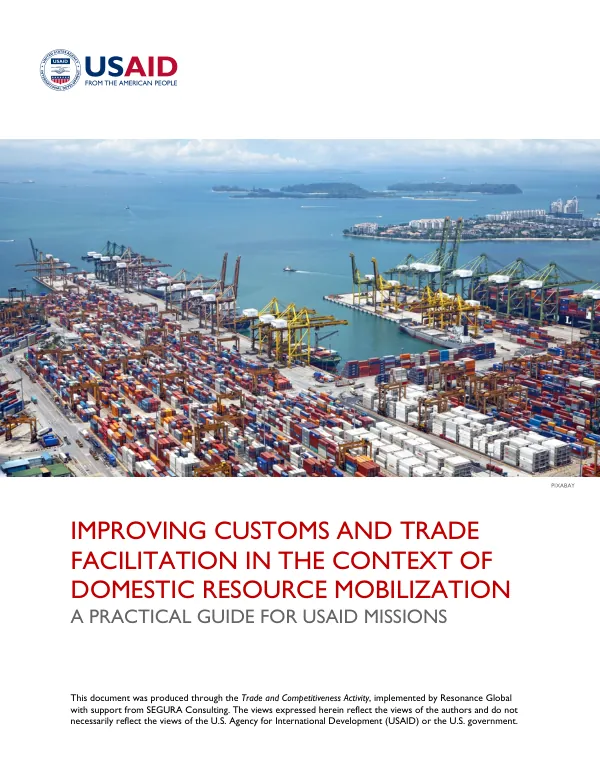
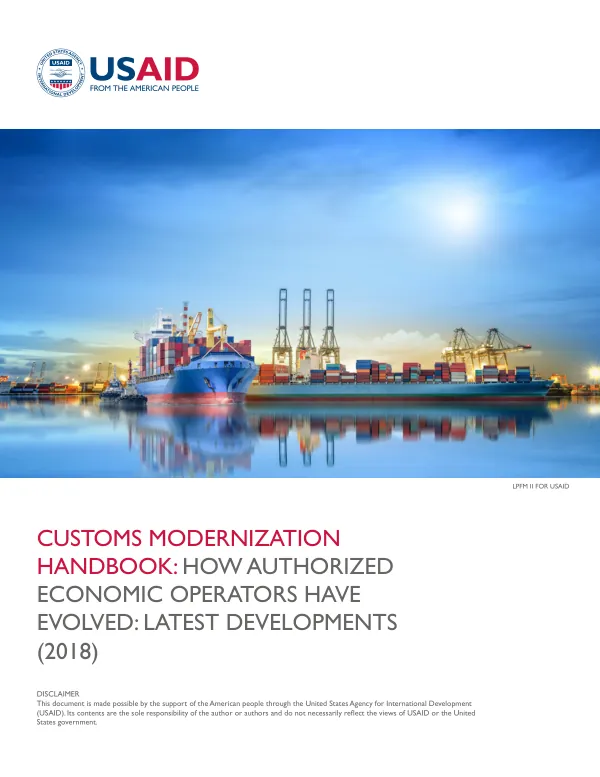
Customs Modernization Handbook: How Authorized Economic Operators Have Evolved
Authorized Economic Operators (AEOs) have evolved significantly in recent years, driven by international agreements and guidance documents on supply chain security.
2018 · 76 pages
Sign in to readA free account is required to download.
Abstract
The World Customs Organization (WCO) Framework of Standards to Secure and Facilitate Global Trade (SAFE Framework) and the World Trade Organization (WTO) Trade Facilitation Agreement (TFA) have been major drivers for change. These agreements have led to a shift in the role of Customs administrations from primarily revenue collectors to providers of security and facilitation of trade. The number of AEO programs has increased considerably, and their focus has expanded from primarily security-related issues to a more comprehensive combination of security and trade facilitation capabilities. The additional effect is that the number of Mutual Recognition Agreements (MRAs) has also increased significantly. Developing country Customs administrations have been assisted by the United States Agency for International Development (USAID) in implementing Customs modernization reforms based on international best practices. The WCO began developing Customs Guidelines on Integrated Supply Chain Management (ISCM Guidelines) in 2002, which were adopted in 2004. The SAFE Framework of Standards was adopted in 2005, with a core concept being the AEO program. In 2007, detailed provisions on the conditions and requirements for Customs administrations and AEOs were incorporated. The SAFE Framework was amended in 2012 to include new parts on coordinated border management and trade continuity and resumption, and in 2015 to include a new pillar to foster closer cooperation between Customs administrations and other government agencies. Under an AEO program, Customs administrations certify companies as AEOs based on specified eligibility criteria. The certification process involves an application, validation, and authorization of an AEO. The AEO certification process is a critical component of efficient border procedures and may play a more coordinated role in border management activities. The updated handbook expands on the 11 steps outlined in the 2010 Handbook and provides more details about the AEO certification process. It targets a broad audience of officials in developing countries who represent not only Customs authorities but also other border agencies and government ministries that need to have a greater level of familiarity with AEO programs. The handbook focuses more strongly than the initial version on the certification process, piloting AEO programs, coordinated border management, and the evolution of MRAs. The handbook begins with a brief overview of AEO background and developments regarding the WCO SAFE Framework of Standards and the WTO Trade Facilitation Agreement. Section 1 presents updates to the AEO program design process. Overviews of the certification process to become AEOs and a more detailed look at piloting an AEO program are provided in Sections 2 and 3. Section 4 focuses on coordinated border management, and Section 5 elaborates on mutual recognition as a major development and benefit for trade. Section 6 provides examples of new developments that are expected to influence the future of Customs work, and Appendix 1 features case studies that detail the experiences of countries that have designed and implemented AEO programs. The handbook is designed as a tool to identify and implement Customs modernization reforms based on international best practices. It provides a practical, step-by-step guide to improving Customs performance, with a specific focus on AEOs. The publication was widely distributed, primarily to developing country Customs administrations, and served as the basis for raising the awareness of AEO programs and providing implementation guidance consistent with the WCO's SAFE Framework of Standards.
Related documents
Documents in this collection
 2021
2021USAID DEC
Remote Developmental Evaluation: A Guide for Funders and Practitioners
Open record
USAID DEC
Design, Implementation, Monitoring, and Evaluation of Cross-Cultural HIV-Related Mental Health and Psychosocial Assistance Programs: A User’s Manual for Researchers and Program Implementers (Adult Version)
Open record