POPULATION SERVICES INTERNATIONAL/DKT INTERNATIONAL
Dashboard du FoQus on Segmentation_Condom Féminin_RDC_juillet 2013
The Republic of the Congo has been grappling with the HIV/AIDS epidemic for nearly two decades.
2013 · 26 pages
Sign in to readA free account is required to download.
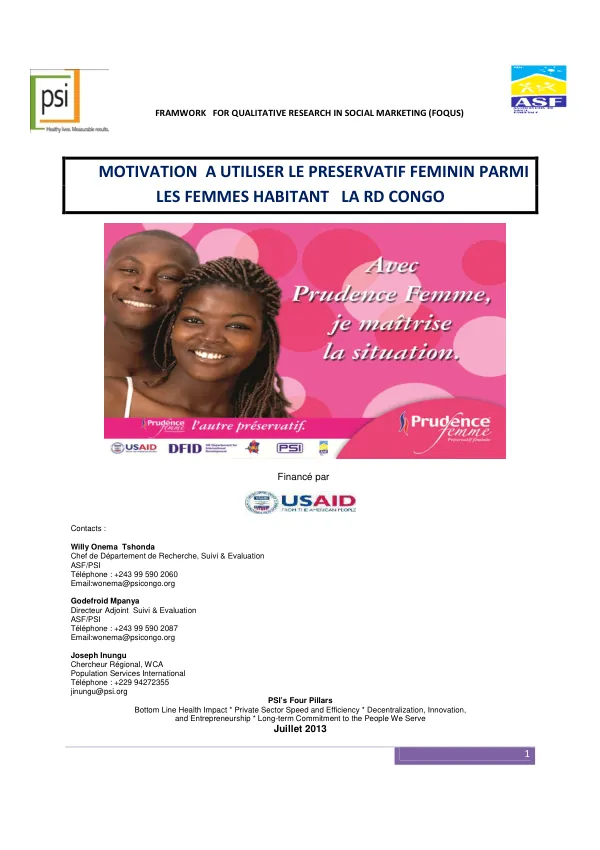
Abstract
The first cases of HIV/AIDS were reported in 1983, and today the virus affects all provinces in the country. The transmission of HIV is primarily through sexual contact. In 2011, serosurveillance studies among pregnant women in various sentinel sites reported a prevalence of 3.5% of HIV, while the 2007 Demographic Survey placed the prevalence at 1.3% among the population aged 15-49. Among adults, the prevalence of HIV is higher among women aged 40-44 (4.4%) and men aged 35-39 (1.8%). The prevalence of HIV is also high among certain subgroups of the population, including sex workers (14%), women displaced by war (7.6%), women in the military (7.5%), and military personnel (3.8%). The increasing number of women infected with HIV/AIDS represents a major challenge in the fight against the pandemic in the DRC. In the absence of a curative treatment or an effective vaccine, abstinence and the use of condoms remain the only effective methods of preventing the transmission of HIV/AIDS among high-risk individuals. Since 1997, the United Nations Programme on HIV/AIDS (UNAIDS) and the World Health Organization (WHO) have encouraged the use of condoms, both male and female, to protect against HIV/AIDS, sexually transmitted infections, and unwanted pregnancies. The Association for Family Health (ASF), a social marketing organization operating in the Congo since 26 years, introduced the Prudence female condom brand in 2005 to serve as a means of protection against HIV/AIDS. In October 2009, this organization received new funding from USAID to conduct social marketing of condoms and promote behavior change among high-risk groups. In the framework of this funding from the American government, ASF/PSI sells male and female condoms through social marketing programs in the provinces of intervention (South Kivu, Kasaï-Oriental, Kasaï-Occidental, Kinshasa, Katanga, Bas-Congo, and Province Orientale). Between 2009 and 2012, ASF/PSI sold an increasing number of Prudence female condoms, with 139,932 units sold in 2009, 199,781 units in 2010, 476,960 units in 2011, and 2,325,513 units in 2012. According to the mid-term evaluation of the project's activities conducted by USAID in August 2012, there is a growing demand for female condoms among women interviewed in the targeted provinces, particularly in Kinshasa, Bas Congo, Kasaï-Oriental, and Katanga. The study aims to better understand the reasons for the use of female condoms among women aged 18-45 in the intervention areas of ASF/PSI. The results of this study will enable ASF/PSI to implement communication activities for behavior change and promote the effective use of female condoms as a means of protection against HIV/AIDS among the target group. Natalie, a 29-year-old student, lives in Matonge with her friends in a studio located in a common courtyard with several other studios. She is engaged to Pitchen, who is unemployed but manages to support himself. Natalie is a high school graduate and earns a living by selling various items at the corner of her street, such as prepaid cards, bread, and eggs. She aspires to get married and have children, and hopes to have enough money to buy a house and a car to lead a better life and ensure a good future for her children. Pélagie, a 20-year-old woman, lives in Pakajuma with her brothers. Her parents are from the Equator and did not have enough money to pay for her education. She has been supporting herself and her brothers by engaging in prostitution for the past five years. Pélagie has a regular boyfriend and a one-year
Related documents
Documents in this collection
 2018
2018USAID DEC
Rapport de Mission Diagnostique et de Renforcement des Capacites Organisationnelles des Conseils Provinciaux de l'Ordre National des Infirmiers du Congo
Open record 2014
2014USAID DEC
Deuxième Enquête Démographique et de Santé en République Démocratique du Congo (EDS-RDC II 2013-2014)
Open record