USAID DEC
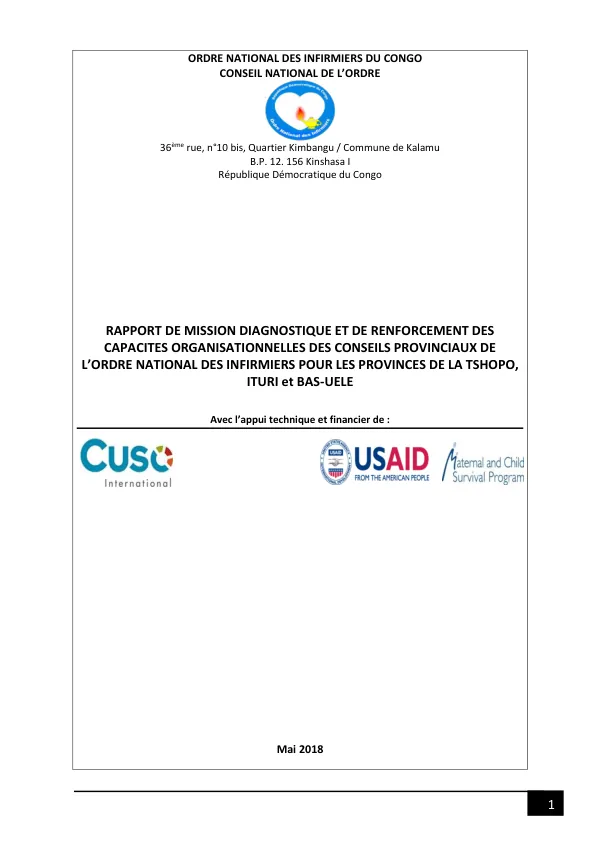
Rapport de Mission Diagnostique et de Renforcement des Capacites Organisationnelles des Conseils Provinciaux de l'Ordre National des Infirmiers du Congo
Sign inCOOPERATIVE FOR ASSISTANCE AND RELIEF EVERYWHERE INTERNATIONAL
Rapport de Mission Diagnostique et de Renforcement des Capacites Organisationnelles des Conseils Provinciaux de l'Ordre National des Infirmiers du Congo
The National Order of Nurses of the Congo, a professional organization, is structured at the national level in Kinshasa and in the 26 provinces.
2018 · 23 pages
Sign in to readA free account is required to download.
Abstract
The organization functions through its organs, including the General Assembly, the National Council, the Provincial Council, the Urban Council, the Territorial Council, and the Cell Council. The Provincial Councils are located in the provincial capitals and have within them the Urban, Territorial, and Cell Councils. The National Order of Nurses of the Congo, ONIC, has been involved in a project with the support of the MCSP, Cuso International, and CVI. The project aims to develop the organizational capacity of the ONIC through a diagnostic process. The diagnostic process involves two missions, one in Goma, North Kivu, and the other in Kisangani, Tshopo Province. The provinces were chosen due to their high number of registered nurses and the need to involve them in the development process. The project's objectives include introducing the concept of organizational development, improving the functioning of the Provincial Councils, and identifying the strengths and weaknesses of the ONIC. The project also aims to improve the relationship between the ONIC and its partners, including the government and other organizations. The diagnostic process will involve interviews with members of the ONIC and its partners, as well as a review of the organization's structure and functioning. The National Order of Nurses of the Congo has a complex organizational structure, with multiple levels of governance and decision-making. The organization is responsible for regulating the nursing profession in the Democratic Republic of Congo and providing support to nurses and midwives. The ONIC has a national council, provincial councils, and local councils, each with its own responsibilities and functions. The project's methodology involves a combination of workshops, interviews, and observations. The project team will conduct interviews with members of the ONIC and its partners, as well as with government officials and other stakeholders. The team will also conduct a review of the organization's structure and functioning, including its policies, procedures, and systems. The project aims to identify the strengths and weaknesses of the ONIC and provide recommendations for improvement. The project's expected outcomes include improved organizational capacity, better functioning of the Provincial Councils, and improved relationships between the ONIC and its partners. The project also aims to improve the quality of care provided by nurses and midwives in the Democratic Republic of Congo. The project's success will depend on the active participation of the ONIC members and partners, as well as the support of the government and other stakeholders. The project's themes include organizational development, capacity building, and partnership development. The project will focus on improving the functioning of the Provincial Councils, identifying the strengths and weaknesses of the ONIC, and improving the relationship between the ONIC and its partners. The project will also address issues related to gender and the role of women in the organization. The project's approach is participatory and inclusive, involving members of the ONIC and its partners in the diagnostic process. The project team will work closely with the ONIC leadership and members to identify the organization's strengths and weaknesses and develop recommendations for improvement. The project aims to build the capacity of the ONIC to provide high-quality care to the people of the Democratic Republic of Congo.
Related documents