CARITAS INTERNATIONAL
Budikadidi DFSA Mid-Term Evaluation Summary Brief
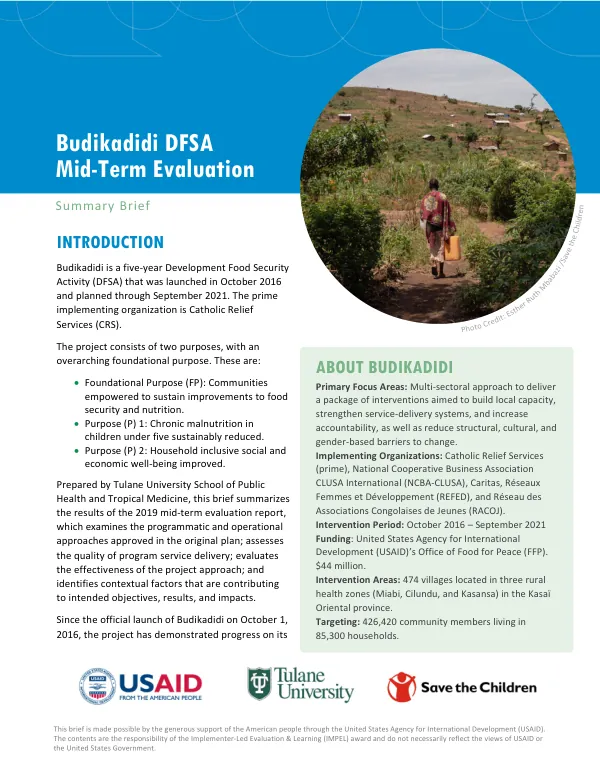
Budikadidi is a five-year Development Food Security Activity (DFSA) launched in October 2016 and planned through September 2021.
2020 · 5 pages
Sign in to readA free account is required to download.
Abstract
The prime implementing organization is Catholic Relief Services (CRS). The project consists of two purposes, with an overarching foundational purpose: Communities empowered to sustain improvements to food security and nutrition, and Chronic malnutrition in children under five sustainably reduced. Household inclusive social and economic well-being is also improved. The project is implemented in 474 villages located in three rural health zones (Miabi, Cilundu, and Kasansa) in the Kasaï Oriental province. The target population consists of 426,420 community members living in 85,300 households. The project has made significant progress in establishing community animation cells (CACs) in all villages, which are transparent and democratic. Care Groups (CGs) have also been established, adhering to international standards. The project has also ensured that the core strategy grows with the population, and newly created families, returnees, and other migrants are included as activity participants. A strong community-based structure for water management has been established, with village chiefs and CAC members involved in governance and accountability. Natural Leaders and Lead Mothers have been equipped and transferred knowledge on WASH concepts and practices. However, the project has faced several challenges, including delays in implementation of activities by key USAID-funded collaborators. The agriculture approach has struggled to reach scale and viability, with some components, such as the market and permagarden approaches, still in the "refine" phase. The permagarden method has been widely adopted, but the evaluation team found that it often failed to follow technical approaches and had quality-related shortcomings. The project has also faced challenges in implementing activities that increase diversity in crop production and livelihoods, which will allow communities to absorb shocks. The evaluation team recommends that the technical staff and leadership assess the current agricultural strategy and establish a set of approaches that can be implemented on a large enough scale to deliver anticipated results. The project must also increase access to potable water points and strengthen the sustainability of water point repairs. One solution may be investing in fewer but higher quality water systems that can provide potable water to greater numbers of people and have a record of low maintenance and high durability. The project must also reinforce recognition of chronic malnutrition among project staff, the health system, and communities. Finally, the project should focus on the activities that have the potential to reduce systemic gender barriers and explore opportunities to better ensure that these activities will continue post-implementation. Establishing firmer links with government sectors, such as the health sector in the case of CGs, or other implementing partners working on health or education in the Budikadidi health zones, may help ensure the longevity of important activities. The project has demonstrated progress on its strategic objectives, and activities are generally being well received by participants. However, the project has an opportunity to improve and learn in several areas, including timeliness of outputs, activities that need to be scaled up or re-focused, specific lessons learned from the Refine & Implement (R&I) approach, and linkages between activities/project purposes and harmonization of approaches between consortium members. The project has invested in and recently installed water systems, but they are failing to meet Sphere standards related to queueing time and the average liter per person per day. This raises concerns about the durability of the borehole foot pumps and whether the new pumps will reach their lifespans. The project has also faced challenges in implementing activities that increase diversity in crop production and livelihoods, which will allow communities to absorb shocks. The evaluation team recommends that the project increase access to potable water points and strengthen the sustainability of water point repairs. The project must also reinforce recognition of chronic malnutrition among project staff, the health system, and communities. Finally, the project should focus on the activities that have the potential to reduce systemic gender barriers and explore opportunities to better ensure that these activities will continue post-implementation.