DEPARTMENT OF AGRICULTURE
Data Driven Decision Support for Securing Kenya’s Water Towers
Water Security in Kenya's Water Towers is a critical issue, with the Constitution recognizing water as a human right and the National Government bearing responsibility for its protection and management.
3 pages
Sign in to readA free account is required to download.
Abstract
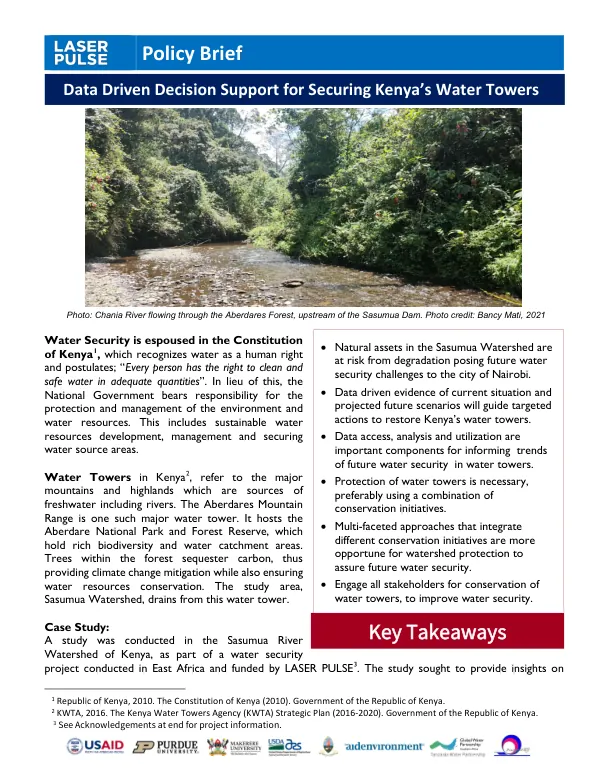
The Aberdare Mountain Range, a major water tower, hosts the Aberdare National Park and Forest Reserve, which holds rich biodiversity and water catchment areas. Trees within the forest sequester carbon, providing climate change mitigation while ensuring water resources conservation. The Sasumua Watershed, located in Nyandarua County, is a key water tower in Kenya, covering an area of 136 km2 and receiving annual rainfall ranging from 1,000 to 1,600 mm. The watershed is home to the Sasumua Dam, which contributes approximately 12% of Nairobi's water supply. Land use in the watershed includes intensive small-scale cultivation, with parcels of land being less than one hectare on average. The Sasumua River flows through the Aberdare Forest, then farmlands, and empties its waters into the Sasumua Reservoir. A study conducted in the Sasumua River Watershed as part of a water security project in East Africa found that natural assets in the watershed are at risk from degradation, posing future water security challenges to the city of Nairobi. The study utilized hydrological data collected from national databases of the Water Resource Authority and the Soil and Water Assessment Tool (SWAT) hydrological model to simulate scenarios of land and water management for a changing climate. The results showed that water security threats in the Sasumua Watershed include agricultural activities encroaching on natural ecosystems above the dam, pollution threats from the Jabini urban center, and land fragmentation with intensive agriculture and encroachment of catchment areas. The study found that a multi-faceted approach, including riparian buffers, filter strips, terracing, field diversions of runoff, water harvesting, and conservation, will be necessary to reverse degradation and attain water security in the Sasumua Watershed. Contour grass buffer strips were found to be the most effective single initiative, and their upscaling is recommended. Remedial and conservation efforts are already being instituted in the Sasumua Watershed by communities and support organizations, including the Sasumua Water Resources Users Association (WRUA). The guiding principles towards sustainable management of water towers in Kenya require ensuring accountability, responsibility, and equity to support responsible use and exploitation of water, ecosystems, and the natural resource base for current and future generations. The Government of Kenya should engage all stakeholders for coordinated implementation of the proposed measures to conserve the Sasumua watershed and other water towers, and thus, facilitate improving water security in Kenya.