USAID DEC
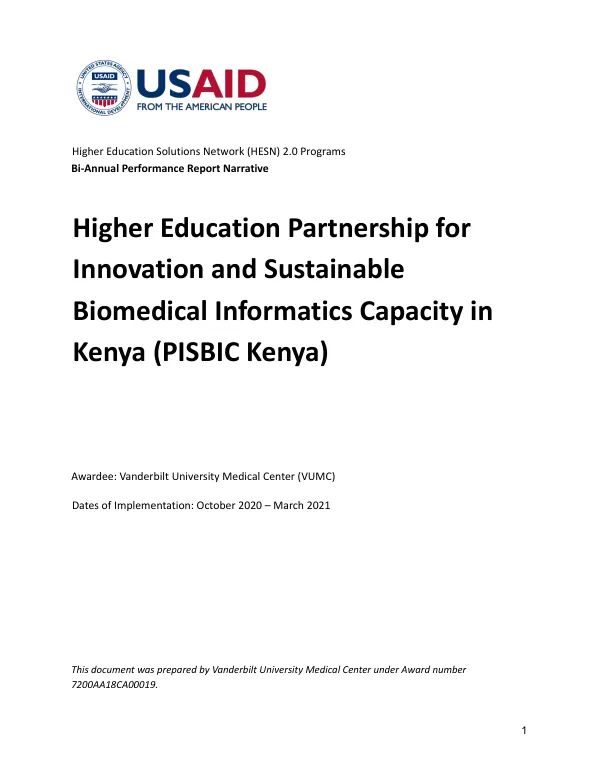
FY2021 Bi-Annual Report: Higher Education Partnership for Innovation and Sustainable Biomedical Informatics Capacity in Kenya (PISBIC Kenya)
Sign inUNIVERSIT6 DE PURDUE
FY2021 Bi-Annual Report: Higher Education Partnership for Innovation and Sustainable Biomedical Informatics Capacity in Kenya (PISBIC Kenya)
The Higher Education Solutions Network (HESN) 2.0 Programs Bi-Annual Performance Report Narrative for the Higher Education Partnership for Innovation and Sustainable Biomedical Informatics Capacity in Kenya (PISBIC Kenya) was prepared by Vanderbilt University Medical Center under Award number 7200AA18CA00019.
2021 · 10 pages
Sign in to readA free account is required to download.
Abstract
The report covers the period from October 2020 to March 2021. PISBIC Kenya aims to sustainably strengthen education, research, and innovation capacity in health informatics (HI) at the Moi University Institute for Biomedical Informatics (IBMI) and across the region. The partnership involves U.S. higher education institutions Vanderbilt University Medical Center and Purdue University, and Kenyan institutions Moi University and Aga Khan University. To achieve its goals, PISBIC Kenya is pursuing activities in three areas: education, research, and service and innovation. In the education sector, PISBIC Kenya has made significant progress in international accreditation of IBMI's Master of Science in Health Informatics (MScHI) program. The team has also continued to add eLearning modules to the Health Informatics in Africa (HELINA) eLearning platform, including a technology transfer course. Additionally, the team has developed 10 eLearning courses for the HELINA platform. In the research sector, PISBIC Kenya has created an e-infrastructure for an HI research and mentoring network through the HELINA Talk platform. The team has also conducted a Ministry of Health (MoH)-endorsed research project on the security of eHealth systems, with data collection underway and expected to inform eHealth security policy. In the service and innovation sector, PISBIC Kenya has capacity-built software engineers at Moi University to support the mUzima mHealth application, which has been adopted nationally in Kenya and is being implemented in other countries. The team has also held weekly developer team meetings and provided training on health data analytics to IBMI developers. Cross-cutting activities include establishing an HI externship program through Moi University, exploring collaboration with the University of Nairobi, expanding communications and marketing for PISBIC Kenya activities, and preliminary sustainability planning. The team has continued to recruit student participants for the externship program and has 20 graduates so far. The team has also updated the mUzima application to support the Ministry of Health Kenya in the COVID-19 response and is exploring mechanisms to work with other USAID partners. Overall, PISBIC Kenya has made significant progress in its activities, with notable achievements in education, research, and service and innovation. The team continues to work towards its goals, with a focus on sustainability and long-term impact.
Related documents