FHI 360
Decentralized Drug Distribution in Liberia: Final Report
The EpiC project in Liberia aimed to achieve and maintain HIV epidemic control through the implementation of decentralized drug distribution (DDD).
2021 · 8 pages
Sign in to readA free account is required to download.
Abstract
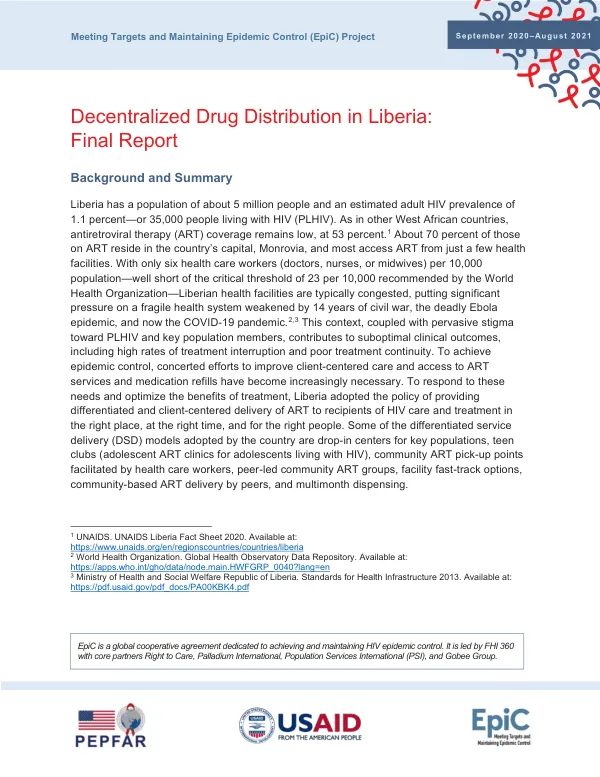
The project was led by FHI 360, in partnership with Right to Care, Palladium International, Population Services International (PSI), and Gobee Group. Liberia has a population of approximately 5 million people, with an estimated adult HIV prevalence of 1.1 percent, or 35,000 people living with HIV (PLHIV). Antiretroviral therapy (ART) coverage in Liberia remains low, at 53 percent, with most ART services concentrated in the capital city, Monrovia. To address the challenges faced by PLHIV in accessing treatment, the EpiC project introduced DDD, an out-of-facility ART delivery model where patients established on treatment access antiretroviral (ARV) medication through private sector or alternative pick-up points. In Liberia, DDD was implemented through community pharmacies and community-based organization (CBO) offices. Patients established on treatment in high-volume public facilities were devolved to private community pharmacies or CBO offices of their choice for ARV refills and returned to the health facility only for clinical reviews and viral load (VL) tests. The EpiC project partnered with the National AIDS/STI Control Program (NACP) to implement a pilot with three public health facilities that devolved clients established on treatment to 25 community pharmacies and two CBOs. Through this pilot, the EpiC project assessed the feasibility of DDD in Liberia to support decongestion of high-volume facilities and documented the process, outputs, and outcomes to inform further national discourse. The project engaged key stakeholders, including the Government of Liberia, LibNeP+, the Liberia Pharmacy Board (LPB), and community pharmacies, to ensure sustainability and local ownership of the DDD model. Client surveys were conducted among 58 PLHIV from Redemption Hospital to assess their interest in DDD through private pharmacies and the barriers they face in accessing routine treatment services at the facility. The surveys found that more women were willing to participate in DDD than men, and that clients were interested in enrolling in DDD after an introductory explanation. The pharmacy assessment was conducted among 198 of the 209 pharmacies registered with the LPB, and found that 97 percent of pharmacies were willing to participate in DDD before learning the full details of DDD, and 75 percent were willing to participate after learning the full details. The EpiC project also assessed the travel times of clients to health facilities and private pharmacies, and found that travel times to private pharmacies were less than travel times to facilities where clients currently pick up ARVs. This highlights the potential for DDD to reduce the time and cost associated with travel to pick up ARVs. The project's findings and recommendations will inform further national discourse on the implementation of DDD in Liberia.