ABT ASSOCIATES
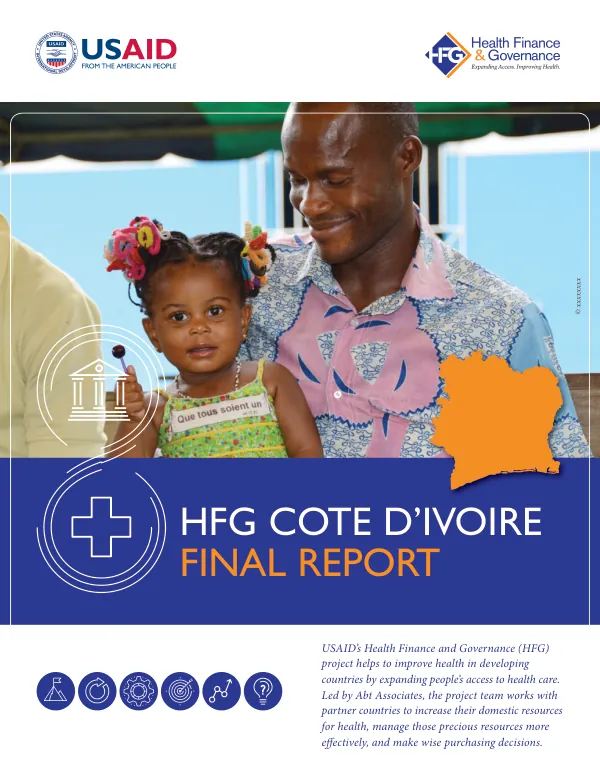
Health Finance and Governance Project (HFG) Cote d'Ivoire Final Report 2012-2018
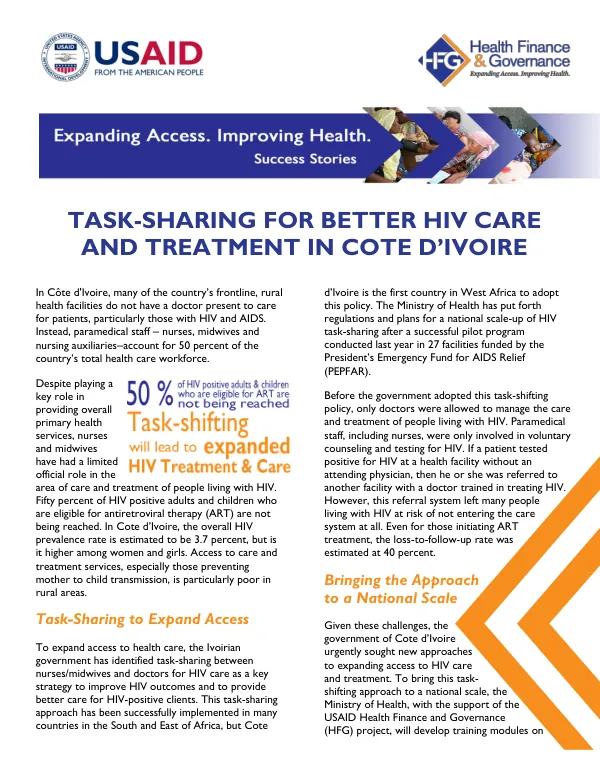
The Health Finance and Governance (HFG) Project in Cote d'Ivoire aimed to address the country's pressing health challenges, including inadequate human resources for health care delivery, insufficient domestic resources for health, and inadequate financial management.
2018 · 12 pages
Sign in to readA free account is required to download.
Abstract
The project, led by Abt Associates, collaborated closely with the Ministry of Health and Public Hygiene (MHPH) and other partners to strengthen the health system and improve access to quality health services for Ivoirian families and communities. Building on previous health financing and governance programs and strategies, HFG supported the country's efforts to build a stronger health workforce, strengthen health financing, and improve governance and accountability in the health sector. The project was funded by the U.S. Agency for International Development (USAID) and the U.S. President's Emergency Plan for AIDS Relief (PEPFAR). One of the key results of the HFG project was the expansion of health workers trained to deliver HIV services. The number of health care workers graduating with the skills needed to initiate antiretroviral therapy (ART) increased from 300 physicians to 1,800 health workers each year. This six-fold increase was made possible by developing and enabling a task sharing policy and pre-service training curriculum changes that resulted in around 1,500 nurses and midwives graduating with the skills to initiate ART each year. The new policy mandated an expanded role for nurses and midwives, allowing them to provide ART services, which was a change from previous policies that only allowed physicians to provide ART services. HFG was instrumental in helping the MHPH design and implement a pre-service education program and develop a curriculum to build the capacity of nurses and midwives in HIV care and treatment. The expansion of health workers is helping to address a critical gap: more than 50 percent of adults and children who are HIV positive have yet to receive life-saving ART. Inadequate numbers of health workers, as well as their uneven distribution throughout the country, have been significant barriers to the scale-up of HIV treatment. With the pre-service training approach in place, there is now a continual pipeline of nurses and midwives with competencies in HIV care and treatment – many of whom are now working in areas where there is a high burden of HIV. The HFG project also contributed to the country's progress toward controlling the HIV epidemic. Recent advances in the national response to HIV have led to results that include a reduction in new HIV infections (from 25,000 in 2010 to 20,000 in 2016) and fewer AIDS-related deaths (from 29,000 in 2010 to 25,000 in 2016). Although only 41 percent of people living with HIV are on treatment, the number has continued to rise in recent years. In light of this remarkable progress, PEPFAR recently identified Cote d'Ivoire as a priority country, noting that it is close to reaching epidemic control. The HFG project's key results over the past five years include: more health workers on the front lines of care, increased resources and better financial management for improved HIV outcomes, institutions empowered to improve governance and accountability, and a stronger health system to respond to public health emergencies. The project's efforts have helped to make health systems improvements, such as task sharing, which expanded access to HIV treatment, and have contributed to the country's progress toward controlling the HIV epidemic.