ICF
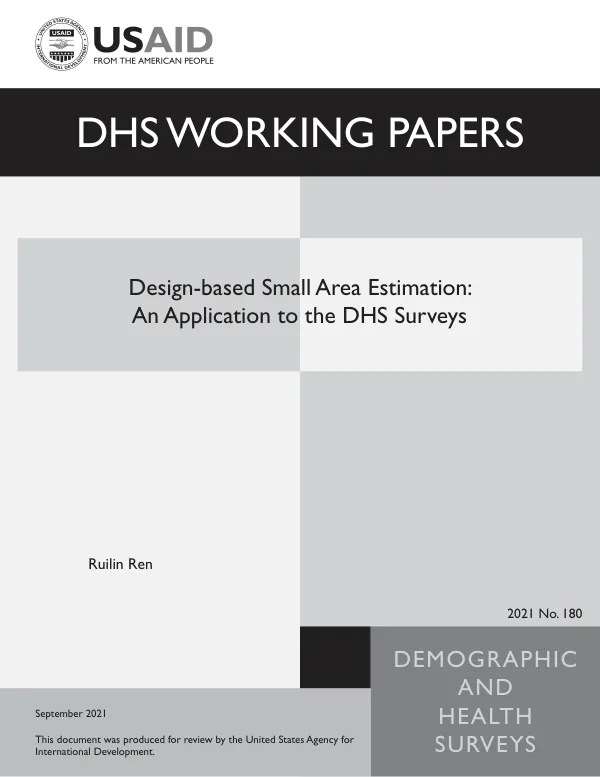
Design-based Small Area Estimation: An Application to the DHS Surveys
Design-based small area estimation is a statistical technique used to produce reliable estimates of population characteristics for small geographic areas.
2021 · 42 pages
Sign in to readA free account is required to download.
Abstract
This method is particularly useful for developing countries where data is often limited and unreliable. The technique involves combining data from multiple sources to produce more accurate estimates. The traditional design-based small area estimation techniques rely on the assumption that the data is representative of the population. However, this assumption may not always hold true, especially in developing countries where data quality is often poor. To address this issue, a new nearest neighbor small area estimation method was proposed. This method uses the nearest neighbor technique to estimate the population characteristics of small areas. The nearest neighbor technique involves selecting a set of neighboring areas that are similar to the area of interest. The population characteristics of these neighboring areas are then used to estimate the population characteristics of the area of interest. The proposed method uses a composite distance measure to select the nearest neighbors, which takes into account multiple variables such as distance, population size, and socioeconomic characteristics. The study used data from the Rwanda Demographic and Health Surveys (DHS) conducted in 2010 and 2014-15. The data included information on women aged 15-49, including their reproductive health, fertility, and mortality. The study used a time-space nearest neighbor method, which involves selecting neighboring areas based on both spatial and temporal proximity. The results of the study showed that the proposed nearest neighbor small area estimation method produced more accurate estimates of population characteristics compared to traditional design-based methods. The method was particularly effective in estimating fertility rates and infant mortality rates. The study also found that the method was robust to different distance measures and neighborhood sizes. The study concluded that the proposed nearest neighbor small area estimation method is a useful tool for producing reliable estimates of population characteristics for small geographic areas. The method can be applied to other developing countries where data is limited and unreliable. The study also highlighted the importance of using multiple sources of data to produce more accurate estimates. The study used a hybrid small area estimation method, which combines the nearest neighbor method with other methods such as direct estimation and consistency-adjusted estimation. The hybrid method produced more accurate estimates of population characteristics compared to the nearest neighbor method alone. The study also found that the hybrid method was robust to different distance measures and neighborhood sizes. The study's findings have implications for policymakers and researchers who rely on demographic data to inform their decisions. The proposed nearest neighbor small area estimation method can be used to produce more accurate estimates of population characteristics, which can inform policies related to reproductive health, fertility, and mortality. The study's findings also highlight the importance of using multiple sources of data to produce more accurate estimates.
Related documents