USAID DEC
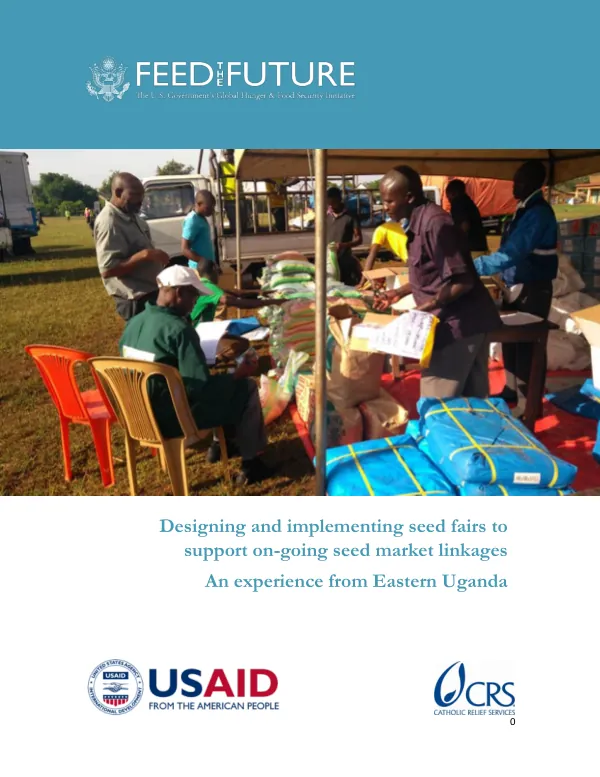
Designing and implementing seed fairs to support on-going seed market linkages: An experience from Eastern Uganda
Sign inCATHOLIC RELIEF SERVICES ORGANIZATION
Designing and implementing seed fairs to support on-going seed market linkages: An experience from Eastern Uganda
The agricultural fairs in Eastern Uganda were implemented by CRS-Uganda and Caritas-Tororo in early 2020, with the objective of providing disaster-affected women and men with the assets, tools, and knowledge necessary to rebuild their livelihoods.
2021 · 30 pages
Sign in to readA free account is required to download.
Abstract
The fairs were supported by a $200,000 grant from the Bill and Melinda Gates Foundation (BMGF) and aimed to restore the livelihoods of 2,000 households. The project was a 4-month market fair project, running from January to April 2020. The fairs provided agricultural inputs, including seeds, tools, pesticides, fertilizer, and tarpaulins, as well as essential food items such as maize meal, salt, sugar, and cooking oil. The CRS-Uganda team reached out to S34D for technical advice, and it was agreed that actions designed to enhance the sustainability of private sector seed provisioning would be tested as part of the agricultural market fairs where possible and appropriate. Nine specific actions were proposed to promote seed market linkages as part of the design and implementation of the agricultural fairs. These actions were designed to be tested through a participatory action research approach, with the goal of learning from the experience and making recommendations for future actions to support sustainable market linkages through seed fair programming. The nine actions proposed for private sector support within the BMGF Uganda seed fairs included creating awareness among targeted farmers about the different types of seed, tools, and services available through local suppliers. This was to be achieved by inviting local vendors to bring a diverse range of inputs and facilitating loans for local suppliers to expand the range of inputs and services available. The actions were modified and applied in practice, with lessons emerging from the experience. The implementation of the actions was facilitated through a participatory action research approach, with feedback and reflections from CRS staff involved in the fairs informing the findings presented in this report. The report describes the ways in which some of the lessons from the southern Africa report were applied in the context of the agricultural input fairs in Eastern Uganda. The lessons included actively designing the supply side, framing the input fairs as an emerging private sector opportunity, and recruiting local suppliers and vendors. The report provides recommendations for future actions to support sustainable market linkages through seed fair programming. These recommendations include refining the actions and contexts most suitable for seed fairs to enable the emergence of ongoing market linkages. The recommendations will be applied in an S34D activity planned for FY21. The agricultural fairs in Eastern Uganda were a response to the flooding in the Mount Elgon area in October 2019, which destroyed farms, bridges, food stocks, sanitation facilities, and homes. The fairs were implemented by CRS, Caritas Tororo, World Vision, and Plan International, with the goal of delivering life-saving support to 1,000 affected households. The fairs were successful in meeting the immediate needs of the affected households, but early recovery support was also deemed necessary. The harvest of November/December 2019 had been affected by prolonged dry spells during the growing season, in addition to the October floods that occurred just before the main maize harvest. The report highlights the importance of seed fairs in supporting the livelihoods of disaster-affected communities. The fairs provided a platform for local suppliers and vendors to sell their products, and for farmers to access the inputs and services they needed to rebuild their livelihoods. The report also emphasizes the need for ongoing support to ensure the sustainability of private sector seed provisioning in the region. The report concludes by highlighting the lessons learned from the experience and the recommendations for future actions to support sustainable market linkages through seed fair programming. The recommendations include refining the actions and contexts most suitable for seed fairs to enable the emergence of ongoing market linkages.