USAID DEC
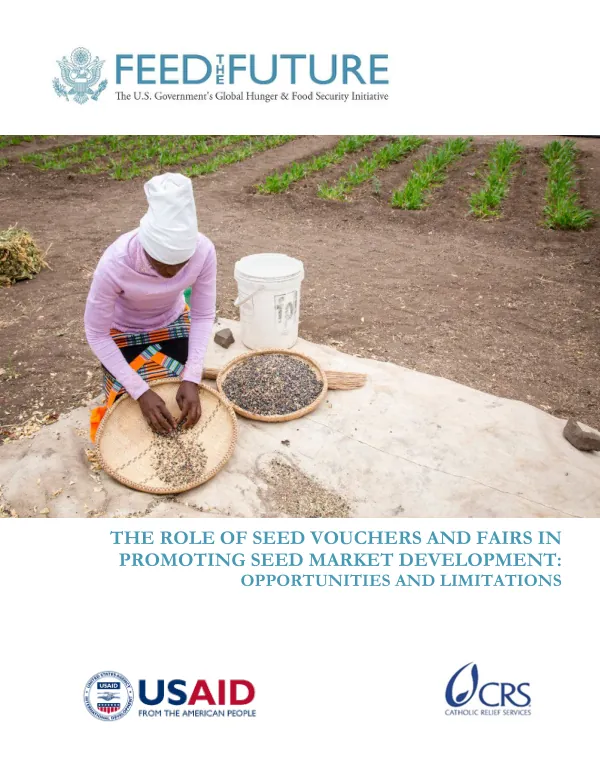
The Role of Seed Vouchers and Fairs in Promoting Seed Market Development: Opportunities and Limitations
Sign inCATHOLIC RELIEF SERVICES ORGANIZATION
The Role of Seed Vouchers and Fairs in Promoting Seed Market Development: Opportunities and Limitations
Seed vouchers and fairs have been implemented in various contexts to promote seed market development and sustainable business models.
2021 · 37 pages
Sign in to readA free account is required to download.
Abstract
The Feed the Future Supporting Seed Systems for Development activity, a global initiative, aimed to improve the functioning of national seed sectors in focus countries. The activity's goal was to strengthen the capacity of market actors, improve market linkages, and catalyze adapted goods and services. A literature review was conducted to examine the effectiveness of seed vouchers and fairs in promoting seed market development. The review identified several intervention approaches, including strengthening capacity within the seed sector, improving market linkages, and generating demand. However, the review also highlighted potential market constraints, such as low capacity of market actors, adapted goods and services, low demand, low purchasing power, and access to finance. Five case studies were conducted in Nepal, Malawi, Uganda, Guatemala, and Ghana to examine the impacts of seed fairs and other approaches on seed vendors. The case studies demonstrated that seed fairs can provide short-term benefits to farmers, but they may not be sufficient to create sustainable market linkages. The interactions that take place within seed fairs are not likely to be sufficient to create these linkages, and additional attention needs to be paid to potential market constraints. The report suggests multiple ways to address each of these challenges to support seed market development over time with or without seed fairs. The report concludes that seed voucher fairs are not the most effective way to promote seed market development over long-term projects. Instead, strengthening the connections between vulnerable farmers and seed traders will be critical to ensure sustainable market linkages. The report highlights the importance of addressing market constraints, such as low capacity of market actors, adapted goods and services, low demand, low purchasing power, and access to finance. The report suggests that alternative approaches, such as improving market linkages and generating demand, may be more effective in promoting seed market development over time. The report also emphasizes the need for further data collection and analysis to better understand the impacts of seed fairs and other approaches on seed vendors and farmers. In conclusion, the report provides evidence that seed voucher fairs are not the most effective way to promote seed market development over long-term projects. Instead, the report suggests that alternative approaches, such as improving market linkages and generating demand, may be more effective in promoting seed market development over time. The report highlights the importance of addressing market constraints and strengthening the connections between vulnerable farmers and seed traders to ensure sustainable market linkages.