USAID DEC
Determining turbine and generator efficiency of a Pico hydro system at different flow rate
Sign inNATIONAL UNIVERSITY OF SCIENCES AND TECHNOLOGY , ISLAMABAD
Determining turbine and generator efficiency of a Pico hydro system at different flow rate
The research focuses on analyzing the turbine and electric efficiency of a Pico hydro system with an installed impulse turbine and a 3-phase AC permanent magnet alternator.
2016 · 26 pages
Sign in to readA free account is required to download.
Abstract
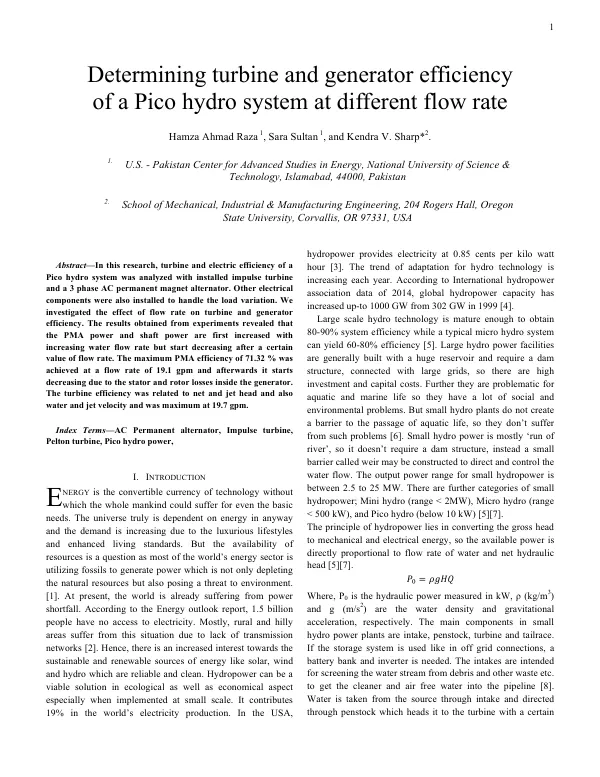
The system is designed to handle load variation with additional electrical components. The study investigates the effect of flow rate on turbine and generator efficiency. The results obtained from experiments reveal that the PMA power and shaft power initially increase with increasing water flow rate but start decreasing after a certain value of flow rate. The maximum PMA efficiency of 71.32% was achieved at a flow rate of 19.1 gpm, and afterwards, it starts decreasing due to stator and rotor losses inside the generator. The turbine efficiency was related to net and jet head and also water and jet velocity, and was maximum at 19.7 gpm. The Pico hydro system is based on a pico hydro flow system installed in the Hydro & Climate lab by Bryan Cobb at Oregon State University. The objective is to build a system that could more efficiently produce electrical power over a range of flow rates by maintaining the frequency. The generator used is an AC Permanent Magnet Alternator with a rectifier kit, which provides a safe range to the load. The experimental setup is based on a system used in [10] with some extra electrical equipment added. The equipment used in this experiment includes a 3-phase permanent magnet alternator, pelton turbine, centrifugal pump, pressure transducer, flow rate sensor, laser tachometer, battery, rectifier, inverter, multi-meters, weighing display meter, and loads. The specifications of the equipment are shown in Table 1. The pelton turbine shaft is coupled with the generator shaft by means of a coupler. The turbine rotation occurs due to water impingement on its blades, and rpm is measured by a laser tachometer. The setup comprises a water flow loop to get a controlled flow rate by means of a centrifugal pump and is measured through a flow sensor with an LED displaying meter. A flow loop valve is used to control the flow rate. The results of the experiment show that the PMA power and shaft power increase with increasing water flow rate but start decreasing after a certain value of flow rate. The maximum PMA efficiency of 71.32% was achieved at a flow rate of 19.1 gpm. The turbine efficiency was related to net and jet head and also water and jet velocity, and was maximum at 19.7 gpm. The study also compares the results with previous research on Pico hydro systems. The results show that the PMA power and shaft power increase with increasing water flow rate but start decreasing after a certain value of flow rate. The maximum PMA efficiency of 71.32% was achieved at a flow rate of 19.1 gpm, which is higher than the efficiency achieved in previous research. The study concludes that the Pico hydro system can efficiently produce electrical power over a range of flow rates by maintaining the frequency. The system can be used to provide electricity to remote areas where access to electricity is limited. The results of the experiment show that the PMA power and shaft power increase with increasing water flow rate but start decreasing after a certain value of flow rate. The maximum PMA efficiency of 71.32% was achieved at a flow rate of 19.1 gpm.
Related documents