ARIZONA STATE UNIVERSITY
USPCASE Energizer Newsletter 2018-2019, Issue 1
The U.S.-Pakistan Centers for Advanced Studies in Energy (USPCASE) is working with faculty at the National University of Sciences and Technology (NUST) and the University of Engineering and Technology Peshawar (UET Peshawar) to deepen their understanding and use of active learning approaches.
2019 · 16 pages
Sign in to readA free account is required to download.
Abstract
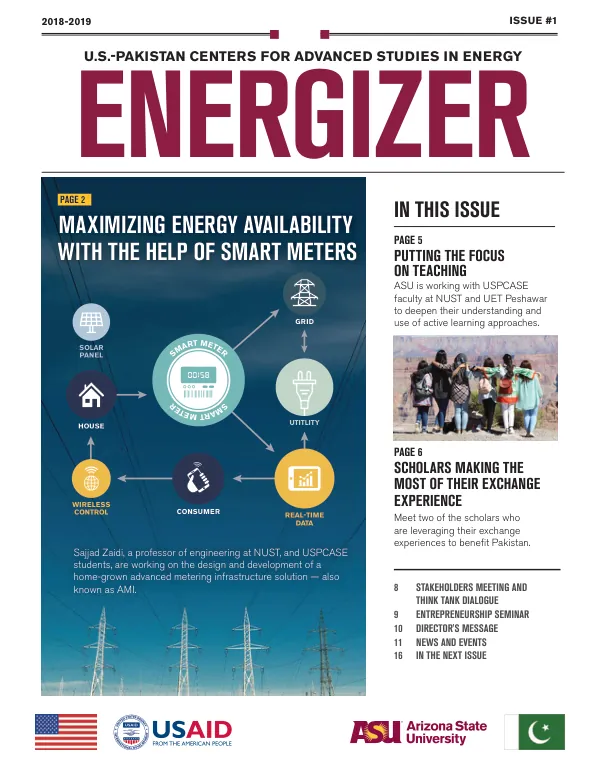
One of the key initiatives is the development of a home-grown advanced metering infrastructure (AMI) solution by Sajjad Zaidi, a professor of engineering at NUST, and USPCASE students. The AMI solution is designed to provide the backbone for the power grid of the future, where distributed energy resources like rooftop solar arrays, customer-owned battery storage devices, and electric vehicles that feed their electrons back onto the power system are as much as part of the electricity resource mix as utility-owned power plants. In Pakistan, AMI could help electricity suppliers better manage the grid, end electricity shortfalls, and integrate customer-owned generation resources like rooftop solar arrays. The meters being developed by Zaidi and his team have several key features, including bi-directional or net metering, which allows businesses and individuals generating their own electricity to deliver unused energy back to their local power grid and get credited back for its retail price. The meters also serve as power quality sensors, enabling continuous monitoring and analysis of voltage and frequency excursions, and facilitating Home Area Networks (HANs) that allow consumers to monitor and control household appliances. The AMI system will help Pakistan economically by reducing power theft, peak loads, and allowing more individuals and parties to contribute to the grid. This will result in a better, more stable grid, increasing investor trust in more development and a better economy. The market size of smart grid technologies, and specifically smart meters, is huge, with a lot of room for new products and new shareholders. Zaidi and his team have already received interest from two major Pakistani electric supply companies, and the estimated cost for the meters is 25,000-28,000 rupees ($178-200 USD), which is less than the current smart meters that cost around 70,000 rupees ($500 USD). The meters also offer a user-friendly interface and cross-checking and easy verification of meter readings, making them more secure and reliable. The USPCASE is also focusing on pedagogy, improving course delivery methods and assessing the outcomes in the teaching and learning environment. Engineering curricula need constant adjustment to maximize alignment to the needs of society and industry, and USPCASE is working with faculty to build their pedagogy toolkits and provide learning contexts for engineers to become excellent designers, problem-solvers, and critical thinkers. Ammar Yasser, corporate engagement specialist for USPCASE, notes that smart metering supports the goal of controlling the excessive waste of electricity in homes and small commercial units. The Government of Pakistan is planning to undertake widespread adoption of this technology in the future, and indigenization of technology will support capacity building and transfer of technology to the country. The USPCASE is working with faculty at NUST and UET Peshawar to develop a home-grown AMI solution that will help Pakistan economically by reducing power theft, peak loads, and allowing more individuals and parties to contribute to the grid. The solution will also provide a better, more stable grid, increasing investor trust in more development and a better economy.