ARIZONA STATE UNIVERSITY
U.S.-Pakistan Centers for Advanced Studies in Energy at ASU Overview
The U.S.-Pakistan Centers for Advanced Studies in Energy, USPCAS-E, is a partnership between Arizona State University (ASU) and two leading Pakistani universities: National University of Sciences and Technology (NUST) and University of Engineering and Technology Peshawar (UET-P).
2019 · 8 pages
Sign in to readA free account is required to download.
Abstract
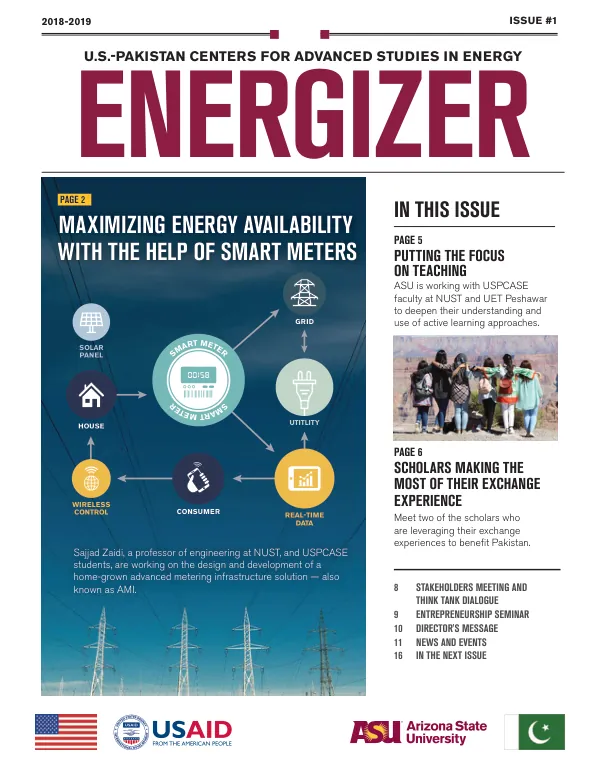
The initiative aims to address Pakistan's energy needs through research, education, and collaboration with government and industry. Pakistan faces significant energy challenges, including rolling blackouts and an energy crisis. The country's energy supply-demand gap has stunted economic growth and exacerbated trade deficit problems. With 67.1 percent of Pakistan's electricity generated from fossil fuels, the country ranks number 33 globally in oil consumption. However, Pakistan has the renewable energy potential to generate approximately 167.7 gigawatts of power, offering a sustainable way to meet the country's energy needs. ASU is helping to facilitate a transition to a future powered increasingly by renewable energy. The university's expertise in developing knowledge leaders in order to transform energy systems is driven by strong training and implementation initiatives in Arizona and abroad. USPCAS-E is benefiting from the expertise and research of ASU's multidisciplinary energy centers as well as capabilities in training and stakeholder engagement. The USPCAS-E program has made significant progress since its inception in 2015. Seven cohorts of faculty and students from NUST and UET-P have visited ASU and OSU for an intensive research and cultural experience. The program has also facilitated the development of 14 new masters and Ph.D. degree programs, with more than 140 new courses developed. Additionally, 36 applied research projects and 12 joint research projects with U.S.-based faculty at ASU and OSU have been initiated. The program has also focused on fostering partnerships and ensuring sustainability. Stakeholder engagement is key to the sustainability of Pakistan's higher education institutions' ability to contribute solutions to Pakistan's energy challenges, drive private sector innovation, promote modernization, strengthen government policy, and stimulate economic growth. Through early and frequent engagement with stakeholders, USPCAS-E is ensuring relevant curricula and the development of research agendas that respond to private sector needs for the long term. The outcomes of USPCAS-E include applied research projects, workshops, and courses that focus on power systems, electric grid and distribution systems, solar photovoltaic systems, renewable energy, thermal energy, energy materials, and energy policy. The program has also established channels to facilitate local and international networking in the energy sector, increasing access to energy-related professions for women and economically disadvantaged students. The program has had a lasting impact on the students and faculty involved. Warda Mushtaq and Syeda Mehwish, two students who studied at ASU as part of the USPCAS-E program, have spoken highly of the experience, citing the supportive environment and opportunities for research and collaboration. The program has also facilitated the development of a network of like-minded professionals in the energy sector, with stakeholders such as Muhammad Raziuddin, CEO of KPOGCL, praising the initiative for bringing together the best brains in Pakistan to discuss common issues and a way forward. Overall, the USPCAS-E program is making significant contributions to addressing Pakistan's energy challenges through research, education, and innovation. The program's focus on sustainability, stakeholder engagement, and networking opportunities has helped to establish a robust and collaborative environment for addressing the country's energy needs.