IRG
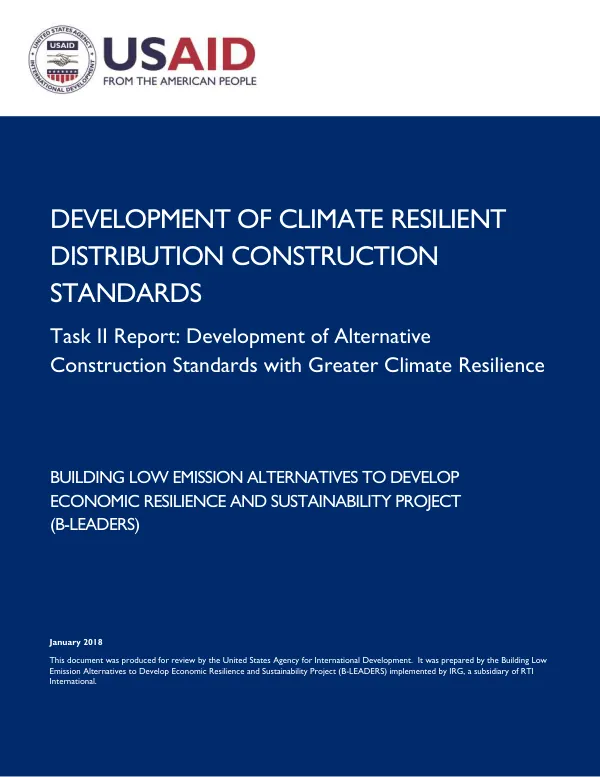
Development of Climate Resilient Distribution Construction Standards
The Philippine Electric Code governs electric power line design in the Philippines.
2018 · 38 pages
Sign in to readA free account is required to download.
Abstract
Part 1 of the Code describes requirements for building electric systems, while Part 2 contains requirements for safeguarding of persons during the installation, operation, and maintenance of electric supply and communications lines and associated equipment. The Code includes provisions for clearances, wind loading, and strength of structures, as well as requirements for underground construction, electric supply stations, and operation and maintenance of electric supply lines and equipment. The Code's wind loading requirements are based on the basic wind speed zones, which are depicted in Figure 1. The wind loading factors for each exposure category are listed in Table 1. The Code also requires that electric power lines be designed to withstand wind loads, with the strength of structures being a critical factor. The strength of structures is typically determined by the type of material used, with wood and steel being common materials used in electric power line construction. The Philippine Electric Code also contains provisions for underground construction, which is becoming increasingly popular due to its ability to reduce the risk of damage from typhoons and other natural disasters. Underground construction involves burying electric power lines and equipment underground, which can provide a higher level of protection against wind and other environmental factors. Typhoons have had a significant impact on the electric infrastructure in the Philippines, with the top six most destructive storms occurring since 2009. The most significant of these storms was Yolanda, which came ashore near Tacloban in Leyte and on Samar with winds of up to 300kph. The damage to the rural electric infrastructure from Typhoon Yolanda was significant, with 33 electric cooperatives sustaining significant damage and 11 being almost totally destroyed. The damage caused by Typhoon Yolanda has raised concerns about the resilience of the electric infrastructure in the Philippines. Many believe that the increase in the number of typhoons and the increase in the number of powerful typhoons like Yolanda may be a result of climate change, and may therefore be a factor to contend with for the foreseeable future. Given the level of destruction visited by Yolanda and other subsequent storms on the electric systems of the affected electric cooperatives, it is tempting to recommend a wholesale increase in structure strength as a means of preventing future damage. However, there must be a consideration both of exposure and cost if the optimal result is to be achieved. Typhoons are statistical events, and while there are areas in the Philippines that have historically suffered more typhoon activity while others have not, there is no assurance that this situation will continue. Leyte, which was heavily damaged by Yolanda, is not in the zone of highest typhoon incidence. Electric cooperatives are consumer-owned electric utilities and must consider cost as a factor as well as structure security. The project will examine options for improving climate resilience of both existing and future electric distribution infrastructure. This will involve analyzing the performance of existing lines, identifying areas for improvement, and developing alternative construction standards with greater climate resilience. The project will also consider the cost implications of different options and will aim to develop a cost-effective solution that balances the need for increased resilience with the need to minimize costs. The project will focus on developing alternative construction standards that can be used to improve the climate resilience of electric distribution infrastructure. This will involve analyzing the performance of existing lines, identifying areas for improvement, and developing new standards that take into account the latest research and best practices in the field. The project will also consider the cost implications of different options and will aim to develop a cost-effective solution that balances the need for increased resilience with the need to minimize costs. The project will examine several options for improving climate resilience, including reinforcing existing lines, using braced structures, and undergrounding. Reinforcing existing lines involves strengthening the existing infrastructure to make it more resilient to typhoons and other natural disasters. This can be achieved through a variety of means, including using heavier materials, increasing the size of the lines, and improving the design of the structures. Using braced structures involves designing new lines that are specifically designed to withstand typhoons and other natural disasters. This can be achieved through the use of bracing systems, which are designed to absorb the forces generated by wind and other environmental factors. Bracing systems can be used in a variety of configurations, including push braces, pull braces, and diagonal braces. Undergrounding involves burying electric power lines and equipment underground, which can provide a higher level of protection against wind and other environmental factors. Undergrounding can be achieved through a variety of means, including trenching, boring, and directional drilling. The project will examine the feasibility of undergrounding as a means of improving climate resilience and will consider the cost implications of different options. The project will also consider the use of heavy-duty conventional construction, which involves using heavier materials and more robust designs to improve the resilience of electric distribution infrastructure. This can be achieved through the use of heavier steel and concrete, as well as more robust designs that take into account the latest research and best practices in the field. The project will examine the performance of existing lines and
Related documents