USAID DEC
Financial Sustainability of Indonesia’s Jaminan Kesehatan Nasional: Performance, Prospects, and Policy Options
Sign inAVENIR HEALTH
Financial Sustainability of Indonesia’s Jaminan Kesehatan Nasional: Performance, Prospects, and Policy Options
Indonesia's national health insurance scheme, Jaminan Kesehatan Nasional or JKN, was launched in January 2014 as one of the world's most ambitious and largest single-payer programs.
2019 · 87 pages
Sign in to readA free account is required to download.
Abstract
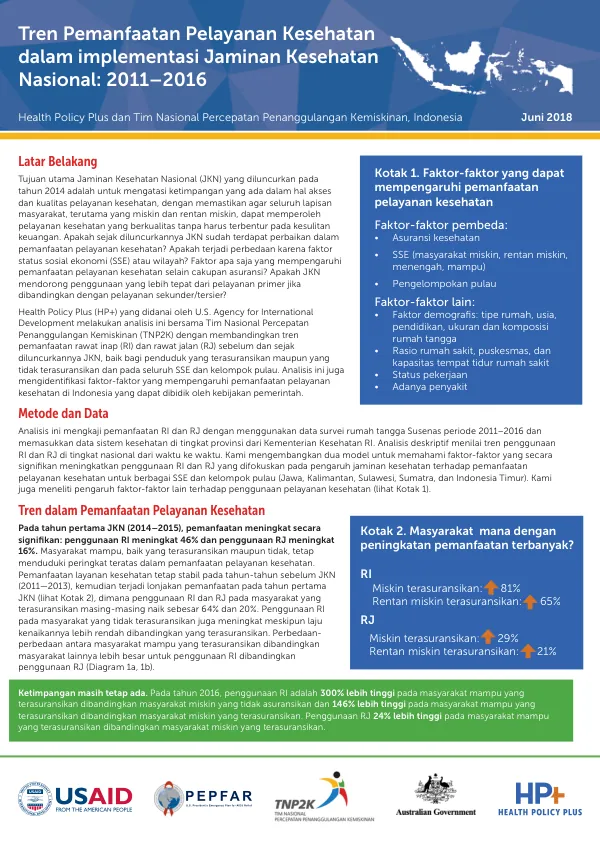
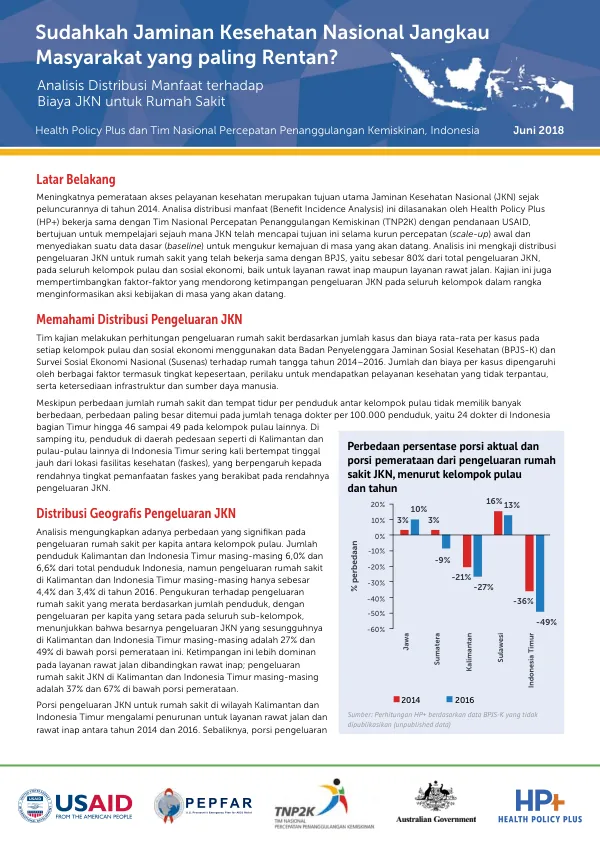
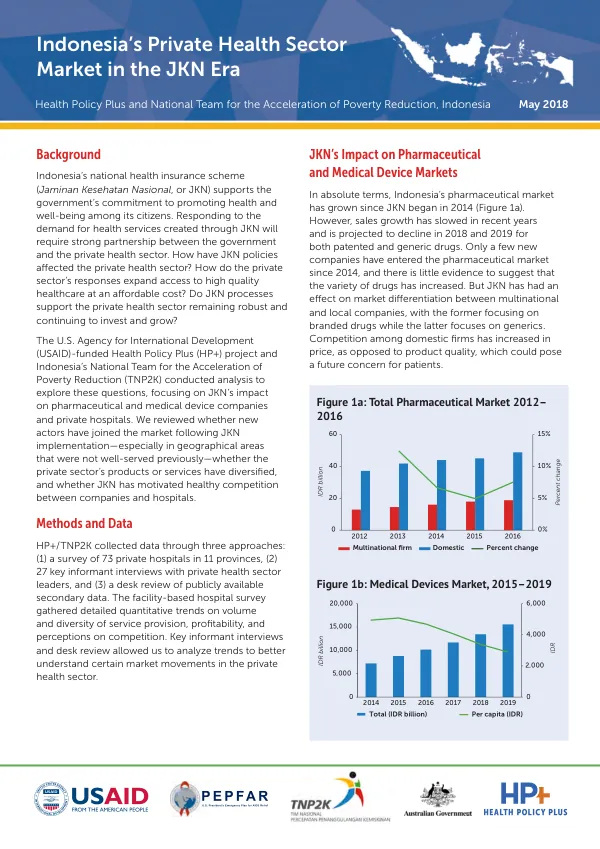
The scheme has made notable progress in increasing enrollment in just a few short years, covering 221 million people, or 83 percent of the country's population as of May 2019. The government is committed to ensuring JKN's ongoing sustainability and having a positive impact on health outcomes, financial protection, health equity, and on the health market and economy in general. The JKN scheme is designed to provide comprehensive health insurance coverage to all Indonesian citizens, with the government committed to ensuring that the scheme is managed sustainably. However, the scheme's annual financial deficits have increased, and its stability is receiving more attention. As JKN continues to scale up toward universal insurance coverage, critical policy decisions are required to increase revenue, rationalize healthcare expenditure, and project any future deficits to ensure the scheme is managed sustainably. The JKN scheme is governed by the National Social Security Council (Dewan Jaminan Sosial Nasional or DJSN), which is responsible for setting the scheme's policies and regulations. The scheme's design features include a single-payer model, where the government is responsible for paying healthcare providers on behalf of beneficiaries. The scheme also includes a range of benefits, including inpatient and outpatient care, as well as preventive and curative services. The JKN scheme has made significant progress in increasing enrollment, with the number of beneficiaries increasing from 100 million in 2014 to 221 million in 2019. The scheme has also made significant progress in reducing out-of-pocket expenditure, with the proportion of out-of-pocket expenditure decreasing from 35% in 2014 to 25% in 2019. However, the JKN scheme faces significant challenges in terms of financial sustainability. The scheme's annual financial deficits have increased, and its stability is receiving more attention. The scheme's revenue is primarily generated through contributions from employers and employees, as well as government subsidies. However, the scheme's expenditure has increased significantly, driven by rising healthcare costs and increasing demand for healthcare services. To address the challenges facing the JKN scheme, the government and partners are evaluating the results of the scheme after more than four years of implementation. The evaluation is focusing on key areas, including revenue, expenditure, and financial sustainability. The evaluation is also examining the scheme's governance arrangements, including the role of the National Social Security Council and the scheme's design features. The evaluation has identified several key trends and challenges facing the JKN scheme. These include increasing revenue and expenditure, rising healthcare costs, and increasing demand for healthcare services. The evaluation has also identified several key policy actions that can be taken to improve the scheme's financial sustainability, including increasing revenue, rationalizing healthcare expenditure, and improving the scheme's governance arrangements. The JKN scheme is a critical component of Indonesia's healthcare system, providing comprehensive health insurance coverage to all Indonesian citizens. The scheme's financial sustainability is critical to ensuring that the scheme continues to provide high-quality healthcare services to beneficiaries. The government and partners are working together to address the challenges facing the scheme and ensure its long-term sustainability.