GOVERNMENT OF BANGLADESH
Disaster Risk Reduction in South Asia
The Office of U.S.
2012 · 2 pages
Sign in to readA free account is required to download.
Abstract
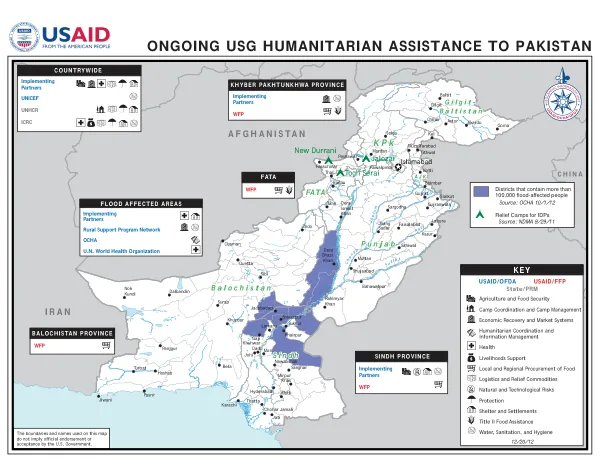
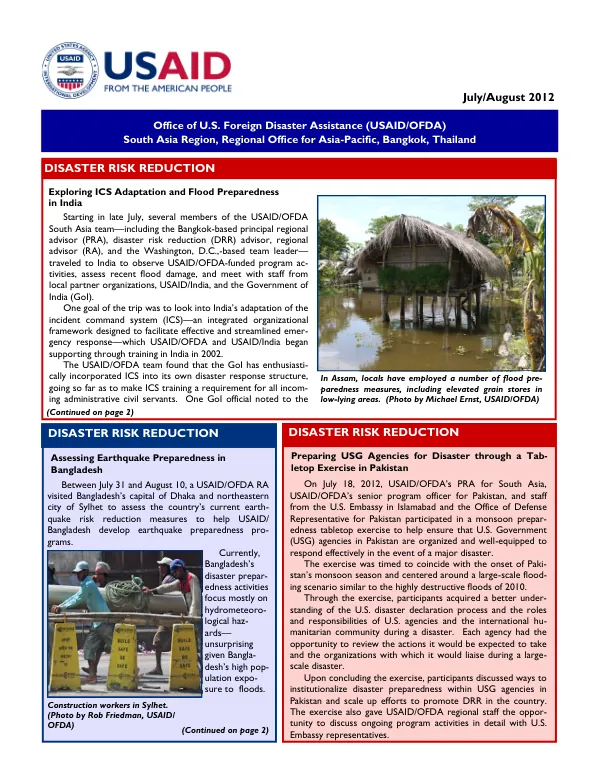
Foreign Disaster Assistance (USAID/OFDA) Regional Office for Asia-Pacific in Bangkok, Thailand, conducted a series of assessments and exercises in July and August 2012 to evaluate disaster risk reduction efforts in South Asia. A tabletop exercise was held on July 18, 2012, to prepare U.S. Government agencies in Pakistan for a major disaster, specifically a large-scale flooding scenario similar to the 2010 floods. The exercise aimed to ensure that U.S. agencies were organized and equipped to respond effectively in the event of a disaster. The exercise involved participants from USAID/OFDA, the U.S. Embassy in Islamabad, and the Office of Defense Representative for Pakistan. Through the exercise, participants gained a better understanding of the U.S. disaster declaration process and the roles and responsibilities of U.S. agencies and the international humanitarian community during a disaster. Each agency had the opportunity to review the actions it would be expected to take and the organizations with which it would liaise during a large-scale disaster. In Bangladesh, a USAID/OFDA Regional Advisor (RA) visited the capital city of Dhaka and the northeastern city of Sylhet to assess the country's current earthquake risk reduction measures. Bangladesh's disaster preparedness activities primarily focus on hydrometeorological hazards, given the country's high population exposure to floods. However, the country also faces a significant risk of earthquakes due to its location on the northeastern edge of the Indian tectonic plate. The USAID/OFDA RA met with representatives from local disaster response agencies, non-governmental organizations, academia, international organizations, and international donors to gather information on Bangladesh's seismic profile and vulnerabilities. The RA catalogued the Government of Bangladesh's earthquake risk reduction efforts over the past several years and identified critical areas for improvement. USAID/OFDA plans to continue tracking the Government of Bangladesh's efforts to improve earthquake preparedness and work with USAID/Bangladesh to build on these activities. In India, a USAID/OFDA team visited the eastern state of Assam to observe USAID/OFDA-funded program activities, assess recent flood damage, and meet with staff from local partner organizations, USAID/India, and the Government of India. The team found that the Government of India has enthusiastically incorporated the incident command system (ICS) into its disaster response structure, making ICS training a requirement for all incoming administrative civil servants. The team also observed effective coping mechanisms developed by people in Assam, such as storing grain in elevated buildings and moving livestock to higher ground at the first sign of flooding. The USAID/OFDA team also spent time in the eastern state of Assam, where often deadly monsoon flooding affects residents each year. The team found that over many years of recurrent flooding, people in Assam have developed effective coping mechanisms, such as storing grain in elevated buildings and moving livestock to higher ground at the first sign of flooding. In addition, many local organizations are developing innovative techniques to facilitate flood recovery, such as cultivating algae that improve post-flood soil fertility when applied to affected croplands. In Pakistan, USAID/OFDA has championed a community-focused approach throughout its portfolio, supporting programs aimed at supporting emergency needs while reducing the risk of future disasters. Through an implementing partner, USAID/OFDA has supported the training of community disaster management committees and teachers on disaster risk reduction and management. As of early August 2012, the partner organization had trained more than 14,800 people in disaster preparedness, mitigation, and management, assisted in the development of nearly 125 community disaster risk reduction plans, and organized 11 disaster response and recovery advocacy events. The Bahaal project, supported by USAID/OFDA, aimed to provide critical support to people affected by the 2010 floods through the Rural Support Programs Network. By August 2012, the Bahaal implementing partner had established nearly 400 community organizations working together to rebuild local infrastructure, mobilized more than 5,060 households to hundreds of worksites, and provided much-needed equipment and cash grants to help families replace lost assets, rehabilitate homes, and invest in income generation activities, with priority given to the most vulnerable people, including women.
Related documents