ICRC
Ongoing USG Humanitarian Assistance to Pakistan
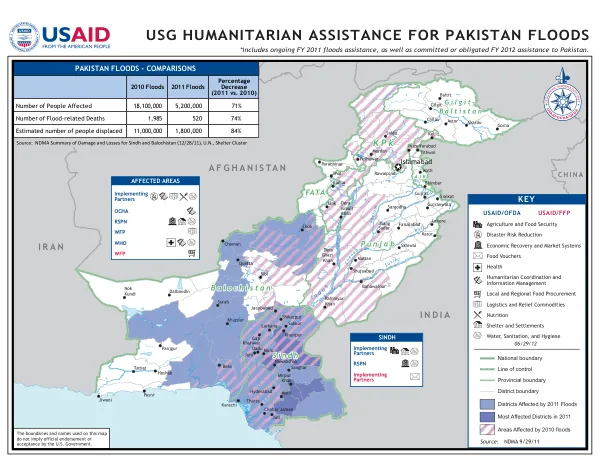
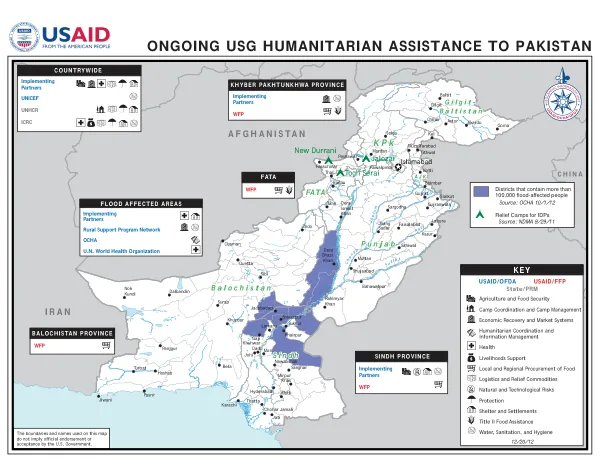
Pakistan's flood-affected areas span across several provinces, including Khyber Pakhtunkhwa, Balochistan, and Sindh.
2012 · 1 pages
Sign in to readA free account is required to download.
Abstract
The provinces of Punjab and FATA are also significantly impacted. The districts of Jacobabad, Shikarpur, and Larkana in Sindh, as well as the districts of Dera Ismail Khan, Tank, and Mardan in Khyber Pakhtunkhwa, contain more than 100,000 flood-affected people. Relief camps for internally displaced persons (IDPs) have been established in various districts, including those in Sindh, Balochistan, and Khyber Pakhtunkhwa. The Rural Support Program Network, OCHA, and the U.N. World Health Organization are among the implementing partners providing humanitarian assistance in these areas. The U.S. Government's humanitarian assistance to Pakistan is ongoing, with support from USAID/OFDA, USAID/FFP, and State/PRM. The assistance focuses on various sectors, including agriculture and food security, camp coordination and camp management, economic recovery and market systems, and shelter and settlements. Key implementing partners involved in the humanitarian response include UNICEF, UNHCR, ICRC, ACDaG I, and IaG DaG IJ. The sectors of agriculture and food security, camp coordination and camp management, economic recovery and market systems, humanitarian coordination and information management, health, livelihoods support, local and regional procurement of food, logistics and relief commodities, natural and technological risks, protection, shelter and settlements, title II food assistance, and water, sanitation, and hygiene are being addressed through this assistance. The humanitarian response is being coordinated by the National Disaster Management Authority (NDMA) and the Office for the Coordination of Humanitarian Affairs (OCHA). The boundaries and names used on the map do not imply official endorsement or acceptance by the U.S. Government.
Related documents