BRAC INTERNATIONAL
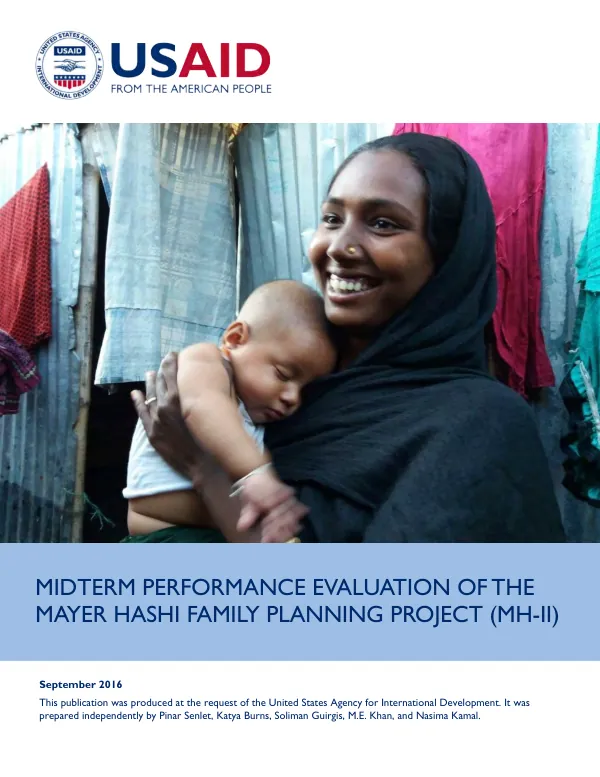
Midterm Performance Evaluation of the Mayer Hashi Family Planning Project (MH-II)
The Mayer Hashi Family Planning Project (MH-II) is a USAID-funded initiative aimed at improving family planning services in Bangladesh.
2016 · 109 pages
Sign in to readA free account is required to download.
Abstract
The project began in October 2013 and is scheduled to conclude in December 2015. The project's primary objective is to increase access to modern family planning methods, particularly for marginalized groups such as garment workers and rural communities. The project's development problem is rooted in the country's high total fertility rate and low contraceptive prevalence rate. According to the Bangladesh Demographic Health Survey (2011 and 2014), the country's total fertility rate is 2.3 children per woman, while the contraceptive prevalence rate is 58.4%. The project aims to address these challenges by increasing access to family planning services, particularly for marginalized groups. The evaluation team used a mixed-methods approach to assess the project's performance. The team collected data from various sources, including facility observations, focus group discussions, and interviews with project beneficiaries and stakeholders. The evaluation questions focused on the project's impact on family planning service delivery, provider capacity, and client satisfaction. The findings indicate that the project has made significant progress in increasing access to family planning services. The couple years of protection (CYP) for laparoscopic assisted partial salpingectomy (LAPM) and injectables has increased from 27 months before the project began to 27 months of project implementation in the 38 MH-II districts. The project has also trained over 2,000 providers in family planning clinical skills, with a significant increase in the number of providers trained in the last 12 months. The project has also made progress in increasing access to family planning services for marginalized groups. The number of garment workers referred to family planning services has increased significantly, with over 10,000 workers receiving LAPMs or injectables between October 2014 and December 2015. The project has also established partnerships with key stakeholders, including the Bangladesh Garment Manufacturers and Exporters Association (BGMEA) and the Family Planning Association of Bangladesh (FPAB). The evaluation team recommends that the project continue to focus on increasing access to family planning services, particularly for marginalized groups. The team also recommends that the project strengthen its partnerships with key stakeholders and continue to provide training and capacity-building support to providers. The project's geographic focus is on the 38 districts of Bangladesh, with a particular emphasis on rural areas and marginalized communities. The project's implementation details include the establishment of a network of family planning service providers, the provision of training and capacity-building support to providers, and the establishment of partnerships with key stakeholders. The project's timeframes are from October 2013 to December 2015, with a midterm evaluation conducted in September 2016. The evaluation team recommends that the project continue to focus on increasing access to family planning services, particularly for marginalized groups, and that the project strengthen its partnerships with key stakeholders.
Related documents