USAID DEC
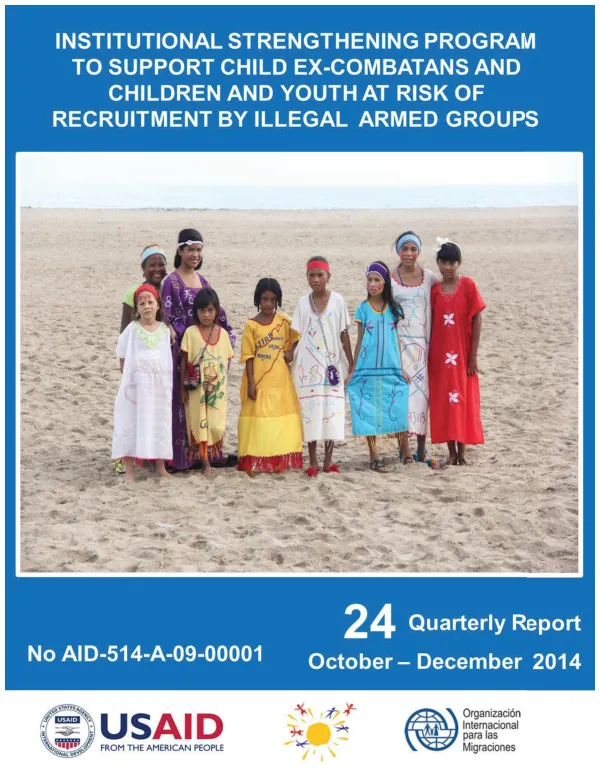
Disengaged Child Soldiers and Adolescents at Risk of Recruitment Program (CHS) Quarterly Report No. 24
Sign inGOVERNMENT OF COLOMBIA
Disengaged Child Soldiers and Adolescents at Risk of Recruitment Program (CHS) Quarterly Report No. 24
The Disengaged Child Soldiers and Youth at Risk of Recruitment Program (CHS) aims to strengthen the capacity of the Government of Colombia (GOC) to assist disengaged child soldiers and youth at risk.
2014 · 41 pages
Sign in to readA free account is required to download.
Abstract
Four intermediate results contribute to the achievement of this objective: IR 1, IR 2, IR 3, and IR 4. IR 1 focuses on the Colombian Family Welfare Institute (ICBF) implementing policies for disengaged child soldiers, while IR 2 involves the GOC implementing policies to reduce vulnerabilities to recruitment in high-risk areas. IR 3 centers on ICBF and the Inter-Sectoral Commission on the Prevention of Recruitment and Use of Child Soldiers (CIPRUNA) improving knowledge management. During the quarter, significant progress was achieved under the results framework established in the Work Plan and Performance Management Plan. Assistance efforts focused on technical assistance for ICBF for the reestablishment of rights and specialized assistance for disengaged children and adolescents (CH&A). CHS also established a goal to promote a greater participation and visibility of disengaged CH&A and other CH&A victims. Two socio-familiar and community-based assistance models were developed and implemented during the quarter, one for indigenous groups and one for women victims. A total of 403 CH&A disengaged from illegal armed groups (IAG) enrolled in the ICBF Assistance Program during the quarter, achieving 81% of the established target. Prevention activities focused on strengthening prevention plans in 58 targeted municipalities. CHS continued to monitor implementation of prevention plans and finalized monitoring of implementation of 43 prevention plans developed in FY 2013. A joint work road plan was developed with CIPRUNA's Technical Secretariat to plan for the monitoring activities for the remaining 15 municipalities. Local-level actions were developed to strengthen local institutions and promote greater inclusion of the issue of recruitment prevention within the agendas of local governments. Peace pedagogy activities included the conclusion of CHS support for the Latin American Biennial on Children and Youth. Three regional analyses on the situation of children and youth in peace process were shared in the departments of Cauca, Tolima, and Valle de Cauca, with the participation of around 40 people. CHS supported the sustainability of the PAZ-OS project development tool by complementing it with a survey. The CHS program has made significant progress in assisting disengaged child soldiers and youth at risk. The program has achieved 81% of the established target for enrolling CH&A in the ICBF Assistance Program. Prevention activities have focused on strengthening prevention plans in 58 targeted municipalities, and peace pedagogy activities have included the conclusion of CHS support for the Latin American Biennial on Children and Youth. The program continues to work towards achieving its objective of strengthening the capacity of the GOC to assist disengaged child soldiers and youth at risk. The Colombian Family Welfare Institute (ICBF) has implemented policies for disengaged child soldiers, including the development and implementation of socio-familiar and community-based assistance models. The GOC has implemented policies to reduce vulnerabilities to recruitment in high-risk areas, including the strengthening of prevention plans in 58 targeted municipalities. ICBF and CIPRUNA have improved knowledge management, including the conclusion of CHS support for the Latin American Biennial on Children and Youth and the sharing of regional analyses on the situation of children and youth in peace process.