USAID DEC
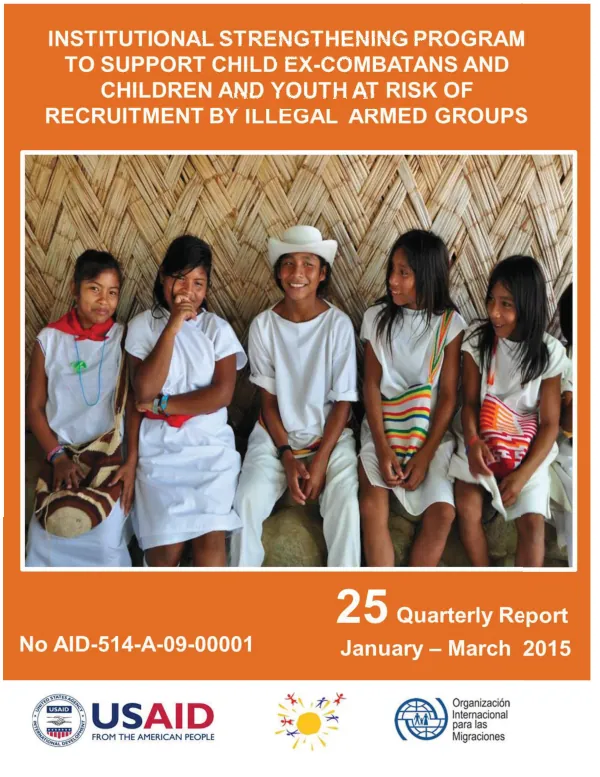
Disengaged Children and Youth at Risk of Recruitment Program Quarterly Report No. 25 January – March 2015
Sign inGOVERNMENT OF COLOMBIA
Disengaged Children and Youth at Risk of Recruitment Program Quarterly Report No. 25 January – March 2015
The Disengaged Children and Youth at Risk of Recruitment Program is a quarterly report that provides an update on the progress made by the Government of Colombia (GOC) in assisting disengaged child soldiers and youth at risk of recruitment.
2015 · 37 pages
Sign in to readA free account is required to download.
Abstract
The report covers the period from January to March 2015 and presents the key achievements, progress, and activities carried out during this quarter. The program's strategic objective is to strengthen the capacity of the GOC to assist disengaged child soldiers and youth at risk. Four intermediate results (IR) contribute to the achievement of this objective: IR 1, IR 2, IR 3, and IR 4. IR 1 focuses on the Colombian Family Welfare Institute (ICBF) implementing policies for disengaged child soldiers, while IR 2 involves the GOC implementing policies to reduce vulnerabilities to recruitment in high-risk areas. IR 3 aims to improve knowledge management through the collaboration of ICBF and the Inter-Sectoral Commission on the Prevention of Recruitment and Use of Child Soldiers (CIPRUNA). IR 4 focuses on monitoring, tracking, and knowledge management. During the quarter, significant progress was made in achieving IR 1. Assistance efforts focused on developing a joint work plan in coordination with the ICBF Protection Directorate technical team and the Reestablishment of Rights Sub-Directorate and the National System for Family Welfare (SNBF). This new work plan will conclude some actions from the 2014 USAID Work Plan and will also implement a series of new strategies to strengthen the ICBF Assistance Program for disengaged CH&A, to strengthen community-based reintegration efforts (based on social inclusion), and to promote participation processes for CH&A victims of the armed conflict. Progress was also made on community-based models in Norte del Cauca (indigenous model) and Bogotá (urban model). The Meta, Caquetá, and Antioquia regions were targeted to create and implement new socio-familiar and community-based models. A joint work plan was established with the Victims Unit. A total of 59 children and adolescents (CH&A) were assisted through the ICBF Assistance Program, with 35 of them being reintegrated into their communities. The report also highlights the progress made in achieving IR 2, IR 3, and IR 4. The GOC implemented policies to reduce vulnerabilities to recruitment in high-risk areas, while ICBF and CIPRUNA improved knowledge management through the development of a joint work plan. Monitoring, tracking, and knowledge management were also strengthened through the implementation of new strategies and the creation of new socio-familiar and community-based models. The report concludes by highlighting the challenges encountered and the actions taken to address them. The priorities for the next quarter are also outlined, including the continuation of the joint work plan with the Victims Unit and the implementation of new strategies to strengthen the ICBF Assistance Program for disengaged CH&A. The report ends by emphasizing the importance of continued support for the program to achieve its strategic objective of strengthening the capacity of the GOC to assist disengaged child soldiers and youth at risk of recruitment.