USAID DEC
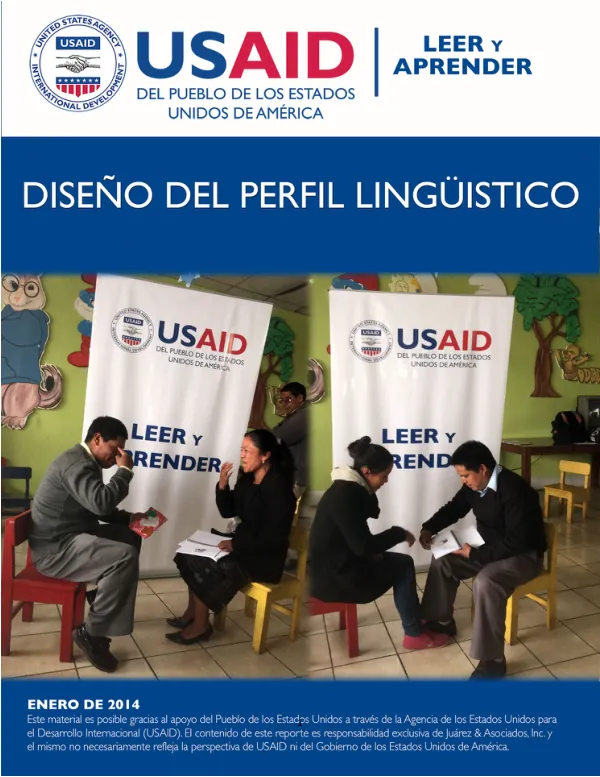
Diseño del Perfil Lingüístico para Estudiantes de Preprimaria y Primaria en Contextos Bilingües
Sign inJUÁREZ Y ASOCIADOS, INC.
Diseño del Perfil Lingüístico para Estudiantes de Preprimaria y Primaria en Contextos Bilingües
The USAID Leer y Aprender project aims to establish the linguistic profile of students entering school in Guatemala.
2015 · 15 pages
Sign in to readA free account is required to download.
Abstract
The project recognizes the importance of determining the linguistic profile of students to utilize their native language, whether Spanish or a Mayan language (K'iche' or Mam), in the teaching-learning process. The project promotes the practice of establishing the linguistic profile of students in schools in the K'iche' and Mam linguistic areas in seven and five municipalities, respectively. The linguistic profile of students is determined through a diagnostic evaluation that includes an interview with parents and students, as well as a diagnostic evaluation of the student. The evaluation is designed to determine the level of oral dominance in Spanish and the Mayan language (Mam or K'iche') of students entering pre-primary and first-grade education. This information will allow teachers to orient their planning in terms of bilingual teaching and, primarily, the development and learning of reading and writing. The diagnostic evaluation is a two-stage process. The first stage involves piloting the application of the evaluation to infer its validity for the purpose for which it was constructed. The second stage involves refining the evaluation to create linguistic profiles dominant in the classroom. This will allow teachers to use the appropriate modality for the development of reading and writing in L1 and L2 with their students. The construct to be evaluated is the oral dominance in K'iche', Mam, or Spanish of students entering pre-primary and first-grade education in bilingual contexts (Mayan languages/Spanish). The construct to be evaluated is linguistic competence, which includes the following sub-constructs and dimensions. Interacción oral (oral interaction) includes the following sub-constructs and dimensions: * Comprende y responde a preguntas relacionadas consigo mismo y su entorno (understands and responds to questions related to themselves and their environment). * Comprensión oral y seguimiento de instrucciones (oral comprehension and following instructions). * Precisión léxica (lexical precision). * Producción léxica (lexical production). * Fonología o pronunciación correcta (phonology or correct pronunciation). * Gramática (grammar). * Expresión oral (oral expression). The diagnostic evaluation consists of seven series, each with a specific number of items. The first and second series consist of 5 items each and are intended to approach the student, knowing if the student understands what is asked and if they can follow instructions in the language. The second and third series, precision léxica and producción léxica, consist of 28 items in total and are related to vocabulary. The fifth series deals with knowing the phonology or correct pronunciation of sounds specific to the Spanish language and emphasizes vowels at the end of words, especially the sounds a, e, and o, as well as consonants such as f, g, d, and ñ. A minimum of three items are developed for each of these aspects. The sixth series, gramática, consists of 12 items in total and deals with identifying the domain of expressions that mark gender and number. The seventh series, expresión oral, consists of 10 items and deals with expressing fluidly a sustained monologue, narrating coherently a story based on visual stimuli, and expressing orally using the basic/logical order of the language (idioms Mayans: verb, object, subject; Spanish: subject, verb, complements) in a context.
Related documents