JUÁREZ Y ASOCIADOS, INC.
Primer Informe Trimestral FY2021: Leer y Aprender de USAID
The Lifelong Learning (LLL) Project, implemented by USAID in Guatemala, aims to improve reading outcomes and increase educational access for children and indigenous youth aged 15 to 24 who are out-of-school.
2021 · 25 pages
Sign in to readA free account is required to download.
Abstract
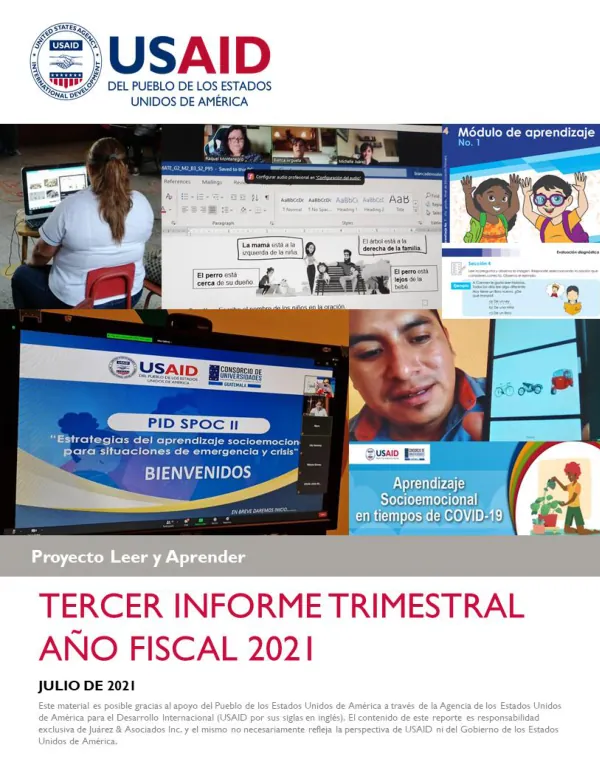
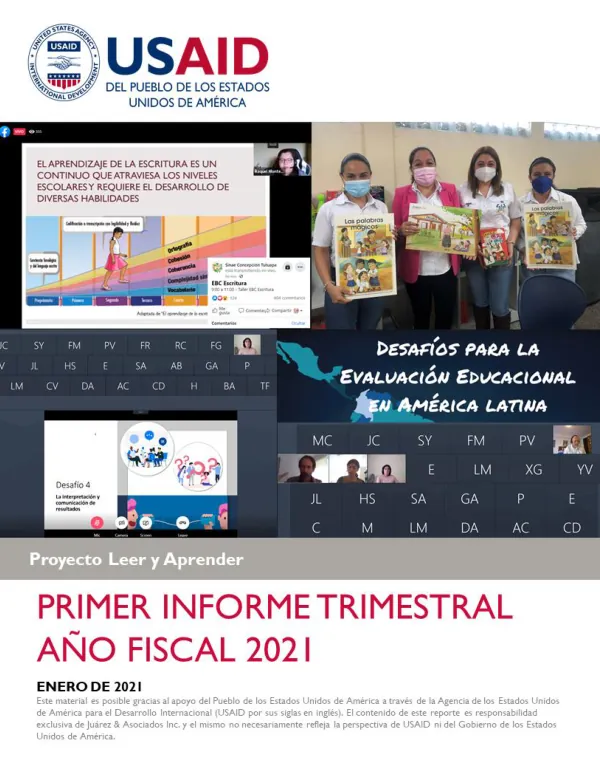
The project's objective is to ensure access to quality education for this vulnerable population. During the first quarter of FY2021, the project focused on supporting the Ministry of Education (MOE) in designing and implementing the educational response to the COVID-19 pandemic. The project maintained close communication with MOE to establish needs and priority requirements for technical assistance due to the closure and start of the school year, the educational system's adaptation to a hybrid modality of face-to-face and distance education, and the implementation of prevention and health safety measures protocols. The project worked in collaboration with staff from various MOE directorates, including the Directorates for Educational Evaluation and Research, Alternative Education, Educational Quality Management, Curriculum, Bilingual Education, Quality Monitoring and Verification, and the Technical Bureau Emergency Care Management of COVID-19. The project also supported the National Educational Coaching System and Departmental Educational Directorates. As part of Component I: Response and Recovery, the project planned and designed the "Safe Back to School" communication campaign and prepared conditions to disseminate and implement protocols once they were published by MOE. The project also designed and coordinated training and coaching processes for the National Educational Coaching System staff to be implemented in the next quarter. The project provided virtual training spaces for pedagogical advisors, teachers, and school principals of the Dideduc of Quiché and San Marcos, mainly in topics of reading comprehension strategies and the use of formative assessment tools in writing. An analysis of international curricular frameworks and the national curriculum was conducted, identifying priority learnings in reading, writing, and mathematics. These prioritized learnings are being used for technical assistance in the design and development of diagnostic assessments and to generate curriculum alignment tools. Component II: Preparation and planning activities included training in the use of Bloom software for the design and production of new reading resources and the beginning of development processes of digital dictionaries in Q'eqchi', Kaqchikel, and Q'anjbo'al, as well as other Mayan languages. The project also defined broad lines of support for updating and adapting guidelines for the Adult Correspondence Education Program and the Flexible Modalities Program from the Alternative Education System. The project proposed a design of a national diagnostic assessment of students' learning, to be given to students at the start of the 2021 school year. This diagnostic assessment will provide information for teachers' pedagogical planning and contribute to efforts to recover lost learning, part of the MOE intervention to solve the lost and delays in learning that most students have suffered during the pandemic. At the end of December 2020, grants were awarded to Funsepa and the Consortium of Universities for Teacher Training in Guatemala. The process involved approving technical proposals for the implementation of the communication campaign for a safe return to school and conditions preparation for the development of technical and teacher training proposals related to pedagogical activities during and after crisis and emergency situations. The project also carried out communication activities, including the development of a communication strategy and the dissemination of information through various channels. The project's performance indicators status is also presented in this report.
Related documents