USAID
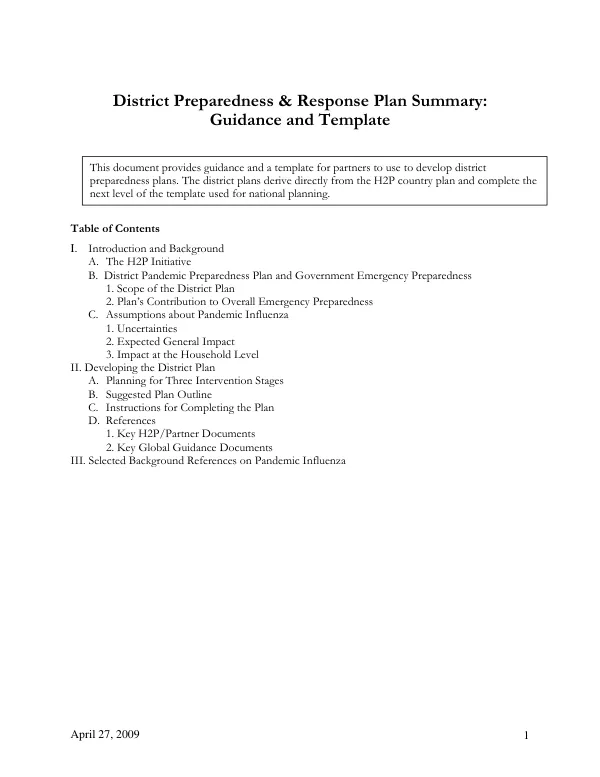
District Preparedness & Response Plan Summary: Guidance and Template
The H2P Initiative is a USAID-funded program that develops humanitarian response networks in preparation for pandemic influenza.
2009 · 18 pages
Sign in to readA free account is required to download.
Abstract
The initiative works within the framework of national emergency response and pandemic preparedness plans, building national, district, and community-level response capability to minimize excess morbidity and mortality and potential massive social disruption in the event of a pandemic. The initiative supports the incorporation of planning for pandemic influenza into national and district emergency preparedness plans and structures. District pandemic preparedness plans are guided by a tool that includes a brief overview of the need and process for planning as well as a matrix to guide specific planning steps. The tool suggests that the district plan consider all sections in the matrix, taking out or including activities according to the local context need. District planners may not see planning for a hypothetical pandemic as a priority, but developing the district plan within the context of overall emergency preparedness can help support general district resilience to emergencies, strengthening of collective response to various threats, good hygiene practices, food security practices, practices that help secure livelihoods and family income, effective coalitions for non-pandemic humanitarian and development initiatives, and application of models and techniques to other emergency preparedness planning. Scientists are predicting that the world will experience an influenza pandemic within the next several years, with many uncertainties about pandemic influenza. The exact arrival time, length, and severity of the next pandemic are not known, and it is unclear to what extent current antiviral drugs, vaccines, and antibiotics will be effective against the new virus or available to all those that need them. The district planning document assumes that once the pandemic starts, geographical spread will be rapid, and time for final planning and preparations will be limited to a few weeks at most. Virtually all communities on earth will experience outbreaks, with roughly 1 person in three in the world becoming ill during a period of up to approximately 1 ½ years. Communities will experience one to three outbreaks of 6–12 weeks duration each, and the pandemic will cause many deaths, with at least 2 of 100 people infected dying from it. The pandemic will have a significant impact at the household level, with at least one family member contracting the disease, and many families in which all potential care givers are ill at the same time. Because of reductions in movement/transportation, many people will be confined at home during peak infection waves due to illness, the need to care for the ill, fear, or governmental restrictions on movement. Children will be out of school for extended periods of time, and most families will not be able to count on hospital-level health care, even for severe cases. The country and district planning processes focus on three intervention stages: preparedness, roll-out, and local response. Preparedness involves comprehensive planning and assignment of responsibilities, development and testing of national training packages and communication plans, and stockpiling of drugs, supplies, and food. Roll-out occurs when the World Health Organization announces sustained human-to-human transmission anywhere in the world, and involves the immediate, urgent, and rapid rollout at scale of H2P interventions listed in the attached matrix. Local response occurs when there is a cluster of cases in a geographic area in or near the district/area, and involves activities in each H2P-supported district, as listed in the district plan matrix. The district plan should include designated names and/or roles of authorities responsible for the implementation of all activities required to organize, coordinate, and execute the district plan. The plan should also include a clear description of how the district plan relates to government plans, what interaction has taken place with government to decide on respective roles, and the extent of government endorsement of the H2P plan.
Related documents