UNITED NATIONS CHILDREN'S FUND
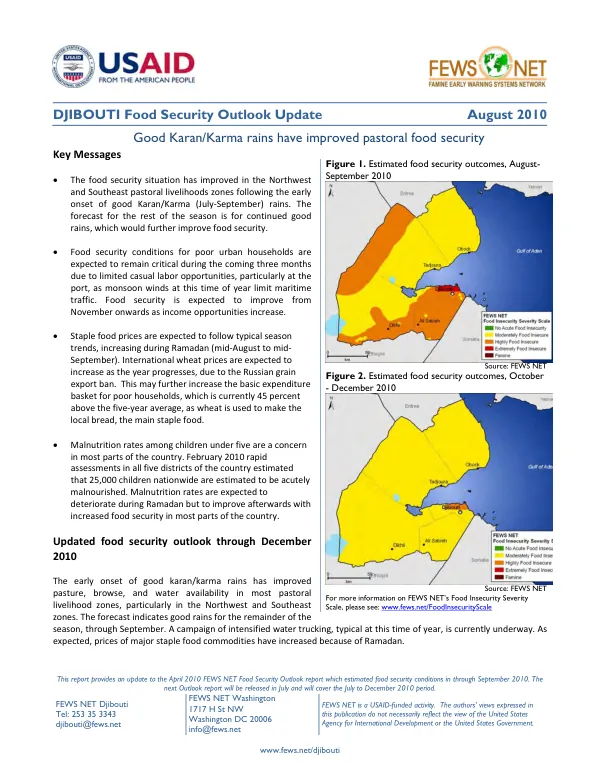
DJIBOUTI Food Security Outlook Update
The food security situation in Djibouti has improved in the Northwest and Southeast pastoral livelihood zones following the early onset of good Karan/Karma rains.
2010 · 3 pages
Sign in to readA free account is required to download.
Abstract
The forecast for the remainder of the season indicates continued good rains, which would further improve food security. Pasture, browse, and water availability have improved in most pastoral livelihood zones, particularly in the Northwest and Southeast zones. In the Northwest pastoral livelihood zone, good rains have led to substantial improvements in pasture and water availability, and livestock value and productivity. Prices of cereals are stable throughout the zone due to the availability of relief food distributions. However, pastoralists are still recovering from several seasons of previous failed rains, which caused substantial declines in livestock holdings. The zone has relatively tenuous links to Djibouti city, and the economy is more closely tied to neighboring Ethiopia. Access to urban markets is poor, and few households receive remittances from urban areas. In the Southeast pastoral livelihood zone, pastoralists have relatively good road and rail access to urban markets in Djibouti. Many households sell milk, wood, and charcoal along the roadside for sale in Djibouti city, Arta, Ali-sabieh, and Dikhil. During July, rains were above normal in the eastern part of this zone, while the western part received normal rains. These good rains improved pasture, browse, and water availability, which in turn improved animal body conditions. Although a substantial improvement in milk production due to the good rains has been observed in this zone, demand is low as most buyers have left the country, as typically occurs at this time of year. Therefore, income from milk has declined in line with seasonal trends. Households are unable to meet basic food needs and currently depend on external food assistance. The performance of the Karan/Karma rains for the remainder of the season is expected to be normal to above normal, leading to improvements in pasture, browse, and water availability. Animal body conditions and livestock prices are expected to improve, leading to good pastoralist terms of trade from September onwards. However, improvements in terms of income and food sources from animals are not expected to improve until September when kidding of goats will occur. Therefore, the food security situation during October to December will improve from highly to moderately food insecure. Pastoralists in the Central livelihood zone depend mostly on urban employment, pensions, and remittances. Income from livestock is very limited in the zone. Remittances, which are the main source of income for poor pastoralists, are now below average as most urban dwellers are currently outside of the country. Furthermore, the month of Ramadan has affected urban households' ability to provide remittances to families in rural areas as the cost of living for the month of Ramadan is substantial. Wood cutting and charcoal production are reduced as active individuals keep activity levels low during the fasting period. Pension payments, however, are regular, allowing pastoralists in this zone to purchase their daily caloric needs. However, prices of staple foods are above average, while the income of households in this zone is limited; therefore, the purchasing power of poor households is limited. Income and food sources from animals have improved due to good rains during July, although food sources from livestock do not contribute much to daily caloric needs. Poor households in this zone are meeting basic food needs through external assistance. They are therefore moderately food insecure and will remain so through the end of the year. A substantial proportion of the population in urban areas live in relative poverty by local standards, and in extreme poverty by international standards, subsisting on less than 200 FD (about $US 1) per person per day. The main sources of income for these households are casual labor, petty trade, low-paid employment, and pensions. Casual labor opportunities are typically low at this time of year and are expected to remain so during the lean period (June-August), as most construction and port activities, the main source of income of poor urban households, decline during the hot season. Petty trade activity also declines as the majority of middle and better-off households leave the city during this time of year. The basic expenditure basket for poor households is currently 45 percent above the five-year average. Although staple food prices have been largely stable since last month, they remain 69 percent above the five-year average.
Related documents