USAID DEC
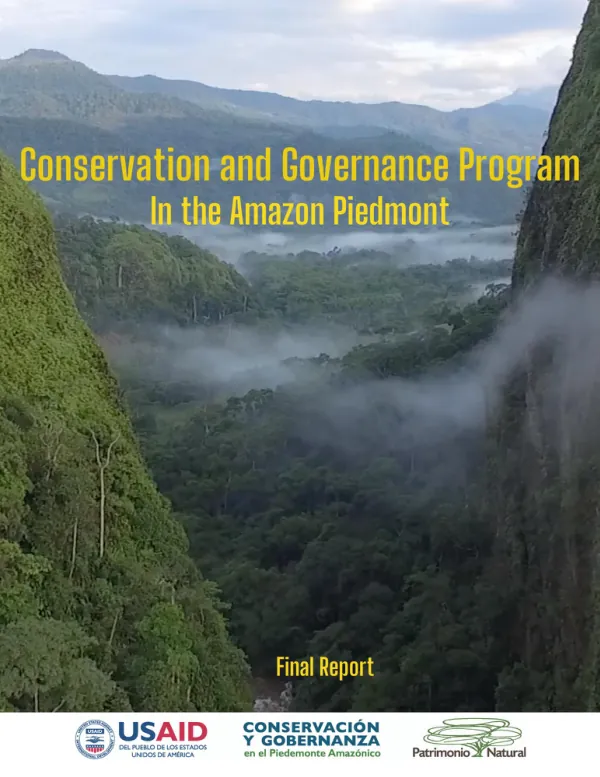
Conservation and Governance Program in the Amazon Piedmont Final Report – (2013 – 2020)
Sign inUSAID
Conservation and Governance Program in the Amazon Piedmont Final Report – (2013 – 2020)
The Conservation and Governance Program in the Amazon Piedmont was launched in 2013 by the Patrimonio Natural Fondo para la Diversidad y Áreas Protegidas (FPN) with funding from the United States Agency for International Development (USAID).
2020 · 121 pages
Sign in to readA free account is required to download.
Abstract
The program aimed to promote conservation and sustainable development in the Amazon Piedmont region of Colombia. The intervention area covered approximately 1.5 million hectares of land, including the departments of Caquetá, Putumayo, and Amazonas. The program's objective was to reduce deforestation and promote sustainable land-use practices, while also strengthening local institutions and improving the livelihoods of communities in the region. The program was implemented in three stages, with the first stage focusing on the establishment of a conservation and governance framework, the second stage on the implementation of conservation and sustainable development projects, and the third stage on the scaling up of successful initiatives. The program's components included the development of a management model for conservation and governance, the implementation of a monitoring and indicators plan, and the establishment of a community innovation model for conservation. The management model was based on the principles of institutional coordination and strengthening, scalability, strong social participation, landscape management, sustainable swaps, adaptive response capacity, economic incentives, and technical assistance. The program's stakeholders included local communities, indigenous peoples, farmers, and other interest groups, as well as government agencies and international organizations. The program's implementation involved the establishment of a network of community innovation laboratories, which served as platforms for community-led innovation and decision-making. The program's results included a reduction in deforestation rates, an increase in conservation incentives, and improved natural resource management. The program also supported the development of sustainable value chains for milk, coffee, cocoa, and agroforestry products, and established a community innovation model for conservation that promoted community-led innovation and decision-making. The program's environmental land management model included the implementation of payment for environmental services and other initiatives of economic incentives for conservation. The program also established a financial mechanism to support conservation efforts and developed land-use planning tools, including the Caquetá Soil and Water Conservation District (DCSAC) and the Use, Occupation, and Ownership (UOO) system. The program's impact was evaluated through a monitoring and indicators plan, which tracked progress against a set of indicators related to deforestation, conservation incentives, natural resource management, economic development, and policy strengthening. The program's results were presented in a series of reports and publications, which provided insights into the program's effectiveness and lessons learned. Overall, the Conservation and Governance Program in the Amazon Piedmont was a comprehensive initiative that promoted conservation and sustainable development in the Amazon Piedmont region of Colombia. The program's results demonstrated the effectiveness of a community-led approach to conservation and sustainable development, and provided insights into the importance of institutional coordination, scalability, and economic incentives in promoting conservation and sustainable development.
Related documents
Documents in this collection
 2020
2020USAID DEC
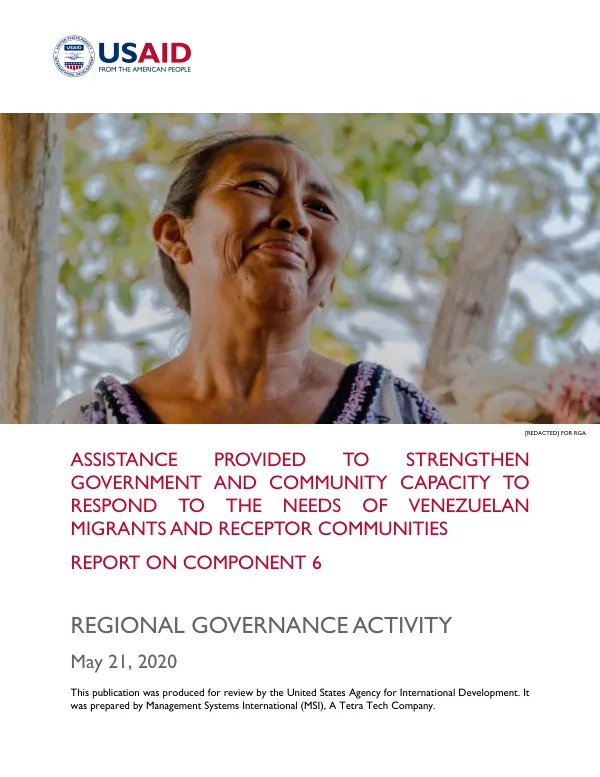
Assistance Provided to Strengthen Government and Community Capacity to Respond to the Needs of Venezuelan Migrants and Receptor Communities: Report on Component 6
Open record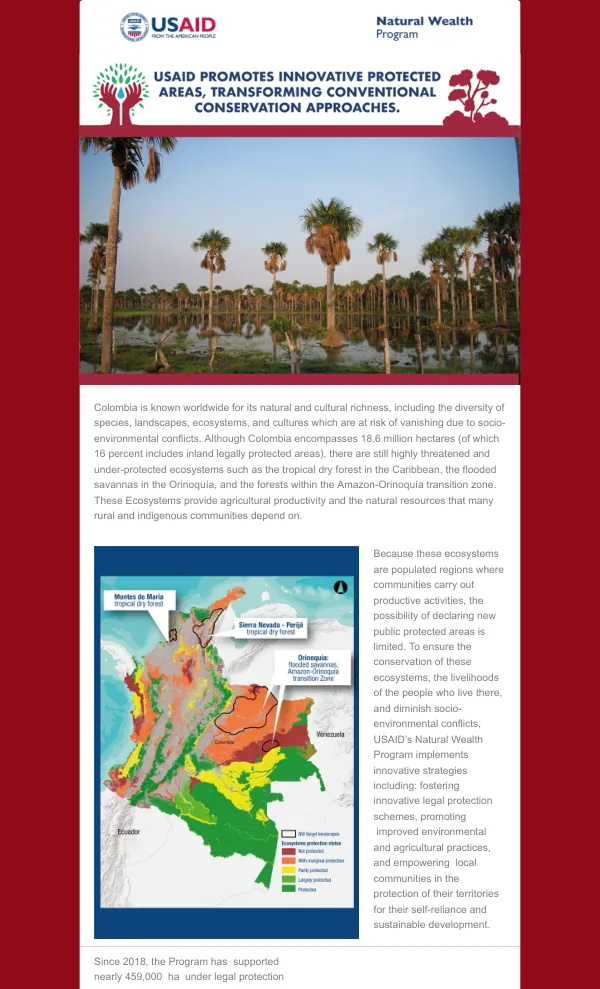 2020
2020USAID DEC
USAID's Natural Wealth Program: Innovative Strategies for Conservation and Sustainable Development in Colombia
Open record