JOHNS HOPKINS UNIVERSITY
Domestic Resource Mobilization for Health in Rwanda
The Ministry of Health Community Development Gender, Elderly and Children (MOHCDGEC) plays a crucial role in governing quality improvement in Tanzania's healthcare system.
2016 · 3 pages
Sign in to readA free account is required to download.
Abstract
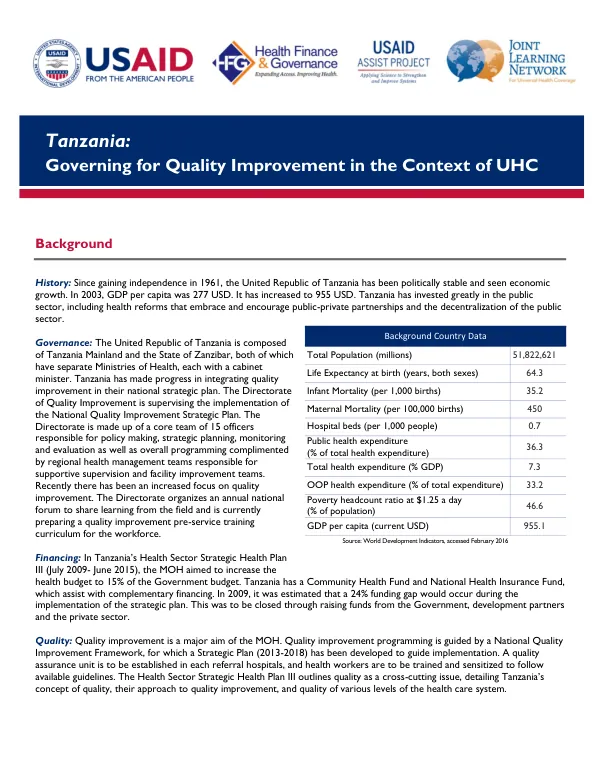
The MOHCDGEC is responsible for licensing and accrediting all public and private healthcare providers, with the Health Inspectorate Unit registering both public and private facilities. The Ministry of Education and Vocational Training is responsible for training and registering health workers, while the Medical Council of Tanganyika licenses and registers physicians, and the National Nurses and Midwifery Council registers nurses and midwives. The National Health Policy supports quality as an overarching goal of the MOHCDGEC, with the policy spearheaded by the MOHCDGEC. The Directorate of Quality Improvement, reporting directly to the Chief Medical Officer in the Ministry of Health, is responsible for policy making, strategic planning, monitoring, and evaluation, as well as overall programming. The Directorate is fairly active and made up of a core team of 15 officers, complemented by regional health management teams responsible for supportive supervision and facility improvement teams. The Tanzania Quality Improvement Framework 2011-2016 details a number of institutions involved in ensuring quality is infused into the leadership of healthcare in the country. The framework outlines the role of the Health Services Inspectorate Unit, the National Quality Improvement Committee, the Health Sector Reform Advocacy Unit, and the Health Education Unit of MOHCDGEC in ensuring quality improvement. Tanzania has made significant progress in integrating quality improvement into its national strategic plan. The Directorate of Quality Improvement is supervising the implementation of the National Quality Improvement Strategic Plan, which aims to improve the quality of healthcare services in the country. The Directorate organizes an annual national forum to share learning from the field and is currently preparing a quality improvement pre-service training curriculum for the workforce. The National Bureau of Statistics is working with Johns Hopkins University to create and house a National Evaluation Platform (NEP) to evaluate health and nutrition programs in Tanzania. The NEP aims to influence decision making at national and subnational levels, with the support of a High-Level Advisory Committee (HLAC). However, it is unclear whether data from the NEP will be made publicly available. Tanzania has a Community Health Fund and National Health Insurance Fund, which assist with complementary financing. The MOHCDGEC has established an Open Performance Review and Appraisal System for government employees, where one's salary is tied to quality and performance of job. In 2009, a pay for performance scheme was introduced for public providers in Tanzania, as a means to improving the quality of maternal, newborn, and child health services. The country's population is approximately 51.8 million, with a life expectancy at birth of 64.3 years and an infant mortality rate of 35.2 per 1,000 births. The maternal mortality rate is 450 per 100,000 births, and the hospital bed density is 0.7 per 1,000 people. Public health expenditure accounts for 36.3% of total health expenditure, while total health expenditure accounts for 7.3% of GDP. Out-of-pocket health expenditure accounts for 33.2% of total expenditure, and the poverty headcount ratio at $1.25 a day is 46.6% of the population.
Related documents
Documents in this collection
 2021
2021USAID DEC
Assessing the National System for Social Accountability in Health: Applying an Assessment Tool to Measure Maturity and Performance of National Social Accountability Systems in Health: Results of a Pilot Study in Rwanda and Malawi
Open record 2018
2018USAID DEC