FAMILY HEALTH INTERNATIONAL
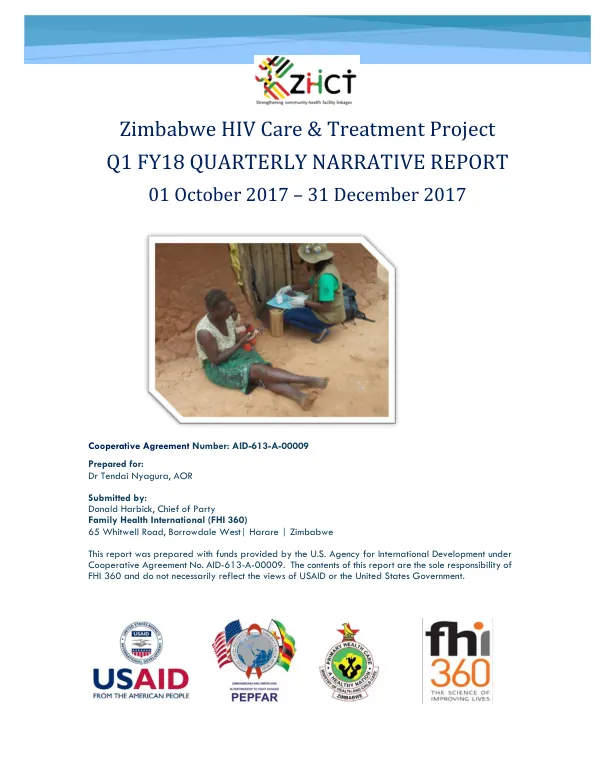
FY17 Semi-Annual Progress Report for the Zimbabwe HIV Care and Treatment Project
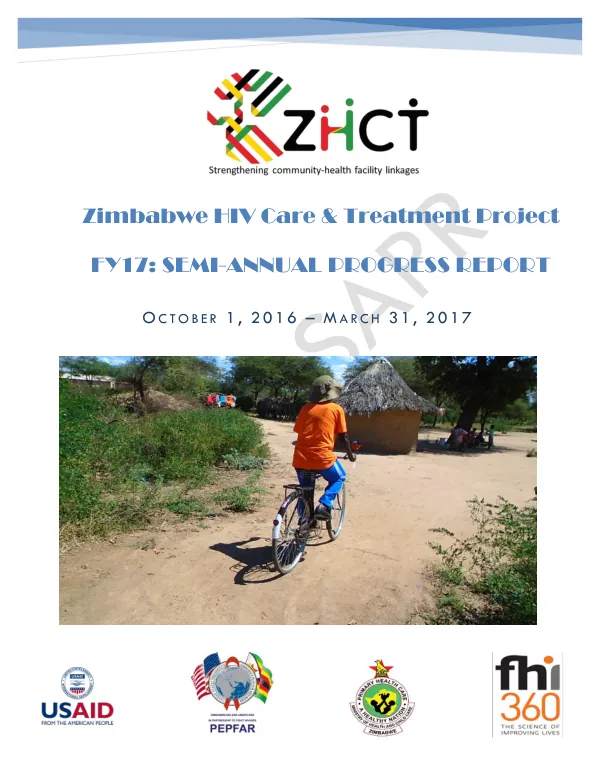
The Zimbabwe HIV Care and Treatment Project is a five-year initiative implemented by FHI 360 and its sub-awardee PLAN International, with funding from the United States Agency for International Development (USAID).
2017 · 20 pages
Sign in to readA free account is required to download.
Abstract
The project aims to strengthen health facility and community linkages for HIV care and treatment in Zimbabwe. The project's primary objective is to increase access to HIV testing, care, and treatment services, particularly among key and vulnerable populations. During the first half of FY17 (October 1, 2016 – March 31, 2017), the project achieved significant milestones in HIV testing services. A total of 10,460 people were tested and received their results, with 4215 newly identified PLHIV. The yield rate across the 10 districts was 40%, with Gokwe South and Kwekwe recording the highest rates at 64% and 59%, respectively. Of the newly diagnosed PLHIV, 65% were linked into care, and 87% were initiated on Antiretroviral Therapy (ART). Additionally, 90% of true ART defaulters were returned into care. The project also expanded into two districts in Masvingo province (Zaka and Gutu) in February 2017. Cumulatively, 5868 PLHIV are currently receiving ARVs through community ARV refill groups (CARGs). The project's laboratory services strengthening efforts resulted in the performance of 35,071 viral load tests. To address the challenges encountered during the period under review, including staff restructuring and incessant rains, the project implemented innovative strategies in the field. These strategies contributed to the high HIV testing yield rates achieved during the first half of FY17. In the remainder of FY17, FHI 360 will intensify efforts to close the gap on COP16 targets by implementing district-specific strategies for differentiated care. Additional locum nurses will be recruited and deployed to high target districts, and measures will be instituted to improve efficient management of available resources. The project's performance indicator summary highlights the following achievements: 4215 newly identified PLHIV, 40% yield rate, 2747 enrolled in care, 65% linkage rate, 2386 initiated on ART, and 5868 PLHIV receiving ARVs through CARGs. The project's laboratory services strengthening efforts resulted in the performance of 35,071 viral load tests. The project's challenges encountered during the period under review include staff restructuring and incessant rains. However, the project's innovative strategies in the field contributed to the high HIV testing yield rates achieved during the first half of FY17. The project's monitoring and evaluation efforts are ongoing, with a focus on generating evidence for other models of testing at community level, including self-testing and community ART initiation. The project's program, administrative, and operational management issues are being addressed through the implementation of district-specific strategies for differentiated care. Additional measures will be instituted to improve efficient management of available resources, including better fleet management, micro-planning at field level, and improved coordination of field activities. The project's sub-award management and monitoring efforts are ongoing, with a focus on ensuring that sub-awardees are meeting their contractual obligations. The project's lessons learned during the first half of FY17 include the importance of innovative strategies in the field, the need for efficient management of available resources, and the importance of generating evidence for other models of testing at community level. The project's priorities for the remainder of FY17 include intensifying efforts to close the gap on COP16 targets, implementing district-specific strategies for differentiated care, and improving efficient management of available resources.