FAMILY HEALTH INTERNATIONAL
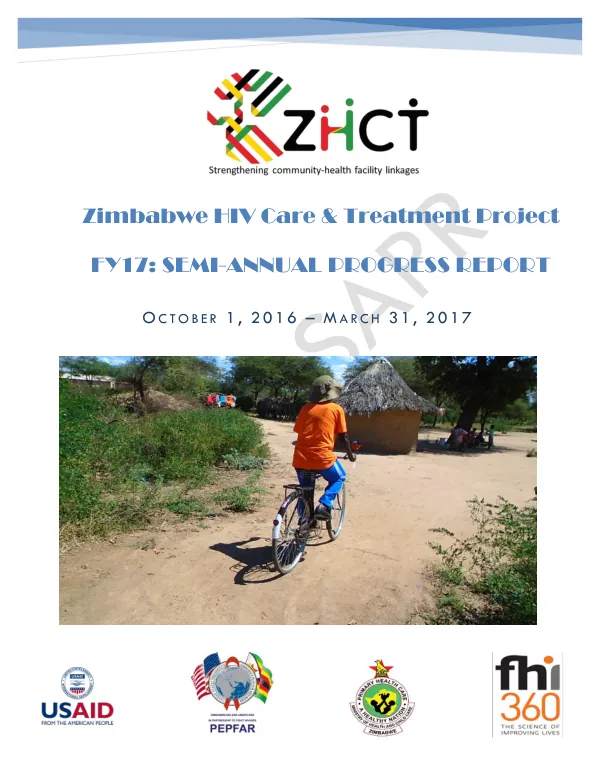
Zimbabwe HIV Care & Treatment Project Q1 FY18 Quarterly Narrative Report
The Zimbabwe HIV Care and Treatment Project (ZHCT) is a collaborative effort between FHI 360 and the Government of Zimbabwe to improve HIV care and treatment services.
2018 · 17 pages
Sign in to readA free account is required to download.
Abstract
The project operates in eight districts, having expanded to two new districts, Chivi and Mwenezi, in Masvingo, and dropped four districts, Buhera, Mutare, Chipinge, and Gweru, by the end of the previous year. As part of a restructuring exercise, FHI 360 is directly implementing the ZHCT project in three provinces: Masvingo, Manicaland, and Midlands, and has abolished the provincial level on the project structure. The project has achieved significant results in the first quarter of FY18. A total of 7,248 people were reached with HIV testing services provided at community level, and 2,672 people were identified to be living with HIV, resulting in a yield of 37% in Q1 of FY18, which is 3% more than the yield achieved in Q4 of FY17. The project continued to jointly implement the Accelerated Remediation Plan (ARP) with other USAID Clinical Partners to address gaps in performance on HTS_TST_POS and TX_NEW in 12 sites. The ZHCT project has also made progress in strengthening community-level health systems to monitor, track, and retain persons living with HIV (PLHIV). In the period under review, the project returned 95% (1,097/1,154) of true defaulters to care and provided ARVs to a total of 6,341 PLHIV at community level through the FHI 360 Community ART Refill Groups (CARGS) as a differentiated care model. The project plans to roll out community ART initiation as a strategy to increase the number of PLHIV identified who are initiated on ART in Q2 of FY18. Peer mentorship among the districts will be rolled out to facilitate exchange of working strategies between better performing districts and poorly performing districts. Additionally, FHI 360 will roll out HIV Self Testing within the community HIV index testing. The project's results are reflected in the HIV testing cascade, which shows a significant increase in the number of individuals tested for HIV and receiving a positive result. The project has also made progress in reaching adolescent girls and young women (AGYW) aged 15-24 years with HIV testing services, with a total of 1,454 AGYW tested in the period under review. The project's performance is monitored through various indicators, including the number of individuals tested for HIV, the number of individuals receiving a positive result, and the number of PLHIV initiated on ART. The project's results are also reflected in the performance of the 11 acceleration sites under the ARP, which showed a significant increase in the number of individuals tested for HIV and receiving a positive result. Overall, the ZHCT project has made significant progress in improving HIV care and treatment services in Zimbabwe, and its results are a testament to the project's commitment to improving the health and well-being of the Zimbabwean people.
Related documents