FEED THE FUTURE
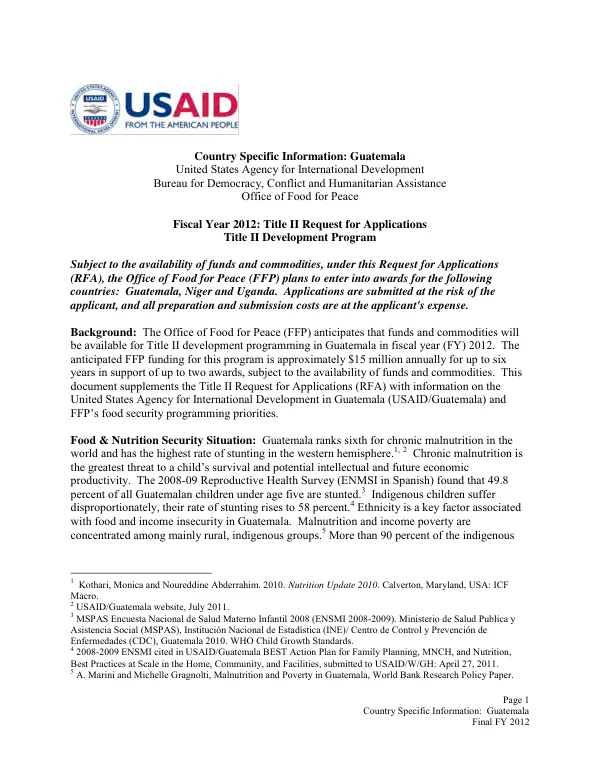
Final FY 2012: Title II Request for Applications for Guatemala
Guatemala has one of the highest rates of chronic malnutrition in the world, with 49.8 percent of children under the age of five suffering from stunting.
2012 · 7 pages
Sign in to readA free account is required to download.
Abstract
This is a major public health issue, as chronic malnutrition is the greatest threat to a child's survival and future economic productivity. Indigenous children are disproportionately affected, with a stunting rate of 58 percent. Malnutrition and income poverty are concentrated among rural, indigenous groups, with more than 90 percent of the population subsisting on income below the poverty line. Guatemala also has a high rate of adult obesity, particularly in urban areas, which is a consequence of stunting in childhood. Women are especially affected, with 31.2 percent having a height of less than 145 centimeters, which is a risk factor for low birth weight. Iron deficiency is a major public health issue, with 47.7 percent of children six-59 months old suffering from iron deficiency anemia, and 70 percent of children six-11 months old being anemic. The country has a high rate of infant mortality, with the two most common causes being upper respiratory infections and diarrheal illnesses. These are often the result of poor infant and child feeding practices, such as not initiating breastfeeding within the first hour after birth and not exclusively breastfeeding until six months. Formative research is needed to understand actual infant and child feeding practices and the barriers to improving them. Maternal malnutrition and mortality are also significant issues, with one-third of Guatemalan women falling below the critical height of 145 centimeters, increasing their risk of complications during childbirth. Maternal mortality is 70/100,000 for non-indigenous women and 211/100,000 for indigenous women. Obstetric complications and maternal malnutrition are the primary causes of maternal mortality. Guatemala is ranked as the tenth most vulnerable country in the world for natural disasters, such as earthquakes, tropical storms, and landslides. These disasters disproportionately affect rural, indigenous populations, particularly young children and women, due to poor health and nutrition. The recent economic crisis has further weakened municipalities, making it difficult for them to promote food and nutrition security. The Government of Guatemala has developed the "Law on National Food and Nutritional Security," but the country continues to suffer from high rates of food and nutrition insecurity. Municipalities lack the capacity, resources, and resources to promote the law within their municipalities and communities. To address this challenge, USAID/Guatemala has committed to focusing its resources and efforts on the five highest-need departments in the Western Highlands, where poverty and food insecurity are highest. Title II efforts will target the most vulnerable households and communities in the Western Highland departments of Huehuetenango, Quetzaltenango, Quiche, San Marcos, and Totonicapan. USAID/Washington and USAID/Guatemala will work with the United States Department of Agriculture (USDA), Feed the Future (FtF), and Global Health Initiative (GHI) to coordinate and concentrate efforts on these high-need departments to create a more significant and sustainable impact on poverty and food and nutrition security. The goal is to work with municipalities to become effective partners in addressing the food and nutrition security challenge. This will involve strengthening municipalities to become effective partners in addressing the food and nutrition security challenge. The focus will be on the five highest-need departments in the Western Highlands, where poverty and food insecurity are highest.