MINISTRY OF EDUCATION
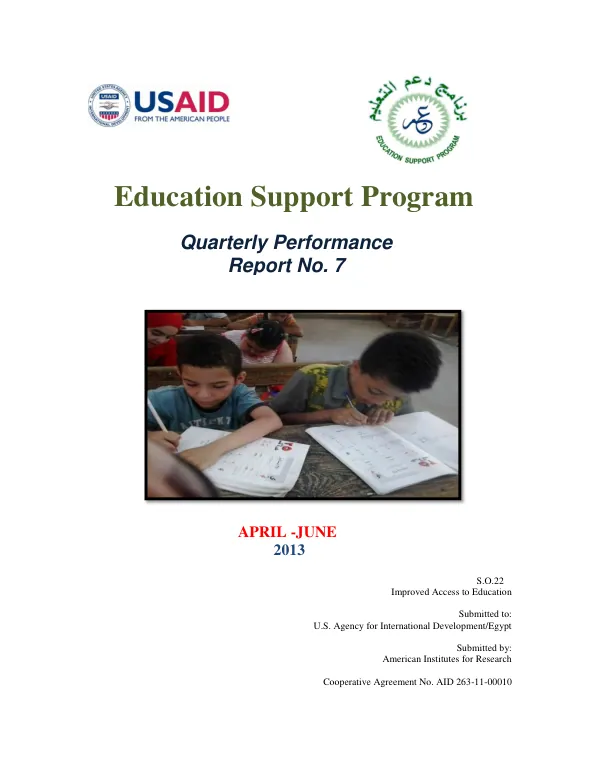
Quarterly Performance Report No. 7: Education Support Program
The Education Support Program (ESP) in Egypt aims to support educational service delivery for Egyptian children during a critical period in the country's history.
2013 · 23 pages
Sign in to readA free account is required to download.
Abstract
The program focuses on strengthening local educational structures, promoting teacher professional development, and enhancing community involvement in educational decision-making and quality improvement. ESP works closely with the Ministry of Education (MOE) to develop and manage local level crisis and contingency planning, reducing the negative impacts of future disruptions to educational service delivery. The program also supports the MOE's efforts to address community level school needs more effectively and respond to education system fragility. Key activities implemented by ESP during the seventh quarter include developing and implementing a remedial reading and writing program, establishing science clubs, and building the capacity of school-based mentors. The program also trained 109,017 Assistant Teachers (ATs) and supported the certification of 50 local MOE training units. ESP continued to work with the MOE's Social Work Departments (SWDs) to build the capacity of Boards of Trustees (BOTs), training 18,843 BOTs, which represents about 65% of the BOTs nationwide. The program also supported the implementation of science clubs, with over 1600 students participating in training on scientific research in 70 scientific clubs in 10 different Idarras. The Professional Academy of Teachers (PAT) remains an effective partner for ESP, and the program has taken major steps in establishing the Professional Development Resources Center (PDRC). ESP has also coordinated with PAT and local training departments to develop annual training plans, allowing local training departments to decide on their own training needs. ESP has made significant progress in various indicators, including the percentage and number of Idarra-level SWDs completed ESP-developed training package endorsed by MOE, the number of students in selected schools participated in reading/writing activities, and the number of newly hired teachers who completed PAT certified training course. The program has also trained 2572 school/Idarra potential leaders successfully completed PAT-certified leadership training package and 2999 mentors who completed PAT certified training package. Despite the security situation in different areas affecting some school activities, ESP continued to work towards its objectives, providing technical support to governorate and Idarra contingency planning committees to develop draft disaster risk reduction and recovery plans. The program also trained 2400 primary school principals on leadership skills as part of a training program developed and delivered by PAT.
Related documents