MINISTRY OF EDUCATION
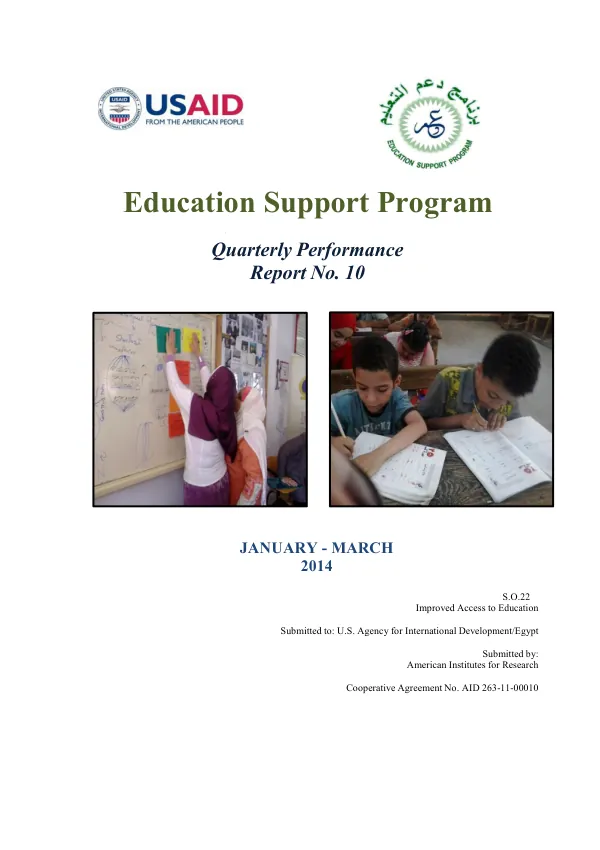
Education Support Program Quarterly Performance Report No. 10 January - March 2014
The Education Support Program (ESP) aims to support educational service delivery for Egyptian children during a critical and unique time in Egypt's history.
2014 · 25 pages
Sign in to readA free account is required to download.
Abstract
While Egyptian society is undergoing a complex transitional process towards democratization and reform, education and the quality of educational services are at the heart of these changes. Since the recent political revolution in Egypt that began on January 25, 2011, Egyptian schools have witnessed changes relating to two very important elements of the country's human resource support for education. The first element was redefining the role that school Boards of Trustees (BOTs) play in promoting citizenship, governance, and community participation. The second element was the Ministry of Education's decision to hire thousands of young Egyptians as new Assistant Teachers (ATs). These young teachers bring a renewed hope to the education system for improvements in education quality, largely inspired by the values of the Arab Spring: human rights, dignity, and justice. In the beginning of Year 2, ESP implemented newly added and modified activities. These activities included developing and implementing a remedial reading and writing program, implementing Science Club, building BOTs' capacity to support at-risk students, building the capacity of school-based mentors, supporting the selection and training of school leaders, and supporting the certification of 50 local MoE training units. ESP also increased the target number of trained ATs to 100,000 and modified the indicators, activities, and the format of the report accordingly. On October 13th, USAID informed AIR that it was preparing to have ESP wind up certain activities. Consequently, ESP suspended activities for the October – December 2013 quarter except for those approved on a short-term basis by USAID: the existing Science Club activities, the remedial reading intervention, and the AT training. Other program activities involving instructional leadership, mentorship and coaching, as well as contingency planning were suspended. On March 4th, USAID informed AIR that there was a reversal in the wind up decision. As such, it asked that AIR default to the original scope of work for the program, and all activities prior to the wind up. Egypt's state of instability also persisted during this quarter. ESP continued to follow its safety procedures to avoid any unnecessary risks while implementing project activities. However, instability caused events in some governorates to be cancelled or suspended. For example, the circumstances were deemed unsuitable for implementing activities in South Sinai and North Sinai. Moreover, due to Egypt's recent turmoil, the schools' mid-year break was longer than usual, which resulted in a considerable delay in the implementation of several ESP activities. Throughout this quarter, Social Work Departments (SWDs) continued BOT training and managed to train 124 BOTs, bringing the current total to 19,791. Additionally, ESP continued to support the implementation of Science Clubs. 1,250 students joined newly formed Science Clubs in their schools, bringing the total number of participating students to 3,188. 1,186 of the participating students completed a minimum of 10 sessions. ESP also continued to support the remedial reading and writing intervention. Classes resumed with the second academic term, and to date 6,735 students have completed a minimum of 28 sessions. ESP worked closely with the central literacy unit to select and prepare cadres of master trainers and more junior trainers to roll out the program to all governorates. During this quarter, 12 master trainers were prepared, and a team of 152 governorate level trainers received initial orientation and training on administering the screening test. A team of 27 trainers representing all of Egypt's governorates formed a planning team in charge of managing program implementation in their respective governorates. Working with the Professional Academy for Teachers (PAT) and the local training departments, ESP trained 46,148 ATs on complementary modules selected by the ATs themselves to complete the required 9-day certified course. The ESP Progress to Date Indicators show significant progress in various areas. The percentage and number of Idarra-level SWDs that completed the ESP-developed training package increased to 271. The percentage and number of BOTs that completed the MoE-endorsed BOT training course increased to 19,791. The number of students in selected schools who participated in reading/writing activities increased to 6,735. The number of students in selected schools who participated in Science Clubs increased to 1,186. The number of Mudderia and Idarra-level trainers certified by PAT to deliver specific courses increased to 381. The number of newly hired teachers who completed PAT-certified training course increased to 115,053. The percentage of newly hired teachers who successfully passed the PAT-certified training course remained at 99%. The number of schools/Idarra potential leaders who successfully completed the PAT-certified leadership training package increased to 2,684. The number of mentors who completed the PAT-certified training package increased to 3,502. The percentage and number of mentors who successfully completed the PAT-certified training package remained at 100%. The number of Idarra leadership teams that successfully completed ESP-developed contingency
Related documents