SAVE THE CHILDREN FUND
East Asia and Pacific Newsletter May and June 2012
The Office of U.S.
2012 · 2 pages
Sign in to readA free account is required to download.
Abstract
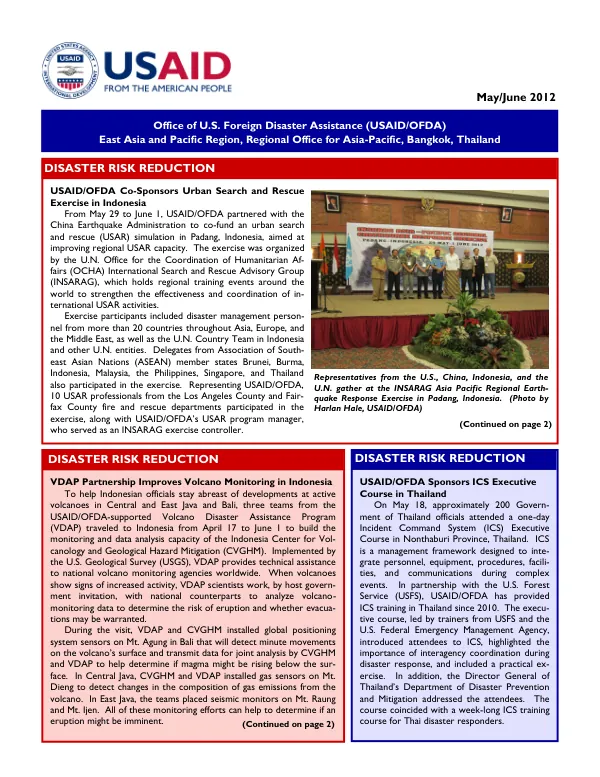
Foreign Disaster Assistance (USAID/OFDA) Regional Office for Asia-Pacific in Bangkok, Thailand, played a key role in disaster risk reduction efforts in the East Asia and Pacific Region during May and June 2012. USAID/OFDA partnered with the China Earthquake Administration to co-fund an urban search and rescue (USAR) simulation in Padang, Indonesia, from May 29 to June 1. The exercise aimed to improve regional USAR capacity by providing participants with information on how international USAR assistance is requested following an emergency, capabilities required to participate in an international response, and how international teams coordinate in a multi-country response setting. The exercise involved disaster management personnel from more than 20 countries, including disaster management personnel from Association of Southeast Asian Nations (ASEAN) member states, the U.N. Country Team in Indonesia, and other U.N. entities. USAID/OFDA also participated in the exercise, with 10 USAR professionals from the Los Angeles County and Fairfax County fire and rescue departments, along with USAID/OFDA's USAR program manager, who served as an INSARAG exercise controller. In addition to the USAR exercise, USAID/OFDA continued to provide technical assistance to national volcano monitoring agencies worldwide through the Volcano Disaster Assistance Program (VDAP). During the month of May and June, VDAP teams traveled to Indonesia to build the monitoring and data analysis capacity of the Indonesia Center for Volcanology and Geological Hazard Mitigation (CVGHM). The partnership between USAID/OFDA, the U.S. Geological Survey (USGS), and CVGHM provided much-needed early warning for volcanic eruptions, enabling USAID/OFDA to meet a key aspect of its mandate: to save lives. The VDAP teams installed global positioning system sensors on Mt. Agung in Bali, gas sensors on Mt. Dieng in Central Java, and seismic monitors on Mt. Raung and Mt. Ijen in East Java. These monitoring efforts can help determine if an eruption might be imminent. The partnership between USAID/OFDA, USGS, and CVGHM continues to provide critical support to national volcano monitoring agencies in Indonesia. USAID/OFDA also sponsored an Incident Command System (ICS) Executive Course in Nonthaburi Province, Thailand, on May 18. The course, led by trainers from the U.S. Forest Service and the U.S. Federal Emergency Management Agency, introduced attendees to ICS, highlighted the importance of interagency coordination during disaster response, and included a practical exercise. The course coincided with a week-long ICS training course for Thai disaster responders. During the month of June, USAID/OFDA Regional Advisor for East Asia and the Pacific Ben Hemingway traveled to Fiji, Vanuatu, and the Solomon Islands to review the progress of ongoing USAID/OFDA disaster risk reduction activities, meet with stakeholders to determine disaster preparedness and disaster response needs, and liaise with regional U.S. Government officials on current and future disaster response and risk reduction planning for the region. The trip strengthened USAID/OFDA's partnerships and laid the foundation for future disaster risk reduction investment in the region. In Burma, USAID/OFDA Regional Advisor for East Asia and the Pacific Brian Heidel and two USGS seismologists visited from May 21-25 to assess existing earthquake hazard understanding and identify ways to reduce the impact of future earthquakes in the country. The USAID/OFDA-sponsored visit was the first of its kind between USGS and the Government of Burma. The U.S. team met with counterparts from the Department of Meteorology and Hydrology and the Ministry of Social Welfare, Relief, and Resettlement within the Government of Burma, the Myanmar Earthquake Commission, the Myanmar Engineering Society, U.N. agencies, and non-governmental organizations. The visit culminated with a half-day Earthquake Preparedness Planning workshop, which was well attended by Government of Burma officials.