USAID DEC
Quarterly Report – September 2014 - January 2015: Ebola Community Action Platform (E-CAP)
Sign inMERCY CORPS INTERNATIONAL
Quarterly Report – September 2014 - January 2015: Ebola Community Action Platform (E-CAP)
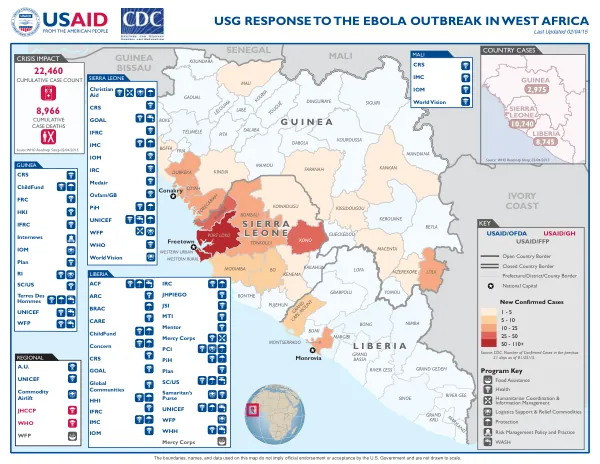
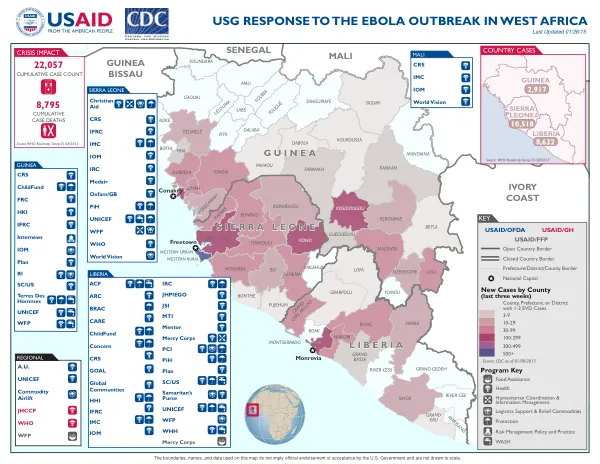
The Ebola Virus Disease (EVD) epidemic in Liberia peaked in early October 2014 with approximately 58 confirmed cases per day, affecting all 15 counties in the country.
2015 · 11 pages
Sign in to readA free account is required to download.
Abstract
The epidemic has caused over 3,587 deaths in Liberia, with the majority of the burden experienced in the Mano River Basin countries of Liberia, Sierra Leone, and Guinea. The epidemic has been characterized as a full-scale emergency, prompting a strong medical and humanitarian response from leading specialist agencies, including the Centers for Disease Control (CDC) and the World Health Organization (WHO), in partnership with national governments, donors, United Nations (UN) agencies, and local non-governmental organizations (NGOs). The Incidence Management System (IMS) has been established in Liberia, led and coordinated by the Ministry of Health (MoH) with support from lead partner agencies. The IMS main committee meets three times a week, with sub-committees focusing on social mobilization, materials and messaging, field mobilization, and monitoring and research. As of January 2015, the epidemic had declined sharply to about one confirmed case per day, concentrated in the counties of Montserrado and Grand Cape Mount. The Ebola Community Action Platform (E-CAP) aims to enhance awareness and uptake of behaviors that reduce EVD transmission across all 15 counties in Liberia through community-led and national social mobilization. E-CAP uses a sub-granting methodology to establish partnerships with local and international NGOs, reaching 2,900 villages and urban settlements. The program's operational timeframe is from September 13, 2014, to April 12, 2015, with a focus on intensive community mobilization activities. Key indicators for E-CAP include the number of community health workers (CHWs) trained and supported, disaggregated by sex, and the number and percentage of community members utilizing target health message practices. As of January 31, 2015, 61% of CHWs trained were male, and 39% were female. The number of community members utilizing target health message practices is not available until partners submit activity reports in February. The E-CAP program is being implemented by Mercy Corps in partnership with Population Services International (PSI). Mercy Corps is responsible for linking activities into Ministry of Health coordination structures at the national level, managing sub-granting with NGOs, and implementing monitoring and evaluation processes. PSI focuses on training mobilizers and supporting mass media activities that complement community-level mobilization. The sub-granting process involved a call for proposals distributed via County Health Teams on November 14, 2014, with 116 proposals received from all 15 counties in Liberia. An assessment of eligible proposals was conducted by a Technical Advisory Panel (TAP), including representatives from the Ministry of Health and John Hopkins University. The TAP assessed proposals based on the quality of the proposal, the relevance of the proposed activities to the E-CAP objectives, and the capacity of the applicant organization to implement the proposed activities. The E-CAP program has established partnerships with 26 lead partners and 50 sub-partners, with a focus on community health education and behavior change. The program aims to reach 2,000,000 community members with target health message practices, with a budget of $9,580,000. The program's geographic area of focus is nationwide, with a focus on areas of high caseloads. The program's indicators include the number of CHWs trained and supported, disaggregated by sex, and the number and percentage of community members utilizing target health message practices. The E-CAP program has established a strong partnership with the Ministry of Health, with a focus on linking activities into Ministry of Health coordination structures at the national level. The program has also established partnerships with local and international NGOs, with a focus on community health education and behavior change. The program's indicators include the number of CHWs trained and supported, disaggregated by sex, and the number and percentage of community members utilizing target health message practices.