USAID DEC
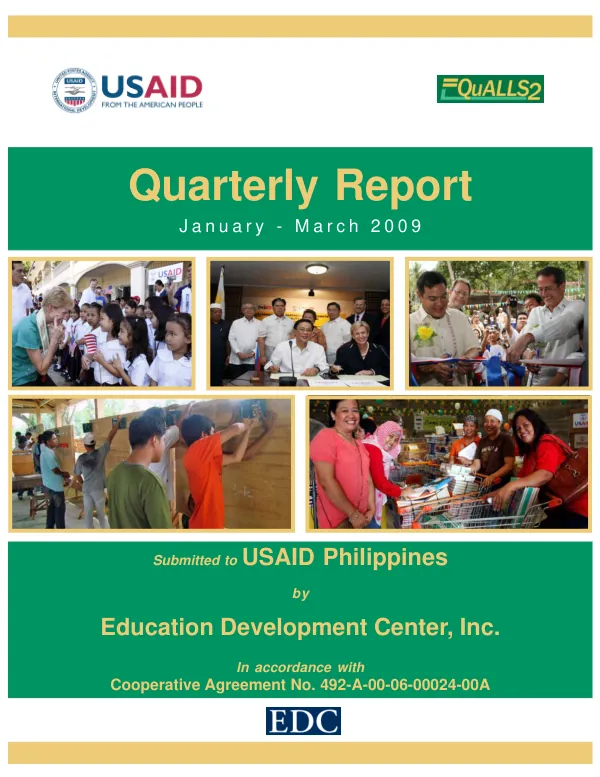
Education Quality and Access for Learning and Livelihood Skills (EQuALLS2) Project Quarterly Report: January – March 2009
Sign inCENTER FOR EDUCATIONAL DEVELOPMENT
Education Quality and Access for Learning and Livelihood Skills (EQuALLS2) Project Quarterly Report: January – March 2009
The Education Quality and Access for Learning and Livelihood Skills (EQuALLS2) Project in the Philippines' Autonomous Region in Muslim Mindanao (ARMM), and Regions 9 and 12, has made significant progress in the second quarter of fiscal year 2009.
2009 · 41 pages
Sign in to readA free account is required to download.
Abstract
The project aims to improve education quality and access for out-of-school youth and children, as well as provide them with livelihood skills. A total of 9,684 out-of-school youth (OSY) have been enrolled in basic education and workforce development programs, with 7,777 learners enrolled in programs to improve basic literacy skills and prepare for reintegration into formal school. Additionally, 1,907 OSYs have been enrolled in workforce and skills development programs, such as food processing, baking, beauty care, gardening and horticulture, arc welding, engine repair and mechanics, and other skills linked to local employment and livelihood opportunities. The project has also made significant progress in providing educational materials to schools. A total of 272,000 books have been placed in schools using an innovative methodology, and two large storage warehouses have been transformed into USAID EQuALLS2 Project Book Centers. Furthermore, 100 Community Incentive Grants (CIG) have been awarded to Parent-Teacher-Community Associations (PTCA) with capacity to implement education projects, with each grant worth $1,000. The project has also partnered with Microsoft to provide computer training and software to 1,000 teacher mentors. A memorandum of understanding was signed with Microsoft on February 27, 2009, to provide free training and discounted software to elementary school teachers in conflict-affected Mindanao. The partnership aims to install 180 computer suites in computer hubs and at the elementary school level by 2011. In addition, the project has launched a project-wide, internet-based Management Information System (MIS) that allows all partners to update their achievements and information. The system allows off-line encoding of data for as long as needed, and the information can be uploaded to the server the next time internet capabilities are available. Technical leadership has been a key factor in the project's success, with lead implementing partners pushing forward with capacity-building activities for PTCAs and building linkages with Local Government Units (LGU). Teacher training programs in English, math, and science have also advanced, with partners rolling out core training programs and follow-up refresher courses to mentors and supplemental training to teachers at the school level. Teaching materials and over a quarter million Brother's Brother Foundation (BBF) books have enhanced the application of knowledge and skills by teachers and generated enthusiasm for reading and learning among children in schools that benefited from this assistance. The project has also sustained the interest of out-of-school children and youth (OSCY) in basic education and workforce development programs, with a total of 7,777 OSCY enrolled in basic education programs during the quarter and an additional 1,690 youth completing trade skills training.
Related documents