USAID/LIBERIA
Educational Stipends Program Summary
The Educational Stipends Program for 12th Graders in Liberia was launched in response to the COVID-19 pandemic, which posed significant financial constraints for students writing the West African Senior School Certificate Examination (WASSCE).
2021 · 2 pages
Sign in to readA free account is required to download.
Abstract
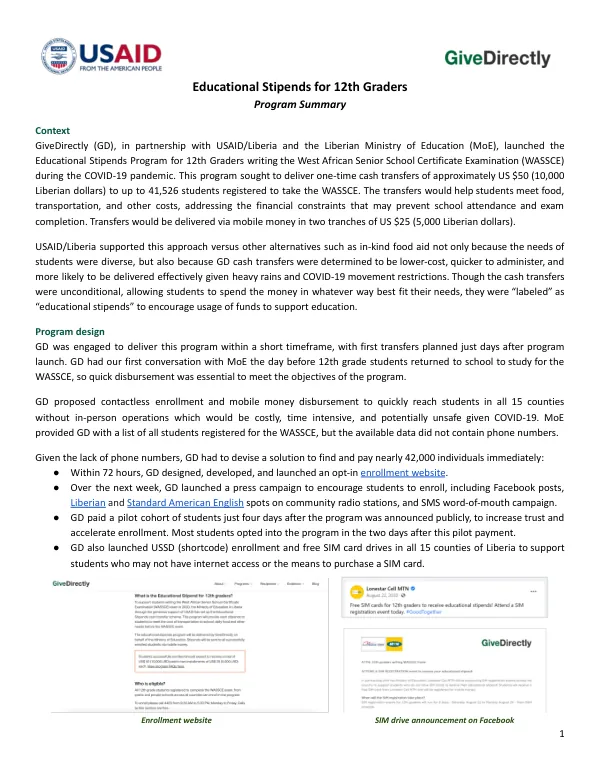
The program, implemented by GiveDirectly (GD) in partnership with USAID/Liberia and the Liberian Ministry of Education (MoE), aimed to deliver one-time cash transfers of approximately US $50 to up to 41,526 students registered to take the WASSCE. The program design involved contactless enrollment and mobile money disbursement to quickly reach students in all 15 counties without in-person operations. Given the lack of phone numbers in the available data, GD devised a solution to find and pay nearly 42,000 individuals immediately. This involved designing, developing, and launching an opt-in enrollment website within 72 hours, launching a press campaign to encourage students to enroll, and paying a pilot cohort of students just four days after the program was announced publicly. The enrollment website was a key component of the program, allowing students to opt-in and receive their stipends. The website was accessible via the internet, and students who may not have had access to the internet were able to enroll via USSD (shortcode) or through free SIM card drives in all 15 counties of Liberia. The program demonstrated the potential of web-based enrollment models in Liberia, with 89.6% of surveyed students enrolling via the website. The results of the program were significant, with 94.9% of stipends disbursed within six weeks of program launch. GD ultimately paid US $1.9M in educational stipends to 37,727 students (90.9% of all students registered for the WASSCE) in 694 schools (98.2% of schools). Students reported reduced barriers to writing the WASSCE, with 74.4% of surveyed students reporting writing all subjects of the WASSCE, and every single surveyed student writing at least one subject. Students spent their stipends on a wide range of items to support them both during the exam and after graduation. The majority of students reported spending some portion of their stipend on food (48.0%), transportation to school (42.2%), and books and educational materials (22.4%). Students also reported adding to their savings (11.4%) and paying back loans or debts (9.7%). Notably, student testimonials indicate that many spent a portion of their stipend to invest in a new or existing business, suggesting that even small, one-time cash transfers may spur entrepreneurial activity in Liberia. Follow-up surveys with students revealed the significant impact of the stipends on their lives. Students reported feeling grateful and relieved, with many expressing their appreciation for the financial assistance. The stipends enabled students to pay their tuition fees, settle their debts, and even invest in new businesses. The program's success demonstrates the potential of cash transfers to support students in crisis situations and promote economic development in Liberia.