USAID DEC
Effective Community Champions: Helping Traditional and Religious Leaders Fight Child, Early, and Forced Marriage
Sign inAVENIR HEALTH
Effective Community Champions: Helping Traditional and Religious Leaders Fight Child, Early, and Forced Marriage
The curriculum for Effective Community Champions was designed and tested in 2021 to address child, early, and forced marriage (CEFM) in Malawi.
2021 · 92 pages
Sign in to readA free account is required to download.
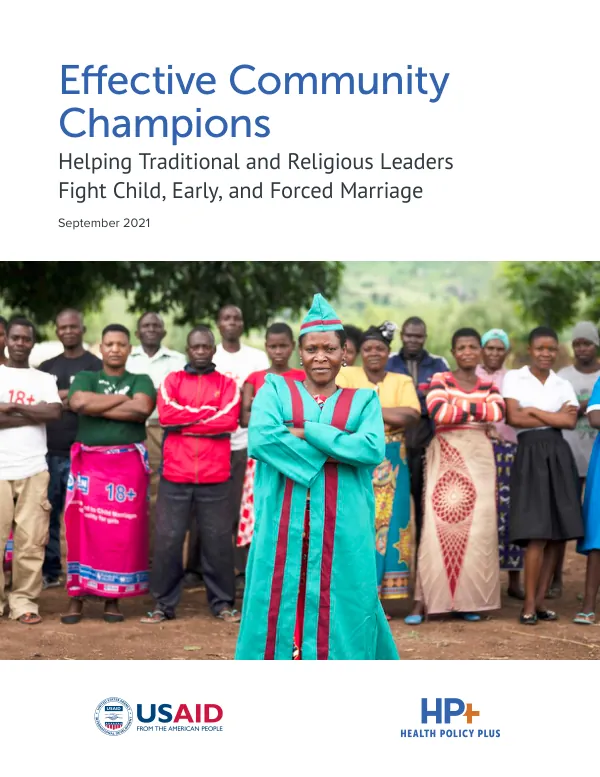
Abstract
A key focus of this work was engaging traditional and religious leaders in Chikwawa and Machinga to leverage their spheres of influence and change social norms. The Health Policy Plus (HP+) project, funded by the U.S. Agency for International Development, identified six essential components to cover in the training to achieve expected results in CEFM. These components include providing information about the harms of CEFM, policy and advocacy work to combat CEFM, and Malawi's current policies and strategies to end CEFM. Participants will also learn about leadership and how their own leadership can play a critical role in advancing Malawi's efforts to end child marriage. Additionally, they will learn effective advocacy messages, intergenerational dialogue, and action planning to carry the training forward. The training is designed to equip traditional and religious leaders with the knowledge and skills necessary to become effective champions against CEFM in their communities. Participants will learn about the importance of including youth voices in development projects and creating individual action plans to spread CEFM messages to various stakeholders. The curriculum consists of 12 modules, including introduction and introspection, defining the problem of CEFM, finding solutions, leadership and influence, leadership and communication, leadership and collaboration, inclusion and intergenerational dialogue, CEFM messaging, group action planning, characteristics of a good mentor, mentoring action plan, and closing. The training also includes annexes with handouts on CEFM legal frameworks, working with youth, COVID-19 considerations, and participant action plans. The training team includes experts from the HP+ project, including Erin McGinn, Jay Gribble, and the HP+ Malawi team as reviewers. The curriculum was developed by Kate Mangino, with contributions from other experts in the field. The training is expected to have a positive impact on reducing CEFM in Malawi by empowering traditional and religious leaders to become effective champions against this practice. The HP+ project has a long history of working on HIV and other health issues, and this training is part of a broader effort to address CEFM in Malawi. The project is implemented by Palladium, in collaboration with other organizations, and is funded by the U.S. Agency for International Development. The training is designed to be adaptable for use outside of Malawi, and a sample agenda is provided for reference. The training is expected to have a lasting impact on reducing CEFM in Malawi by empowering traditional and religious leaders to become effective champions against this practice. By providing them with the knowledge and skills necessary to address CEFM, the training aims to change social norms and generate action for local implementation of laws and policies that combat child marriage.
Related documents
Documents in this collection
 2019
2019USAID DEC
Total Market Approach Projection Tool: User’s Guide and Lessons Learned from an Application in Two Countries
Open record 2021
2021USAID DEC