MERCY CORPS INTERNATIONAL
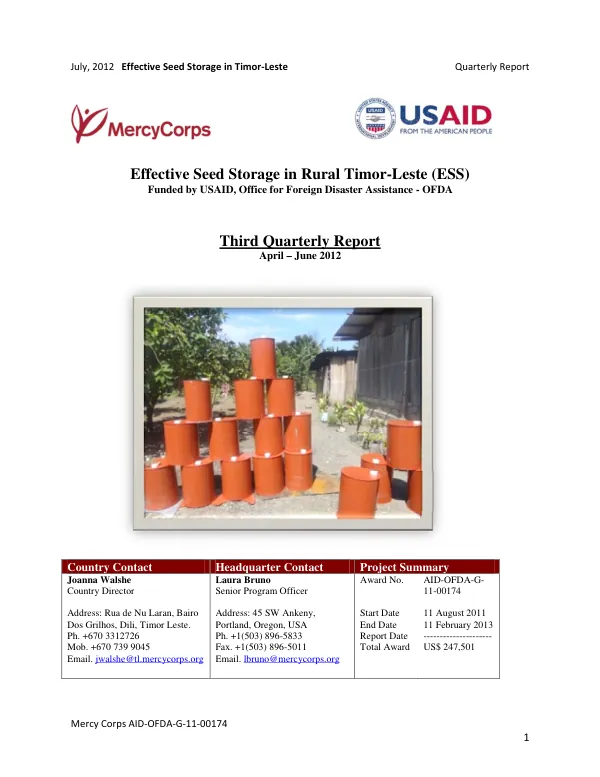
Effective Seed Storage in Timor-Leste: Quarterly Report April-June 2012
The agricultural development initiative in Timor-Leste, funded by USAID's Office for Foreign Disaster Assistance, aims to improve post-harvest seed storage for rural farmers.
2012 · 9 pages
Sign in to readA free account is required to download.
Abstract
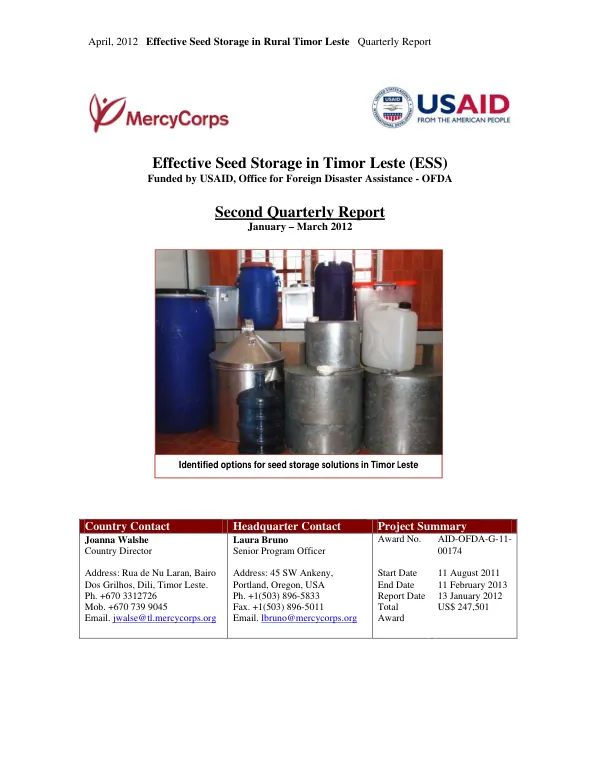
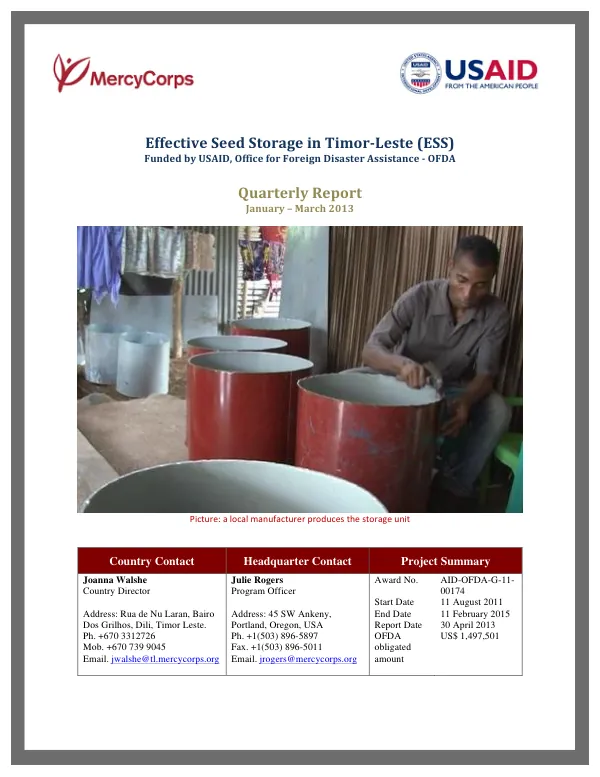
The majority of farmers in the target districts of Ainaro and Manufahi rely on subsistence agriculture and face challenges such as poor seed quality, limited market access, and high post-harvest seed loss. The Effective Seed Storage (ESS) program, implemented by Mercy Corps, seeks to address these issues by introducing effective post-harvest storage systems, primarily focusing on maize, the main staple crop in Timor-Leste. The ESS program involves local manufacturers in efforts to increase access to improved storage systems and combines this with capacity building for farmers and extension workers to sustainably link farmers with viable input and output markets. The program complements an existing 3.5-year, $1.7 million European Commission-funded Sustainable Crop Production, Utilization, and Resource management through Capacity Enhancement in two districts of Timor-Leste (SECURE) program, implemented by Mercy Corps and partners in the two target districts. ESS will fill a critical gap in the ongoing program while benefiting from cost efficiencies and established relationships with farmers and the Ministry of Agriculture. In the third quarter of 2012, the ESS program conducted consultation meetings with 4 communities on the selection of the best storage unit for production. A total of 149 farmers participated, with 87% selecting a metal silo with airtight lid, 9% selecting a metal silo with large opening, and the remaining 4% selecting other designs. The preferred silo model was identified as a custom-designed metal silo with airtight lid, which has locally desired attributes such as oxygen-free environment, rat and fire resistance, and durability in humid tropical climate conditions. The ESS team then focused on developing the market around this preferred silo model. Two local manufacturers were selected and trained to produce improved seed storage units for supported farmers. The manufacturers were identified through a sealed tender quotation process, and the project selected the two lowest bidders. The decision to select just two manufacturers at this stage of the project was made to focus energy on developing and testing the supply-side supports to further future supply. The project aims to stimulate both supply and demand for effective seed storage units, which are nearly non-existent in the Timor-Leste market. The ESS program has made significant progress in the third quarter of 2012, with 149 farmers consulted to identify the preferred storage unit design. The project has also selected two local manufacturers to produce improved seed storage units, and has begun developing the market around the preferred silo model. The program aims to improve post-harvest seed storage for rural farmers, increase access to improved storage systems, and sustainably link farmers with viable input and output markets. The geographic focus of the ESS program is the target districts of Ainaro and Manufahi in Timor-Leste. The program has a total budget of $247,501, and has spent $0 as of the end of the third quarter of 2012. The program aims to reach 27,503 beneficiaries, including farmers and extension workers, and has a target of increasing the number of months of food self-sufficiency for beneficiary families from 8.1 months to at least 3 months. The program also aims to increase the number of people benefiting from seeds systems/agricultural inputs activities from 0 to 1,560.
Related documents