CATHOLIC RELIEF SERVICES ORGANIZATION
Effective Seed Storage in Timor-Leste (ESS)
The agricultural development initiative in Timor-Leste focuses on improving post-harvest seed storage systems to enhance crop production and livelihoods in rural areas.
2013 · 7 pages
Sign in to readA free account is required to download.
Abstract
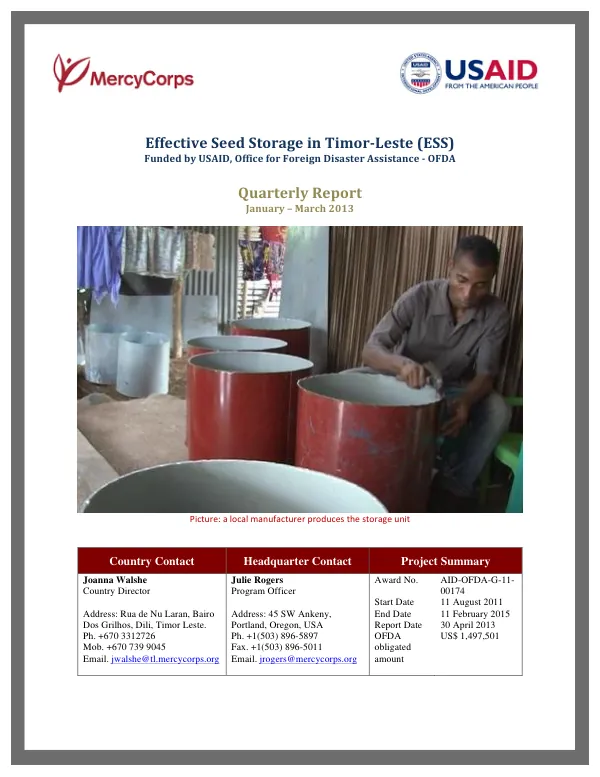
The majority of farmers in the target districts of Ainaro and Manufahi rely on subsistence agriculture for their livelihoods and are caught in a poverty trap due to poor seed quality and storage. Continuous use of farm-saved seed leads to reduced yields, and the lack of appropriate on-farm storage results in high post-harvest seed loss. The Effective Seed Storage (ESS) program, implemented by Mercy Corps, aims to introduce effective post-harvest storage systems, primarily focusing on maize, the main staple crop in Timor-Leste. The program involves local manufacturers in efforts to increase access to improved storage systems and combines this with capacity building for farmers and extension workers to sustainably link farmers with viable input and output markets. In March 2013, the program was granted nationwide expansion to cover at least 10 districts of Timor-Leste for another 24 months. The program has made significant progress in its first year, with 2,337 voucher-recipient farmers accessing the storage unit by the end of the first phase. In addition, 110 farmers purchased the storage system without vouchers, resulting in a total of 1,041 farmers who purchased without vouchers. The program has also trained 26 extension workers in both districts, and 34 farmers have adopted improved storage designs. The program has achieved a 50% reduction in seed loss amongst pilot farmers and has increased the availability of maize in households by an additional 1.95 months. The ESS program has also facilitated market events in district-level markets to introduce the developed seed storage system. Four market events were facilitated in January 2013, and an additional 933 farmers accessed seed storage units. The program has also reduced the voucher's value from $30 to $20, resulting in savings and increased access to the storage system for farmers. The program's expansion plans include partnering with Catholic Relief Services (CRS) and five local NGOs to cover at least 10 districts of Timor-Leste. The total estimated amount for the expansion is $2.3 million, incrementally-funded by OFDA, with $1.25 million awarded for the first year. The program's objectives include sustainable post-harvest protection of seeds and grain stocks, improving crop production and livelihoods in rural Timor-Leste.