USAID DEC
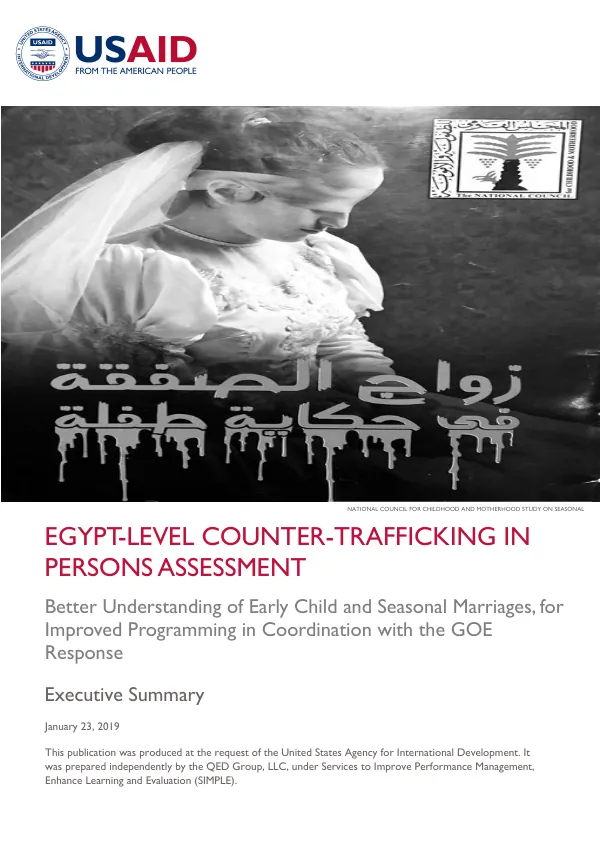
Egypt-Level Counter-Trafficking In Persons (C-TIP) Assessment: Better Understanding of Early Child and Seasonal Marriages
Sign inQED GROUP, LLC
Egypt-Level Counter-Trafficking In Persons (C-TIP) Assessment: Better Understanding of Early Child and Seasonal Marriages
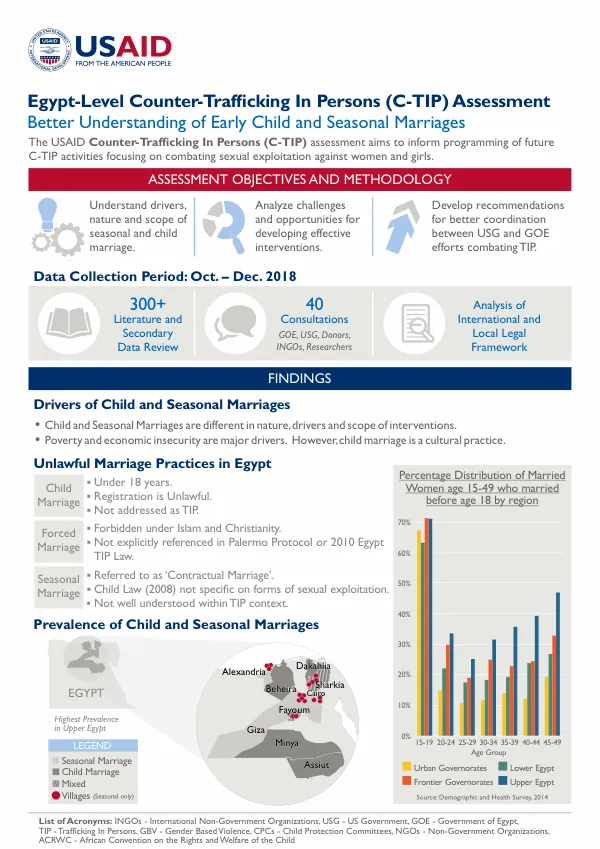
The USAID Counter-Trafficking in Persons (C-TIP) assessment in Egypt aims to inform programming of future C-TIP activities focusing on combating sexual exploitation against women and girls.
2019 · 2 pages
Sign in to readA free account is required to download.
Abstract
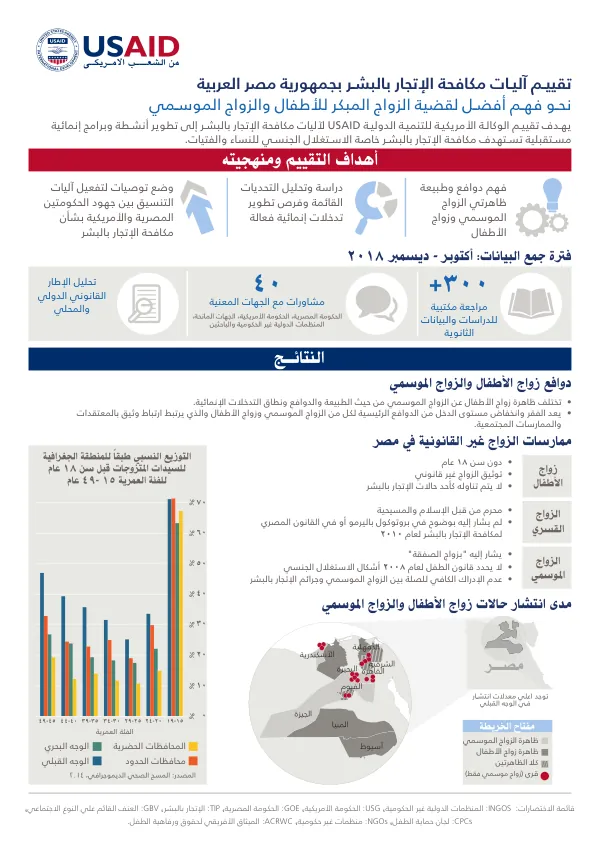
The assessment seeks to understand the drivers, nature, and scope of seasonal and child marriage, as well as develop recommendations for better coordination between the US Government and the Government of Egypt in combating TIP. Poverty and economic insecurity are major drivers of child and seasonal marriages, with child marriage being a cultural practice. Unlawful marriage practices in Egypt include marriages under the age of 18, which are not addressed as TIP. These practices are forbidden under Islam and Christianity, but not explicitly referenced in the Palermo Protocol or the 2010 Egypt TIP Law. Child marriage is not well understood within the TIP context, and its prevalence varies by region, with the highest prevalence in Upper Egypt. The assessment found that child and seasonal marriages are different in nature, drivers, and scope of interventions. Seasonal marriage is an "underground phenomenon" difficult to trace and prosecute, while child marriage is not effectively sanctioned since it is unregistered. Limited awareness among lawyers, judges, and prosecutors of the relation between seasonal marriage and the 2010 TIP Law contributes to the challenges in combating these practices. The assessment recommends awareness campaigns promoting girls' education and emphasizing the harmful effects of seasonal marriage and its connection to TIP in coordination with local NGOs and communities. Coordinated programming addressing health, education, and economic impacts of child marriage is also recommended, as well as capacity building of Child Protection Committees to convey the distinction between child and seasonal marriages and related combating approaches. Implementation of income-generating activities in vulnerable communities and technical assistance scoping different case management approaches in TIP, child protection, and GBV are also recommended. Support for the reintegration of survivors with aid in housing, health, psychological, and legal needs, and employment is also necessary. Capacity building of local NGOs and shelters, and strengthening the national referral system to deliver comprehensive case management of victims are also essential. The assessment highlights the need for leveraging existing platforms for capacity building of judges and prosecutors on sexual exploitation and TIP, as well as data collection on seasonal and child marriages leveraging national surveys. The report emphasizes the importance of addressing the contextual challenges, including the lack of community awareness of seasonal and child marriages, which creates a negative impact on girls and children. The assessment also identifies existing gaps in Protection, Prosecution, and Prevention addressing seasonal marriage within the C-TIP context. These gaps include awareness, advocacy, and school-based counseling, engagement of religious and community leaders, health, enrollment, and retention in education, community schools, empowerment of girls and boys, social protection, and cash transfer. The report recommends addressing these gaps through community mobilization in "hot spots" and raising awareness, education, economic empowerment, leadership programs, Child Protection Committees, helplines for family and children, legal support by NGOs, shelters, and village health units. The assessment concludes that the C-TIP framework is unlikely to be effective in addressing child marriage, as it is not considered TIP. However, coordinated programming addressing health, education, and economic impacts of child marriage can be effective in combating these practices. The report emphasizes the need for a comprehensive approach that addresses the root causes of child and seasonal marriages, including poverty, economic insecurity, and cultural practices.
Related documents