ICF
USAID/Egypt Foreign Assistance Act Section 119 Biodiversity Analysis
The USAID/Egypt Foreign Assistance Act Section 119 Biodiversity Analysis was conducted in August 2020 to assess the status of biodiversity in Egypt and identify actions necessary to address threats to biodiversity.
2020 · 114 pages
Sign in to readA free account is required to download.
Abstract
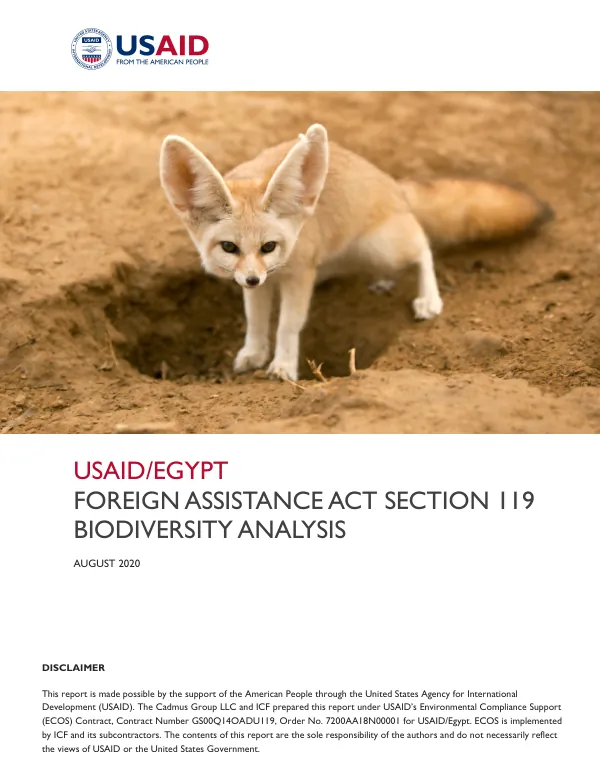
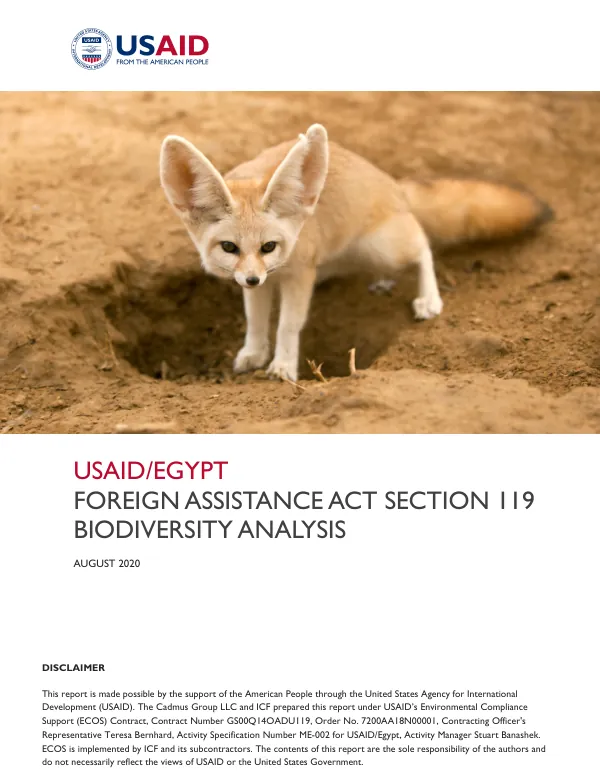
The analysis was prepared by The Cadmus Group LLC and ICF, with funding from the United States Agency for International Development (USAID). Egypt's biodiversity is characterized by a diverse range of ecosystems, including deserts, oases, and Mediterranean coastal areas. The country is home to a wide variety of plant and animal species, including the fennec fox, which is found in North Africa from Morocco to Egypt. However, Egypt's biodiversity is under threat from various drivers, including habitat destruction, overgrazing, and climate change. The analysis identified several key ecosystem types in Egypt, including deserts, oases, and Mediterranean coastal areas. The country's species diversity is also significant, with over 1,000 species of plants and animals found in Egypt. However, many of these species are threatened or endangered due to habitat loss and degradation. Egypt's protected areas cover approximately 10% of the country's land area, with several national parks and wildlife reserves established to conserve biodiversity. However, these protected areas are often fragmented and lack effective management and enforcement. Key natural resources outside protected areas include forests, grasslands, and wetlands, which are under threat from overgrazing, deforestation, and pollution. The analysis identified several drivers of threats to biodiversity in Egypt, including habitat destruction, overgrazing, and climate change. These drivers are linked to various actions necessary to address biodiversity threats, including the establishment of protected areas, sustainable land-use planning, and climate change mitigation and adaptation. The analysis found that USAID/Egypt contributes to actions necessary to address biodiversity threats, including the establishment of protected areas and sustainable land-use planning. However, there are several gaps in USAID/Egypt's biodiversity program, including a lack of effective monitoring and evaluation, inadequate funding, and limited engagement with local communities. Based on the analysis, several high-priority recommendations were made for USAID/Egypt, including the establishment of a national biodiversity strategy, the development of a sustainable land-use plan, and the enhancement of protected area management. The recommendations also emphasized the need for increased funding and engagement with local communities to address biodiversity threats in Egypt. The analysis was conducted by a team of experts from The Cadmus Group LLC and ICF, with funding from USAID. The report includes several annexes, including a bibliography, threatened and endangered species information, and a list of protected areas and natural resources outside protected areas in Egypt.