USAID
Connecting People and Communities to Ensure a Healthy Planet
Arizona and Egypt share common challenges in managing and using water, balancing protection and use of rural lands, and expanding industry while protecting air, water, and land.
4 pages
Sign in to readA free account is required to download.
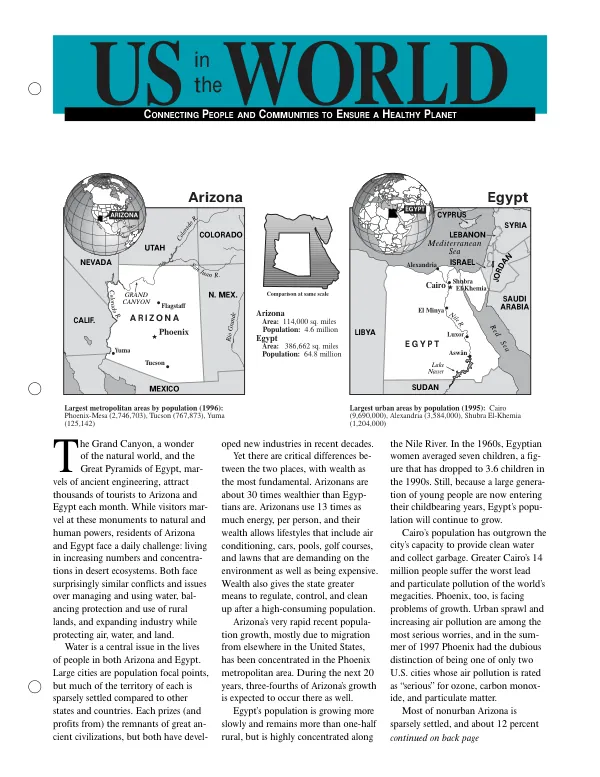
Abstract
Both states face conflicts over water management, with large cities serving as population focal points, but much of the territory of each is sparsely settled compared to other states and countries. Arizona and Egypt prize the remnants of great ancient civilizations, but both have developed new industries in recent decades. Arizona's population has grown rapidly, with a 57% increase due to migration from other states between 1996 and 1997. The state's population is projected to reach 6.4 million by 2025, with an annual growth rate of 2.7%. In contrast, Egypt's population is growing more slowly, with a 1.9% annual growth rate, but is projected to reach 97.6 million by 2025. Arizona's population is younger, with a higher percentage of preschoolers, while Egypt's population is older, with a higher percentage of people over 60. Both states face water management challenges, with Arizona using 1,619 gallons of water per capita per day, while Egypt uses 690 gallons per capita per day. Arizona's water use is primarily for agriculture, accounting for 84% of total water use, while Egypt's water use is also primarily for agriculture, accounting for 85% of total water use. Arizona has 51 endangered and threatened species, including the jaguar, ocelot, and Mexican spotted owl, while Egypt has 33 threatened animals, including the slender-horned gazelle and white-headed duck. Arizona's economy has been driven by technology since World War II, with major employers such as Intel Corporation and Motorola, Inc. However, the state has one of the country's higher poverty rates, with 17.5% of the population living below the poverty level. Poverty is concentrated in areas with large Native American populations, with Apache County having a 41.4% poverty rate in 1993. In contrast, Egypt's GDP per capita is $765, with a high percentage of the population living in poverty, particularly in rural areas. Egypt's population is projected to increase 51% by 2025, with large numbers of young people entering their childbearing years. The urban population is projected to exceed 60% by 2025, with 99% of the population living along the banks of the Nile River and its delta. Egypt's water resources are polluted from many sources, including salinized runoff water from irrigated land, agricultural pesticides, industrial effluents, and untreated sewage. The country's soils are being damaged and depleted as salinization results from irrigation, and urban sprawl and windblown sands remove some soils from agricultural use altogether. Arizona and Egypt face similar challenges in managing and using water, balancing protection and use of rural lands, and expanding industry while protecting air, water, and land. Both states have developed new industries in recent decades, but face conflicts over water management and have high poverty rates. Arizona's population is younger, while Egypt's population is older, and both states have unique socioeconomic factors that impact their development.