USAID
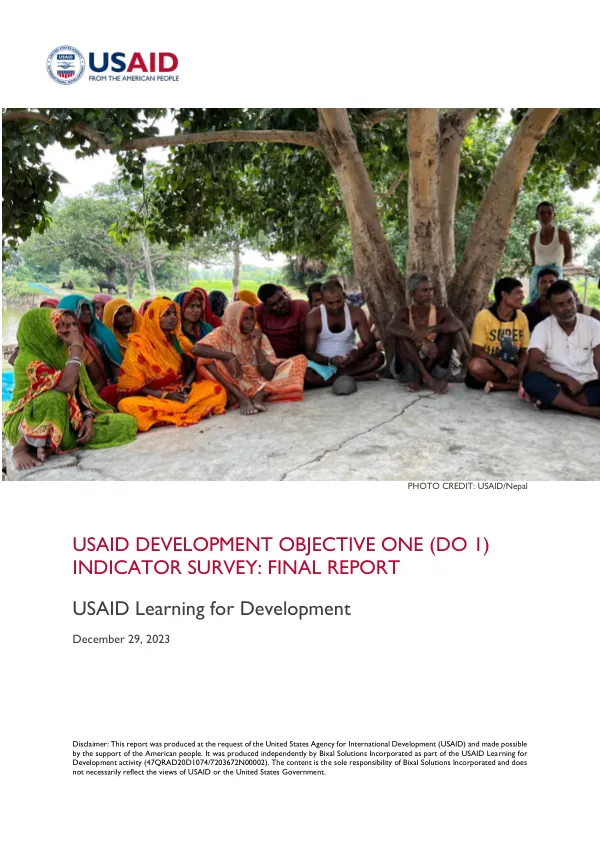
USAID Development Objective 1 Indicator Survey Final Report
USAID Development Objective One Indicator Survey: Final Report was produced by Bixal Solutions Incorporated as part of the USAID Learning for Development activity.
2024 · 182 pages
Sign in to readA free account is required to download.
Abstract
The report was made possible by the support of the American people and is the sole responsibility of Bixal Solutions Incorporated. It does not necessarily reflect the views of USAID or the United States Government. The survey aimed to assess progress toward USAID Development Objective One, which focuses on strengthening democratic systems, promoting equality under the law, and enhancing citizen demand for democracy. The report presents findings from a comprehensive survey conducted in USAID focus areas. Demographic data from the survey indicate that the majority of respondents were male, with a median age of 35 years. The survey also collected data on citizen engagement and confidence in governance processes, including local government decision-making, access to judicial systems, and satisfaction with the progress of realizing fundamental rights. Citizen confidence in local government decision-making processes was reported at 1.1-2 percent, with a significant proportion of respondents indicating they actively participate in oversight and monitoring of subnational government activities. Women, youth, and marginalized citizens expressed higher satisfaction with the progress of realizing their fundamental rights, with 1.2-3 percent of respondents indicating they are satisfied. Public confidence in the role of civil society organizations (CSOs) and media was reported at 1.3-2 percent, with a significant proportion of respondents indicating they believe in the importance of CSOs and media in promoting democracy. Citizen participation in local-level government planning processes was reported at 5.2-3 percent, with a significant proportion of respondents indicating they are engaged in planning processes. The survey also collected data on access to justice and quality of government services, including health and education sector disaggregation. Citizen satisfaction with the quality of services from government service provider entities was reported at 5.1-3 percent, with a significant proportion of respondents indicating they are receiving quality services. Resilience and social safety net coverage were also assessed through the survey. Citizen perception of local government preparedness for future shocks and stresses was reported at 5.3-3 percent, with a significant proportion of respondents indicating they believe the local government will respond effectively to future shocks and stresses. Social and financial safety net coverage was reported at 5.3-4 percent, with a significant proportion of respondents indicating they are enrolled in at least one safety net measure. The report highlights areas for further study, including the impact of CSOs and media on democratic systems, the effectiveness of local government planning processes, and the resilience of communities to future shocks and stresses. Technical recommendations are also provided, including the need for continued support for democratic systems, equality under the law, and citizen demand for democracy. The survey framework sources, additional information on sampling, and a list of sampled local government units are provided in the annexes. Indicator data analysis protocols are also included, detailing the methodology used to collect and analyze data.