USAID DEC
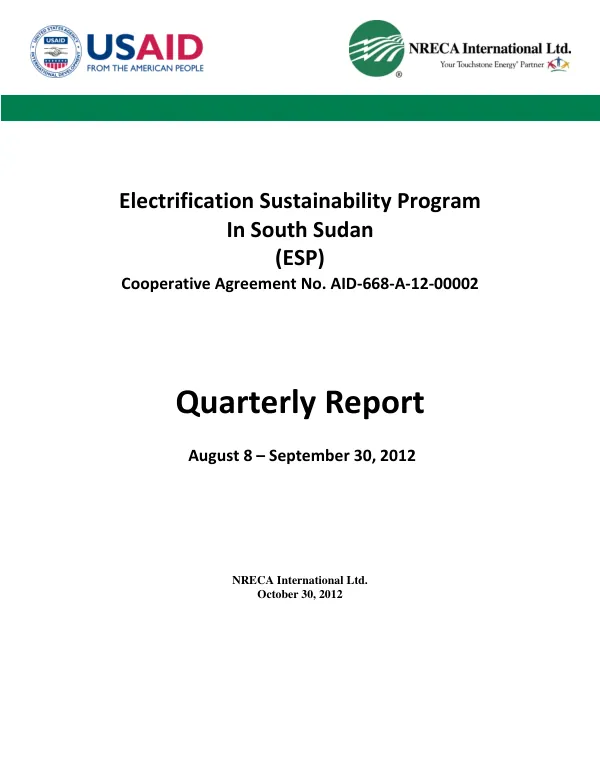
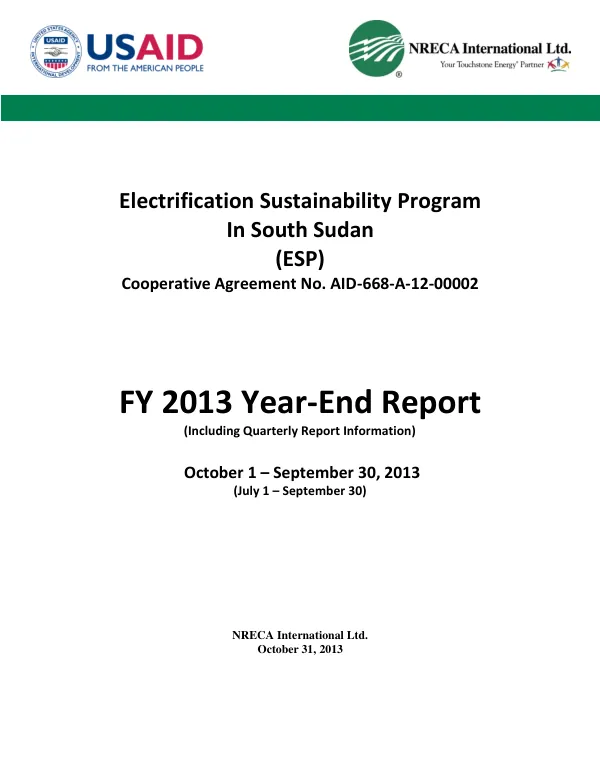
Electrification Sustainability Program In South Sudan (ESP) Year-End Report - FY 2013
Sign inUSAID
Electrification Sustainability Program In South Sudan (ESP) Year-End Report - FY 2013
The Electrification Sustainability Program in South Sudan (ESP) is a cooperative agreement between the United States Agency for International Development (USAID) and NRECA International Ltd.
2013 · 47 pages
Sign in to readA free account is required to download.
Abstract
The program aims to provide technical and financial sustainability support to small electric utilities in South Sudan, with a focus on Kapoeta, Maridi, and Yei electric utilities. The ESP program is a continuation of the South Sudan Rural Electrification Project, which has provided infrastructure and institutional support to strengthen power sector planning in South Sudan since 2005. The program has financed the design and construction of small generation-distribution utilities in Yei, Kapoeta, and Maridi, which have evolved into self-sustaining municipal electric cooperatives serving approximately 2,200 consumers. The ESP program has three main objectives: to provide technical and financial sustainability support to the three utilities, to increase the capacity of the Yei micro-hydro hybrid generation system, and to provide utility evaluation and development support for the Yambio utility. The program has achieved significant results, including the completion of a customer information system (CIS) and accounting workshops for the three utilities, as well as the training of utility staff in areas such as lineman training, power generator training, and inventory management. The program has also made significant progress in increasing the capacity of the Yei micro-hydro hybrid generation system, with a 10% increase in electricity generation during the reporting period. Additionally, the program has provided utility evaluation and development support for the Yambio utility, including the development of a utility operations report and the provision of daily technical assistance and mentoring. Despite these achievements, the program has faced several challenges, including the reorganization of South Sudan's government, logistics issues, and strained relations between Yei County Commissioner and YECO officials. The program has also faced challenges in increasing service connections, with a shortage of materials restricting the three utilities in connecting new customers. The ESP program has made significant progress in achieving its objectives, with a total of 1,200 service connections made during the reporting period. The program has also achieved a 27% increase in household income among program participants compared to the control group. The program has also made significant progress in increasing the capacity of the Yei micro-hydro hybrid generation system, with a 10% increase in electricity generation during the reporting period. The ESP program has also made significant progress in providing utility evaluation and development support for the Yambio utility, including the development of a utility operations report and the provision of daily technical assistance and mentoring. The program has also provided training and mentoring to utility staff in areas such as lineman training, power generator training, and inventory management. The ESP program has a strong project team, with a Chief of Party and a Deputy Chief of Party providing leadership and technical guidance. The program has also made significant progress in achieving its financial objectives, with a total of $1.2 million in reimbursement payments made to the utilities during the reporting period. Overall, the ESP program has made significant progress in achieving its objectives, with a focus on providing technical and financial sustainability support to small electric utilities in South Sudan. The program has faced several challenges, but has made significant progress in increasing service connections, increasing the capacity of the Yei micro-hydro hybrid generation system, and providing utility evaluation and development support for the Yambio utility.
Related documents