USAID DEC
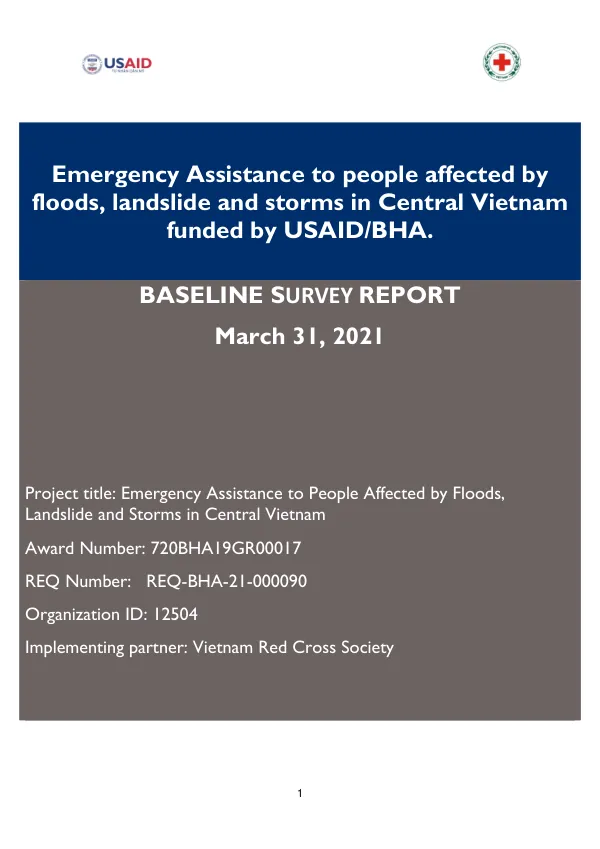
Emergency Assistance to People Affected by Floods, Landslide and Storms in Central Vietnam: Baseline Survey Report
Sign inUSAID/BHA
Emergency Assistance to People Affected by Floods, Landslide and Storms in Central Vietnam: Baseline Survey Report
The Emergency Assistance to People Affected by Floods, Landslide, and Storms in Central Vietnam project was funded by USAID/BHA and implemented by the Vietnam Red Cross Society.
2021 · 9 pages
Sign in to readA free account is required to download.
Abstract
The project aimed to support local people in the Central coastal provinces with emergency assistance. The project's target area included four provinces: Ha Tinh, Quang Binh, Quang Tri, and Thua Thien Hue. The floods caused significant damage to infrastructure, including roads, schools, health centers, and community facilities, affecting 1.5 million people and exposing a total of seven million people to the storms. The floods also caused an estimated loss of agricultural production, with over 360 schools flooded or damaged, two million livestock dead, and 30,000 hectares of agricultural production lost or damaged. The Vietnam Red Cross Association conducted a baseline survey in March 2021 to evaluate the situation of communities affected by the floods, assess their needs, and suggest actions to improve their livelihood conditions. The survey aimed to provide sufficient data for project monitoring and evaluation. The survey used a cross-sectional study design, targeting 400 people in 16 communes, with 25 people in each commune. The sample size was calculated using the formula recommended by the Swiss Red Cross Association, with an assumed proportion of people affected by the floods of 0.5 and a margin of error of 0.05. The survey used a systematic and stratified sample selection method. The questionnaire consisted of six parts, including general information, basic needs of households, WASH essentials, housing, livelihood, and community resources. The questionnaire was pre-tested to ensure that the questions made sense and were easy to answer for people living in rural areas. Volunteers who collected data were trained by the PMER of VNRC HQ on interview techniques, data collection, and sample size selection. The survey found that the percentage of households who reported being able to meet their basic needs was low, ranging from 6% to 19% across the four provinces. The percentage of households with poor or nearly poor economic conditions was high, ranging from 33% to 65% across the four provinces. The survey also found that the percentage of households who had reduced essential WASH-related basic needs expenditures was low, ranging from 6% to 49% across the four provinces. The survey results indicate that the communities affected by the floods face significant challenges in accessing basic needs, including food, water, shelter, and healthcare. The results also suggest that the households with poor or nearly poor economic conditions are the most vulnerable and require urgent assistance. The survey provides valuable data for project monitoring and evaluation, and its findings will inform the development of interventions to improve the livelihood conditions of the affected communities.