USAID DEC
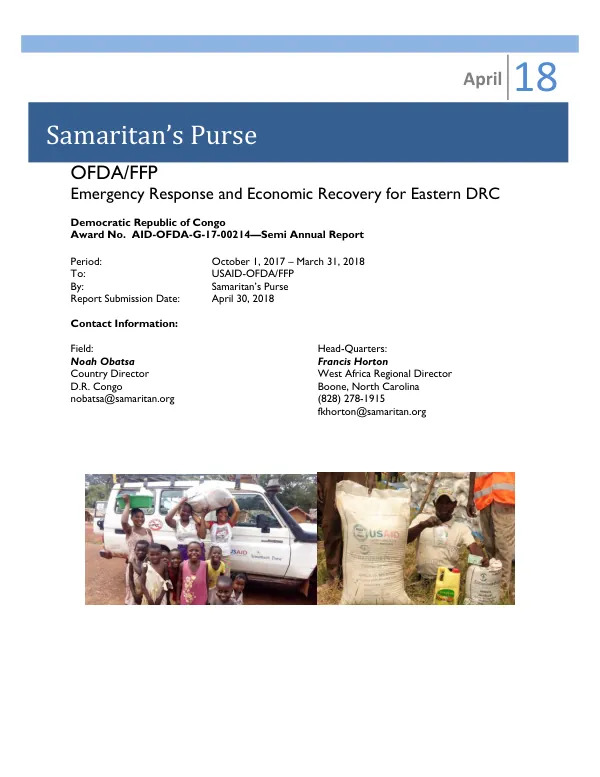
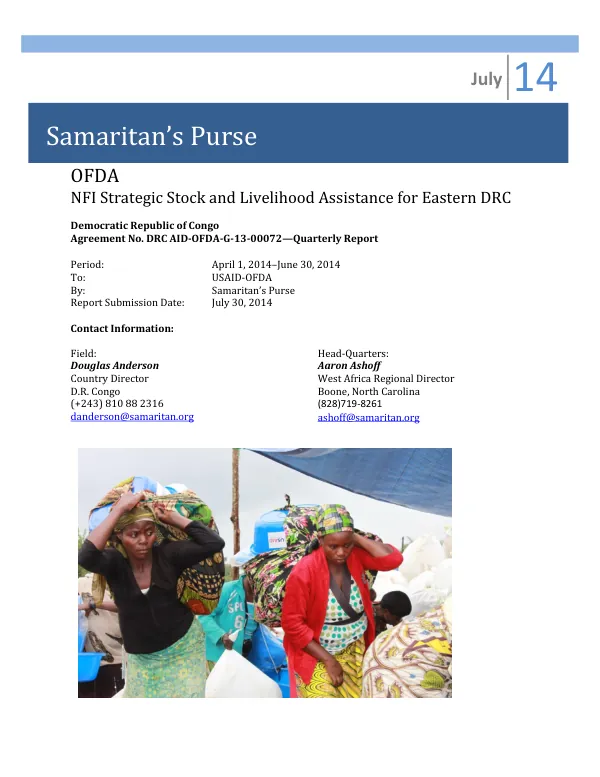
Emergency Response and Economic Recovery for Eastern DRC, 4th Quarter Report 2014, AID-OFDA-A-14-00011
Sign inCATHOLIC RELIEF SERVICES ORGANIZATION
Emergency Response and Economic Recovery for Eastern DRC, 4th Quarter Report 2014, AID-OFDA-A-14-00011
The Emergency Response and Economic Recovery for Eastern DRC project aims to meet the emergency needs of conflict-affected households while promoting rapid recovery of affected livelihoods and markets.
2014 · 6 pages
Sign in to readA free account is required to download.
Abstract
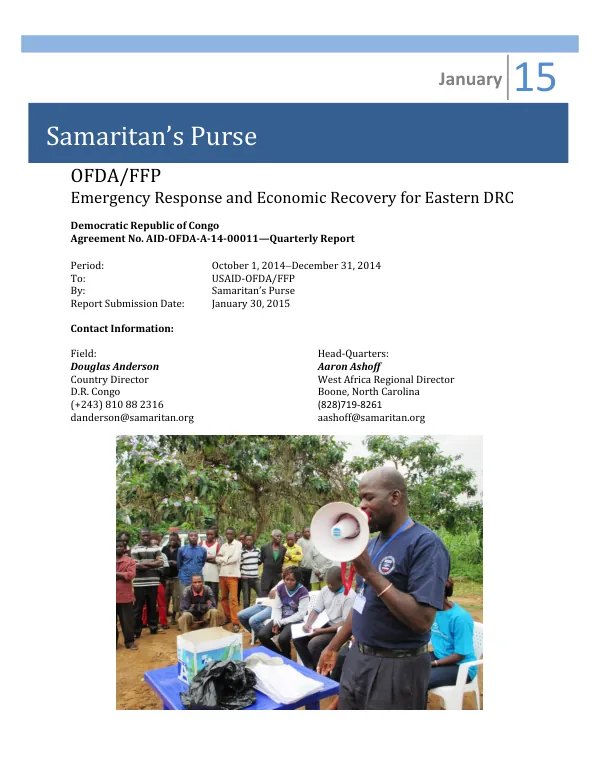
This project will quickly distribute food and non-food item (NFI) kits in emergency situations to help war-affected populations cope with displacement and loss. Support will be provided through both direct distributions and with a voucher-fair system, depending upon the market conditions in the targeted region. The project activities will improve food security through increased agricultural production, diversified consumption, and livestock distribution. The project has three sectors: Logistics Support and Relief Commodities, Agriculture and Food Security, and Food for Peace: Regional Procurement and Voucher. Sector 1 aims to efficiently and rapidly respond to the needs of conflict-affected populations in Eastern Congo by distributing NFI kits. To date, Samaritan's Purse has not reached any beneficiaries because full project activities have yet to commence. However, the team has finalized the detailed implementation plan and submitted it to USAID for approval. The team has also received approval for a change of scope involving the addition of 1,800 NFI kits received from Norwegian Refugee Council as a gift-in-kind. In the fourth quarter of 2014, the agriculture and food security team in Faradje Territory registered 2,925 direct beneficiaries. The beneficiaries began training on various topics, including vegetable farming, nutritional benefits of vegetables, and housing goats. The team conducted a virtual tool fair for all 2,000 beneficiaries in Faradje Territory, and 1,935 beneficiaries received the tools they had ordered. The remaining 65 beneficiaries will receive their tools in January. The team also conducted vulnerability surveys and baseline surveys in Beni Territory and completed focus group discussions in and around Cantine. The food team has visited a fair organized by Solidarités to share information on current food distribution processes and to standardize distribution procedures amongst actors in the same region. The team has also received warehousing training from SP Global Food Adviser, Allister Clewlow. Samaritan's Purse has chosen Grow More Seeds and Chemicals Ltd. from Kampala, Uganda to supply food commodities such as beans, maize, vegetable oil, and salt. The team has designed and procured 9,000 vouchers from Kenya for fairs. The team has also relied on coordination with the UN and other actors intervening in Watalinga to overcome the challenges of accessing the locality. The project has faced several challenges, including insecurity in the vicinity of the Virunga National Forest and the Rwenzori Mountains, which has limited humanitarian access to the region. The team has made use of the humanitarian helicopter service offered by WFP/UNHAS to access Watalinga. The team has also built strong relationships with community leaders to gain a critical understanding of prevailing sociocultural issues and to ensure that SP is well linked to local information networks. The unpredictability of the DRC customs exemption application process has been an enormous programmatic and financial burden, making it difficult to moderate beneficiary expectations and putting strain on vendor relations.